4.10 The operating cash flow discussion does not say that a [amount] build-up of contract assets drove most of the working-capital outflow
Company H · a US-listed aerospace services company · SEC-style question
In brief
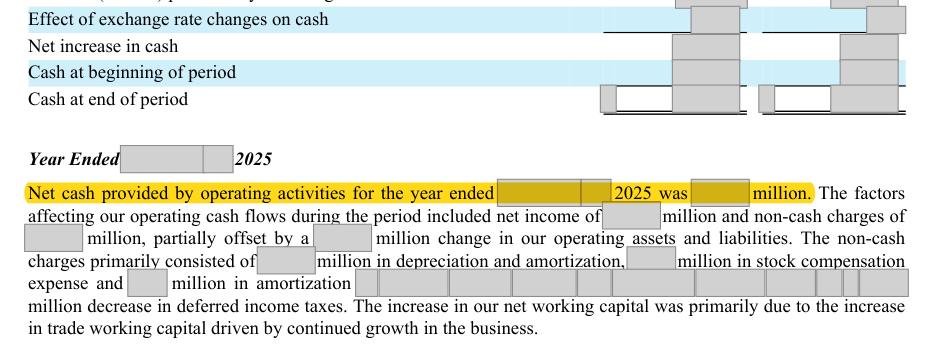
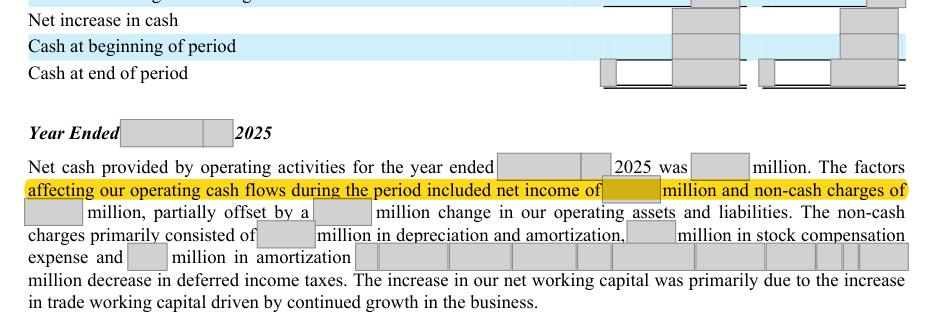
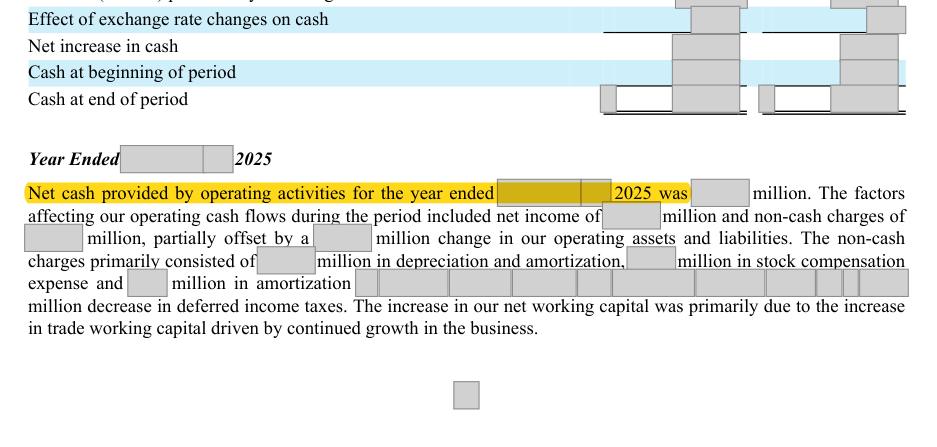
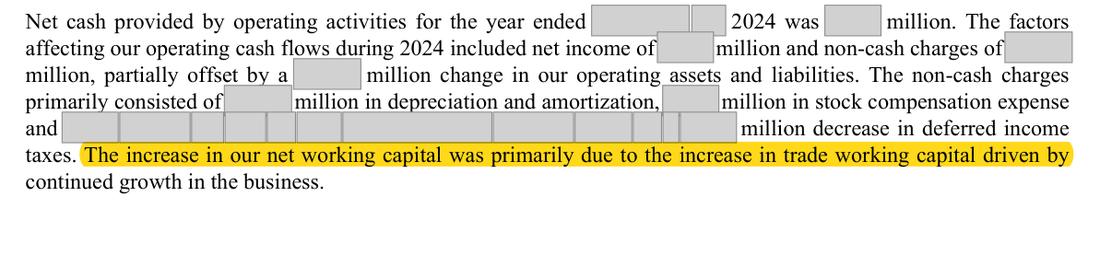
The MD&A says operating cash flow of [amount] was reduced by a [amount] change in operating assets and liabilities, explained only as an increase in trade working capital from growth. The cash-flow statement shows that the change is mostly contract assets (unbilled work), up [amount], with receivables up [amount], partly offset by inventories, payables and other items. The same one-line explanation is used for 2024. Whether the contract-asset build reflects longer turnaround on new engine programs or slower billing is something only management can explain.
The evidence, as filed
What the filing shows, and what the rule requires
| What the filing shows | What the rule requires |
|---|---|
MD&A: operating cash flow 'included net income of [amount] and non-cash charges of [amount], partially offset by a [amount] change in our operating assets and liabilities ... The increase in our net working capital was primarily due to the increase in trade working capital driven by continued growth in the business.' Cash-flow statement: contract assets ([n]), accounts receivable ([n]), inventories [n]. | An analysis of the working-capital movement that names its main drivers (contract assets, receivables, inventories, payables), why they moved (for example turnaround times on new engine programs, billing milestones, collection terms), and whether the trend is expected to continue and affect liquidity. |
The rule
Regulation S-K Item 303(b)(1)
Analyze the registrant's ability to generate and obtain adequate amounts of cash to meet its requirements and its plans for cash in the short-term
Version: Text in force at the date of this review · Source: 17 CFR 229.303 (Regulation S-K Item 303), as amended by Release 33-10890
Regulation S-K Item 303, Instruction 2 to paragraph (b)
The discussion must not merely repeat numerical data contained in the financial statements.
Version: Text in force at the date of this review · Source: 17 CFR 229.303 (Regulation S-K Item 303), as amended by Release 33-10890
Why it applies here. Item 303(b)(1) asks for an analysis of the ability to generate cash and of known trends reasonably likely to affect liquidity, and Instruction 2 to paragraph (b) says the discussion must not merely repeat numerical data from the statements. A growing balance of unbilled work is the main use of operating cash and a possible trend; the MD&A does not mention contract assets at all. Because the reason for the build-up is known only to management, and growth may genuinely explain it, the point is put as a question.
Why it matters
Readers cannot judge whether the [amount] working-capital absorption in 2025 is growth-related and self-correcting or a lasting drag on cash conversion.
How often the SEC staff raises this. In 1,100 SEC staff comment letters on fiscal 2023 and 2024 Forms 10-K, released January 2025 to October 2026, MD&A liquidity and capital resources drew 47 of the 1,774 numbered comments (2.6%): topic 12 of 25 by frequency.
Exposure
None while the point is a question; analysis of working-capital drivers is a common staff request on liquidity sections.
Our workings
the MD&A cash-flow discussion for 2025 gives the [amount] working-capital outflow and attributes it to growth in trade working capital; the 2024 discussion uses the same sentence, as did the prior-year Form 10-K.
the cash-flow statement shows the components: contract assets ([n]), accounts receivable ([n]), inventories [n], prepaid and other ([n]), payables and accruals [n], contract liabilities [n], related parties ([n]), income taxes [n].
the components sum to ([n]); contract assets alone are [n] / [n] = 96.3% of the net outflow; contract assets net rose from [n] to [n], so [n] - [n] = [n], an increase of [n] / [n] = 17.1%, faster than revenue growth of [n]%.
| Change in operating assets and liabilities, 2025 | USD thousand |
|---|---|
| Accounts receivable, net | ([n]) |
| Contract assets, net | ([n]) |
| Inventories, net | [n] |
| Prepaid expenses and other current assets | ([n]) |
| Accounts payable, accrued expenses and other current liabilities | [n] |
| Contract liabilities | [n] |
| Due to/from related parties | ([n]) |
| Income taxes payable and receivable | [n] |
| Total: -[n] - [n] + [n] - [n] + [n] + [n] - [n] + [n] | ([n]) |
| Contract assets share of the outflow: [n] / [n] | 96.3% |
| Contract assets net, balance sheet: [n] - [n] | [n] |
| Growth in contract assets: [n] / [n] | 17.1% |
| Contract assets increase in millions: [n] / [n] | [n] |
| Receivables increase in millions: [n] / [n] | [n] |
Management’s best defense, and our reply
Management would say the cash-flow statement already shows each component, Instruction 3 discourages duplicating it, and the sentence identifies the reason that matters: the business grew [n]% and trade working capital grew with it. It may add that contract assets are simply the unbilled portion of engines in process and naturally track revenue. That may be so, but contract assets grew 17.1%, faster than revenue, and are 96.3% of the outflow, so an analysis would name them and say whether the trend will continue; whether there is more to it is for management to answer.
The fix
- Add: 'The [amount] working-capital outflow reflected a [amount] increase in contract assets, mainly [reason], and a [amount] increase in receivables, partly offset by lower inventories and higher payables; we expect [trend].'
Question for the company
What drove the [amount] increase in contract assets in 2025 (for example longer turnaround on [engine program] and [engine program] work, billing milestones on engine utilization contracts, or customer payment terms), is the build-up expected to continue, and why is it not discussed in the liquidity section?
Evidence relied on
| # | What it shows | Type | Where |
|---|---|---|---|
| 1 | 2025 operating cash flow | Document | Form 10-K 2025, page 63 |
| 2 | net income and non-cash charges in the operating cash flow analysis | Document | Form 10-K 2025, page 63 |
| 3 | MD&A gives the 2025 working-capital outflow | Document | Form 10-K 2025, page 63 |
| 4 | the only explanation given for the outflow | Document | Form 10-K 2025, page 63 |
| 5 | the same sentence explains the 2024 movement | Document | Form 10-K 2025, page 64 |
| 6 | contract assets were the largest working-capital outflow | Document | Form 10-K 2025, page 79 |
| 7 | receivables outflow | Document | Form 10-K 2025, page 79 |
| 8 | inventories released cash in 2025 | Document | Form 10-K 2025, page 79 |
| 9 | other component of the outflow | Document | Form 10-K 2025, page 79 |
| 10 | payables offset | Document | Form 10-K 2025, page 79 |
| 11 | contract liabilities offset | Document | Form 10-K 2025, page 79 |
| 12 | related-party component | Document | Form 10-K 2025, page 79 |
| 13 | tax component | Document | Form 10-K 2025, page 79 |
| 14 | balance sheet contract assets both year ends | Document | Form 10-K 2025, page 75 |
| 15 | revenue growth for comparison | Document | Form 10-K 2025, page 59 |
Absence check
- Document
- Form 10-K 2025
- Where it would appear
- Net cash provided by operating activities for the year ended [date] was
- What is missing
- any mention of contract assets or of the components and reasons for the working-capital outflow
- Pages looked at
- p.62-64 (Liquidity and Capital Resources, Cash Flows)
- Result
- 'contract assets' hits p.18 (risk factor), [n] and [n] (statements), [n] (notes), none in the MD&A; 'unbilled' hits p.84 and [n] (receivables policy and note); 'trade working capital' hits p.63 and [n], the one-line explanation itself; 'days sales outstanding' has no hits.
Prepared by Pramanex from the company’s public SEC filings, without the company’s involvement, to show how a 10-K Pre-filing Check reads. The company is not named, and nothing on this page is a statement about any identifiable company. Observations are not an audit, review or other attestation or assurance engagement, and not legal advice. An SEC-style question is a question, not a conclusion.
Want this on your own 10-K, before you file?
Start with three free findings on your latest 10-K, or book a fixed-price 10-K Pre-filing Check.
Your next 10-K will be in draft before the audit is done.
Have it read before you file.
Start with three free findings on your latest 10-K, or book a fixed-price 10-K check. Drafts only under NDA, inside your insider trading policy.