4.09 Adjusted EBITDA adjustments described as 'not recurring' include charges taken in every one of the last three years
Company H · a US-listed aerospace services company · SEC-style question
In brief
The MD&A defines Adjusted EBITDA as adjusted for 'items not recurring in the ordinary course of business', naming business transformation costs, and footnote (4) calls the quarterly management fees paid to the sponsors 'other costs not recurring in the ordinary course of business'. Business transformation costs were adjusted in fiscal 2023, 2024 and 2025, and the sponsor fees were expensed in each of those years. Regulation S-K Item 10(e)(1)(ii)(B) bars describing an adjustment as non-recurring when a similar charge arose in the prior two years. Whether the reworded label still describes these items as non-recurring is a judgment for management.
The evidence, as filed
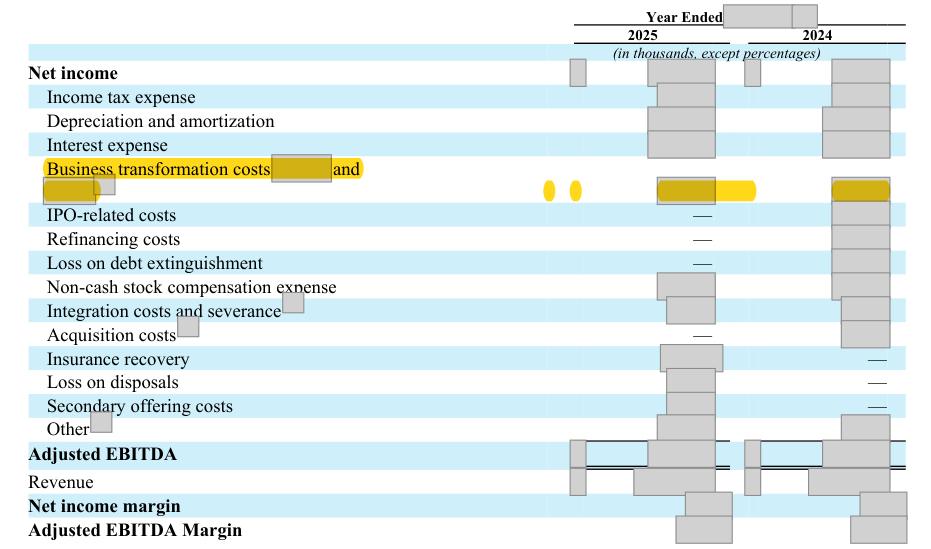
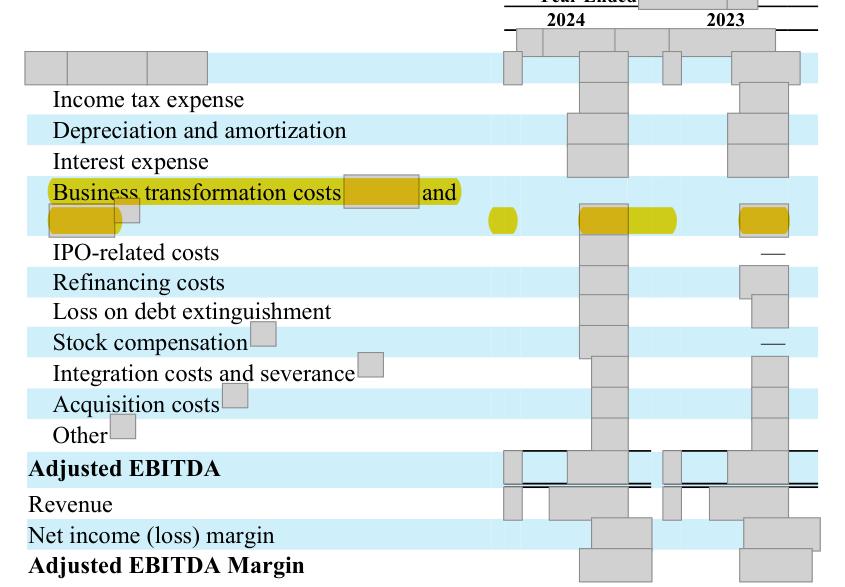
2 further page extracts: screenshot withheld to protect the company’s identity. The rows below say what each shows.
What the filing shows, and what the rule requires
| What the filing shows | What the rule requires |
|---|---|
Adjustments for business transformation costs ([amount] fiscal 2025; [amount] fiscal 2024; [amount] fiscal 2023) and quarterly sponsor management fees ([amount] in each of fiscal 2023-2025) are described as items or costs 'not recurring in the ordinary course of business'; the prior-year Form 10-K called the same items 'non-recurring'. | Adjustments that recur year after year described by their nature (for example 'business transformation costs' or 'sponsor management fees') without a label that calls them non-recurring, infrequent or unusual, or a statement of why management considers the label met. |
The rule
Regulation S-K Item 10(e)(1)(ii)(B)
Adjust a non-GAAP performance measure to eliminate or smooth items identified as non-recurring, infrequent or unusual, when the nature of the charge or gain is such that it is reasonably likely to recur within two years or there was a similar charge or gain within the prior two years
Version: Text in force at the date of this review · Source: 17 CFR 229.10(e) (Regulation S-K Item 10(e)), as adopted by Release 33-8176 and amended to date
SEC Division of Corporation Finance, Non-GAAP Financial Measures C&DI Question [n]
The prohibition is based on the description of the charge or gain that is being adjusted. It would not be appropriate to state that a charge or gain is non-recurring, infrequent or unusual unless it meets the specified criteria.
Version: Text in force at the date of this review · Source: Compliance and Disclosure Interpretations: Non-GAAP Financial Measures
Why it applies here. under Item 10(e)(1)(ii)(B) and the staff's interpretation, the test turns on the description, not on whether the adjustment may be made; the adjustments themselves are permitted. The fiscal 2025 wording was changed from 'non-recurring' to 'not recurring in the ordinary course of business', which may be read as 'outside the ordinary course' rather than 'will not recur'; whether a reader takes it as a non-recurring label is the open question.
Why it matters
If the staff reads the wording as a non-recurring label, it would ask the company to remove it in future filings; the adjustments themselves may continue. The point does not affect the Adjusted EBITDA amounts.
How often the SEC staff raises this. In 1,100 SEC staff comment letters on fiscal 2023 and 2024 Forms 10-K, released January 2025 to October 2026, non-GAAP measures drew 317 of the 1,774 numbered comments (17.9%): the most frequent topic.
Exposure
None while the point is a question. If the staff read the wording as a non-recurring label, the usual outcome would be a comment letter and a future-filings undertaking.
Our workings
the MD&A definition and footnote (4) to the reconciliation describe the adjusted items as 'not recurring in the ordinary course of business'; footnote (4) expressly includes the quarterly management fees payable under the sponsor consulting services agreements. The reconciliation shows business transformation costs of [n] (fiscal 2025) and [n] (fiscal 2024) thousand, and the prior-year report shows [amount] for fiscal 2023. Note 17 shows [amount] expensed for advisory and consulting services in each of fiscal 2025, 2024 and 2023, and the agreements run at most to the second anniversary of the IPO in [date] (earlier if the sponsors' holdings fall below set thresholds). The prior-year report used the words 'non-recurring items' and 'other non-recurring costs' for the same adjustments.
see workings - each item recurs in each of the three years shown.
| Adjusted item | Fiscal 2023 | Fiscal 2024 | Fiscal 2025 | Recurs in prior two years? |
|---|---|---|---|---|
| Business transformation costs ([engine program] and [engine program]), $ million | [n] | [n] | [n] / [n] = [n] | Yes - charged in each of the three years |
| Sponsor advisory and consulting fees expensed, $ million | [n] | [n] | [n] | Yes - quarterly fees under agreements running to [date] |
| Integration costs and severance, $ thousand | not tested | [n] | [n] | Yes - both years shown |
Management’s best defense, and our reply
Management can argue that 'not recurring in the ordinary course of business' means costs that arise outside the ordinary operating cycle (a defined transformation program, sponsor arrangements that end in [date]), not costs that will never recur, and that the wording was deliberately changed from the prior year's 'non-recurring' for that reason. It can add that the staff interpretation permits the adjustments themselves and that the costs are clearly identified and quantified in the reconciliation. That reading is tenable, which is why this is put as a question; however, the phrase still uses the word 'recurring' for items that have occurred in each of the last three years, and a reader may take it as the non-recurring label the rule restricts.
The fix
- Describe the adjustments by nature, e.g. 'further adjusted for certain non-cash items and for business transformation costs, integration and severance costs, sponsor management fees and other items management does not consider indicative of core operating performance', and drop 'not recurring' from the definition and footnote (4).
Question for the company
Business transformation costs were adjusted in each of fiscal 2023, 2024 and 2025, and the sponsor management fees are paid quarterly and were expensed in each of those years. Does management regard the description 'not recurring in the ordinary course of business' as identifying these items as non-recurring for Item 10(e)(1)(ii)(B), and would it consider describing them by their nature only (for example 'business transformation costs' and 'sponsor management fees') in future filings?
Evidence relied on
| # | What it shows | Type | Where |
|---|---|---|---|
| 1 | the Adjusted EBITDA definition describes business transformation and integration costs as items not recurring | Document | Form 10-K 2025, page 56 |
| 2 | business transformation costs adjusted in fiscal 2025 and fiscal 2024 (USD thousand) | Document | Form 10-K 2025, page 57 |
| 3 | footnote (4) labels quarterly sponsor management fees as costs not recurring | Document | Form 10-K 2025, page 57 |
| 4 | the sponsor advisory and consulting fees were expensed in each of the three years | Document | Form 10-K 2025, page 109 |
| 5 | prior-year report: business transformation costs also adjusted in fiscal 2023 ($ million) | Document | Form 10-K 2024 (prior year), page 56 |
| 6 | the prior-year report described the same adjustments as non-recurring items | Document | Form 10-K 2024 (prior year), page 55 |
| 7 | The audited segment note defines Segment Adjusted EBITDA with the same 'not recurring' wording and names business transformation costs | Document | Form 10-K 2025, page 122 |
Prepared by Pramanex from the company’s public SEC filings, without the company’s involvement, to show how a 10-K Pre-filing Check reads. The company is not named, and nothing on this page is a statement about any identifiable company. Observations are not an audit, review or other attestation or assurance engagement, and not legal advice. An SEC-style question is a question, not a conclusion.
Want this on your own 10-K, before you file?
Start with three free findings on your latest 10-K, or book a fixed-price 10-K Pre-filing Check.
Your next 10-K will be in draft before the audit is done.
Have it read before you file.
Start with three free findings on your latest 10-K, or book a fixed-price 10-K check. Drafts only under NDA, inside your insider trading policy.