3.03 Exhibit 10.[n]: the confidential treatment the index relies on ran only to [date]
Company G · a US-listed specialty pharmaceutical company · SEC-style question
In brief
Exhibit 10.[n], the 2010 supply agreement with [supplier], is incorporated in its redacted 2010 form, with a footnote saying confidential treatment has been granted for the redacted portions. The last order of the Securities and Exchange Commission (SEC) on EDGAR for that exhibit, dated [date], extended the confidentiality only through [date], eleven months before this 10-K was filed. No later order and no re-filed version of the exhibit appear on EDGAR.
The evidence, as filed

What the filing shows, and what the rule requires
| What the filing shows | What the rule requires |
|---|---|
Exhibit 10.[n] incorporated from the Form 10-Q of [date] with the footnote 'Confidential treatment has been granted for portions of this exhibit'; the latest order on EDGAR for that exhibit runs through [date] | Either an extension order covering the filing date, or the agreement re-filed with redactions marked under Item 601(b)(10)(iv) (or in full), with the footnote changed to match; or the exhibit removed if the agreement is no longer material and in force |
| What we checked. Every confidential-treatment order on EDGAR for the company (2008-2023), the exhibit index and footnotes of this 10-K and the prior-year 10-K, and the exhibit lists of every Form 10-Q and Form 10-K filed after [date] | |
The rule
Regulation S-K Item 601(b)(10)(iv)
The registrant may redact specific provisions or terms of exhibits required to be filed by this paragraph (b)([n]) if the registrant customarily and actually treats that information as private or confidential and if the omitted information is not material.
Version: Text in force at the date of this review · Source: 17 CFR 229.601(b)(10)(iv), Regulation S-K (eCFR, as amended by Release 33-10618)
Regulation S-K Item 601(b)(10)(i)(A)
Every contract not made in the ordinary course of business that is material to the registrant and is to be performed in whole or in part at or after the filing of the registration statement or report.
Version: Text in force at the date of this review · Source: 17 CFR 229.601(b)(10)(i)(A), Regulation S-K (eCFR, as amended)
Why it applies here. once an order lapses, the redacted text is no longer protected by it; staff practice since the 2019 amendments is that a company with an expiring order either applies for an extension, re-files the exhibit with redactions that meet Item 601(b)(10)(iv), or files it in full. If none of these happened, the footnote is out of date and the exhibit may be incomplete; if the agreement has ended or is no longer material, it need not be listed at all. Which applies is known only to the company, so this is a question.
Why it matters
If no extension or re-filing exists, the exhibit index states a confidentiality grant that has lapsed, and the agreement on file may lack terms that must now be either justified as immaterial and confidential under the current rule or disclosed.
How often the SEC staff raises this. In 1,100 SEC staff comment letters on fiscal 2023 and 2024 Forms 10-K, released January 2025 to October 2026, exhibits and certifications drew 41 of the 1,774 numbered comments (2.3%): topic 13 of 25 by frequency.
Exposure
A question. If the grant has lapsed, the realistic consequence is a staff request to re-file the agreement (redacted under the current rule or in full) and to correct the footnote; no penalty in practice.
Our workings
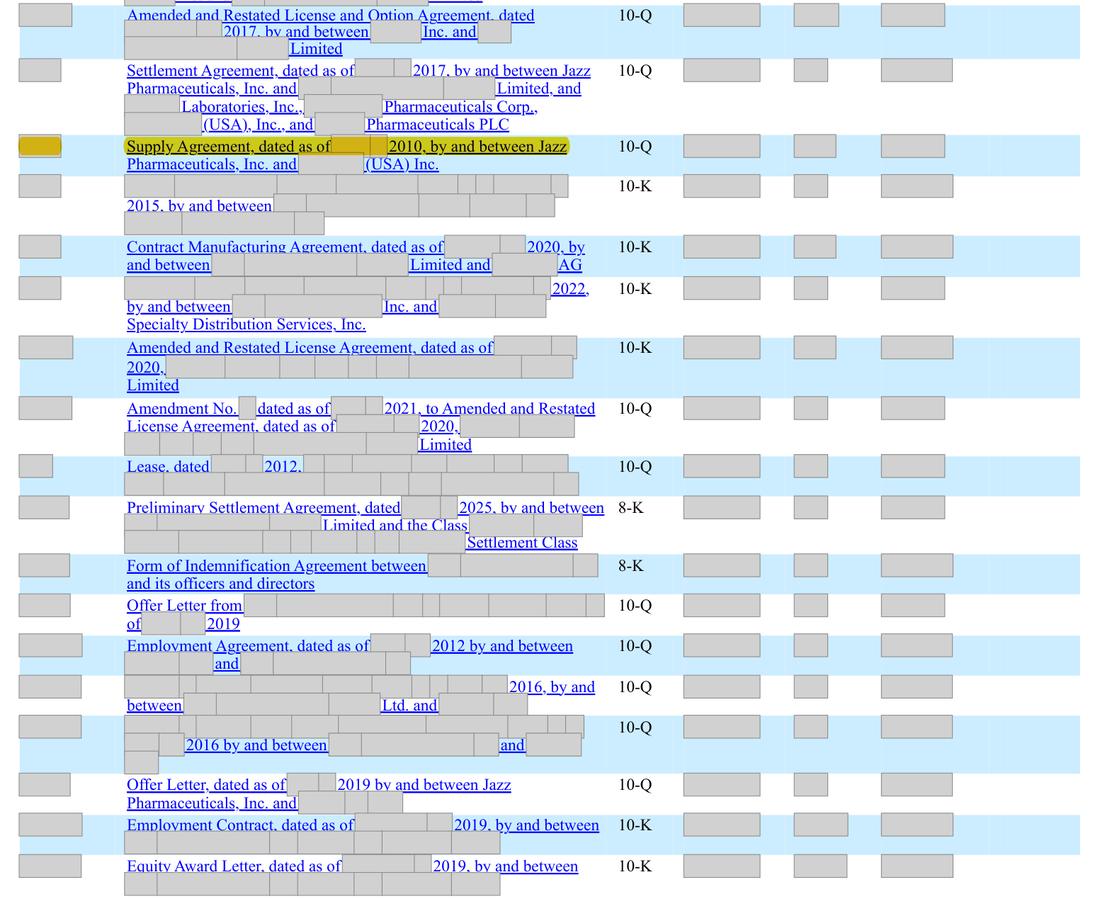
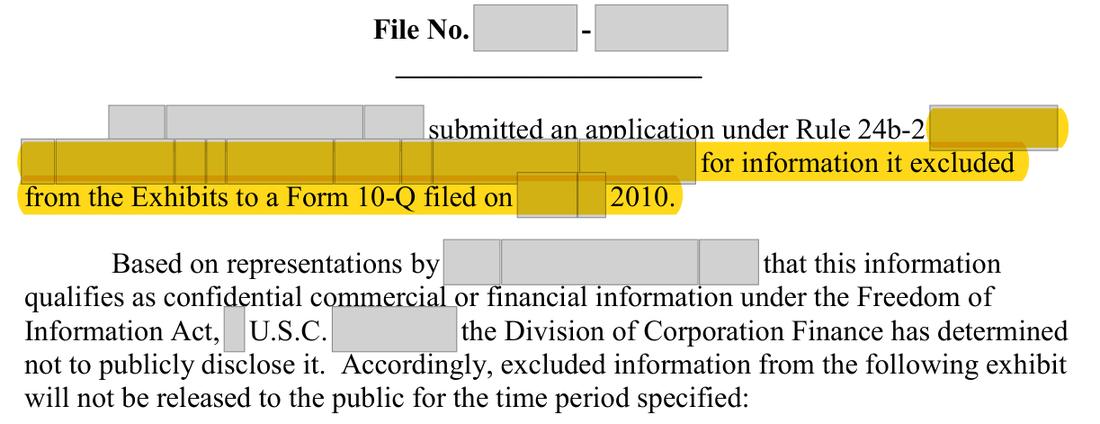
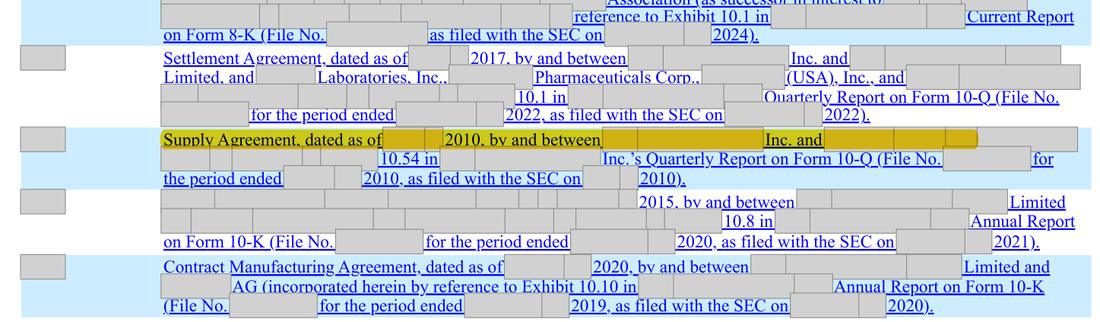
the exhibit index lists [n], the Supply Agreement dated as of [date] between the Company, Inc. and [supplier] (USA) Inc., incorporated from Exhibit 10.[n] to the Form 10-Q of [date], marked with a dagger whose footnote says confidential treatment has been granted and the redacted portions filed separately with the SEC. The SEC's orders on EDGAR show the grant for that exhibit extended in 2015 through [date] and, by the order of [date], through [date]. The company's EDGAR filing list to [date] contains no later order for that exhibit (the last order of any kind is dated [date] and covers a different exhibit), and no Form 10-Q or Form 10-K since [date] re-files the agreement. The prior-year 10-K, filed on [date], carried the same row and footnote while the order was still running.
none.
| Order date | Exhibit covered | Confidential through |
|---|---|---|
| [date] | Exhibits to the Form 10-Q filed [date] | [date] |
| [date] (extension) | Exhibits to the Form 10-Q filed [date] | [date] |
| [date] (extension) | Exhibit 10.[n] to the Form 10-Q filed [date] | [date] |
| None later on EDGAR (checked [date]) |
Management’s best defense, and our reply
The company may have applied for an extension before [date]; while an application is pending the redacted text stays confidential, and short-form extension orders are not always easy to find on EDGAR. It may also regard a 2010 supply agreement as continuing but no longer material, so that the row is kept only for completeness. However, the footnote says a grant exists, and the only grant on public record ended eleven months before the 10-K was filed, with no re-filed exhibit since; the company should be able to show which of these positions applies.
The fix
- Confirm the status; if no extension exists, re-file the agreement with the next Form 10-Q with redactions marked under Item 601(b)(10)(iv) and change the footnote to the standard redaction legend, or remove the row if the agreement is no longer in force and material.
Question for the company
Was the confidential treatment for the [supplier] supply agreement (Exhibit 10.[n] to the Form 10-Q of [date], listed as Exhibit 10.[n]) extended beyond [date], and if so by which order? If not, does the company intend to re-file the agreement under Item 601(b)(10)(iv) or in full, or does it consider that the agreement is no longer a material contract in force?
Evidence relied on
| # | What it shows | Type | Where |
|---|---|---|---|
| 1 | Exhibit index row [n], with the dagger mark, incorporated from Exhibit 10.[n] to the Form 10-Q of [date] | Document | Form 10-K 2025, page 112 |
| 2 | The dagger footnote: the redaction rests on a grant of confidential treatment | Document | Form 10-K 2025, page 114 |
| 3 | SEC order of [date]: an extension for the [date] Form 10-Q exhibit | Document | |
| 4 | The extended period ends on [date], before this 10-K was filed | Document | |
| 5 | SEC order of [date]: the earlier five-year extension for the same exhibit, showing the company's past practice of renewing | Document | |
| 6 | Prior-year 10-K, filed [date] while the order still ran: the same exhibit and dagger | Document | Form 10-K 2024 (prior year), page 107 |
Prepared by Pramanex from the company’s public SEC filings, without the company’s involvement, to show how a 10-K Pre-filing Check reads. The company is not named, and nothing on this page is a statement about any identifiable company. Observations are not an audit, review or other attestation or assurance engagement, and not legal advice. An SEC-style question is a question, not a conclusion.
Want this on your own 10-K, before you file?
Start with three free findings on your latest 10-K, or book a fixed-price 10-K Pre-filing Check.
Your next 10-K will be in draft before the audit is done.
Have it read before you file.
Start with three free findings on your latest 10-K, or book a fixed-price 10-K check. Drafts only under NDA, inside your insider trading policy.