3.02 Amendments to the [counterparty] authorized generic agreement, effective [date], are not filed as an exhibit
Company G · a US-listed specialty pharmaceutical company · SEC-style question
In brief
Items 1 and 7 say the authorized generic (AG) agreement with [counterparty] was amended, effective [date], to extend [counterparty]'s selling period to [date] and to reduce the royalty rate after 2025. The exhibit index lists the 2017 settlement agreement with [counterparty] (Exhibit 10.[n]) but no amendment to it and no AG agreement. Regulation S-K requires an amendment to a previously filed exhibit to be filed unless that exhibit is no longer required. Whether the AG terms sit in Exhibit 10.[n] is known only to management; in its 2025 reply to the SEC staff, which closed its review without asking for the [counterparty] agreements, the company called the [counterparty] royalty not quantitatively material.
The evidence, as filed
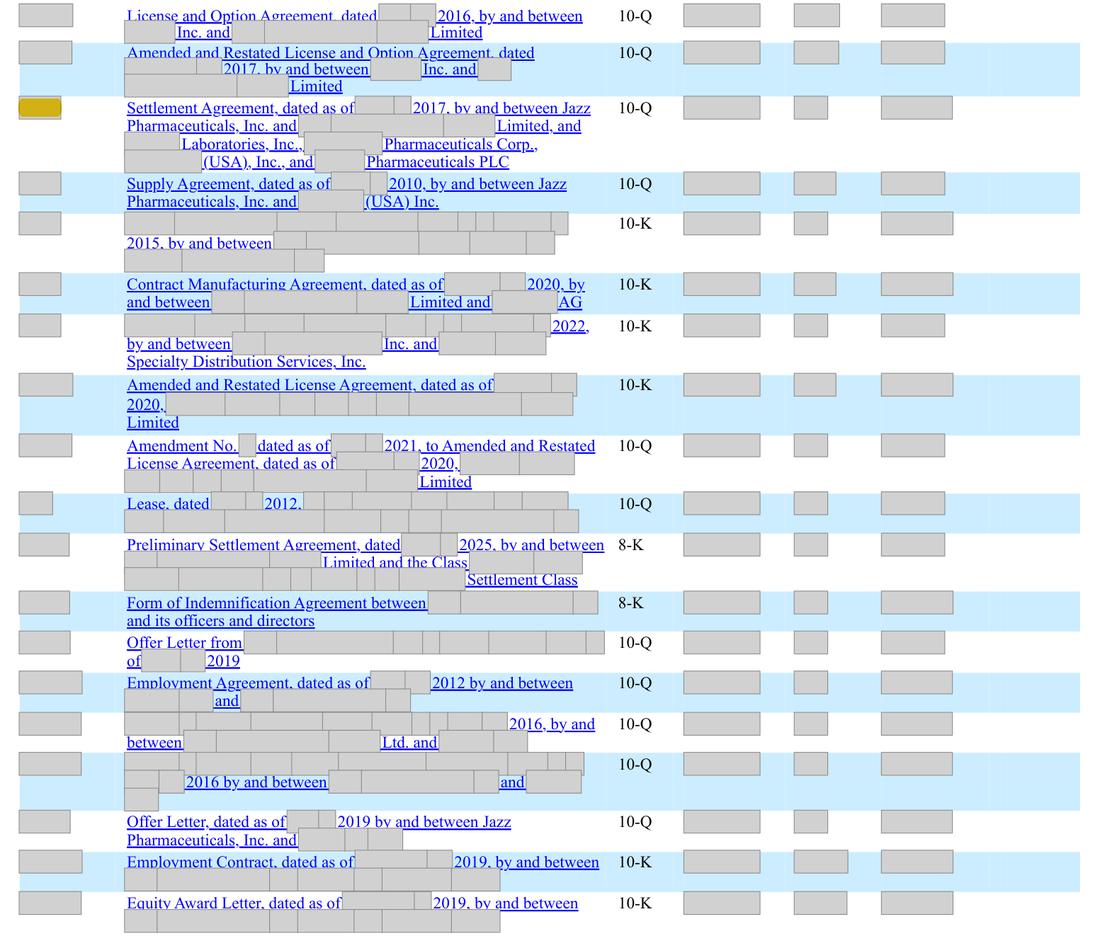
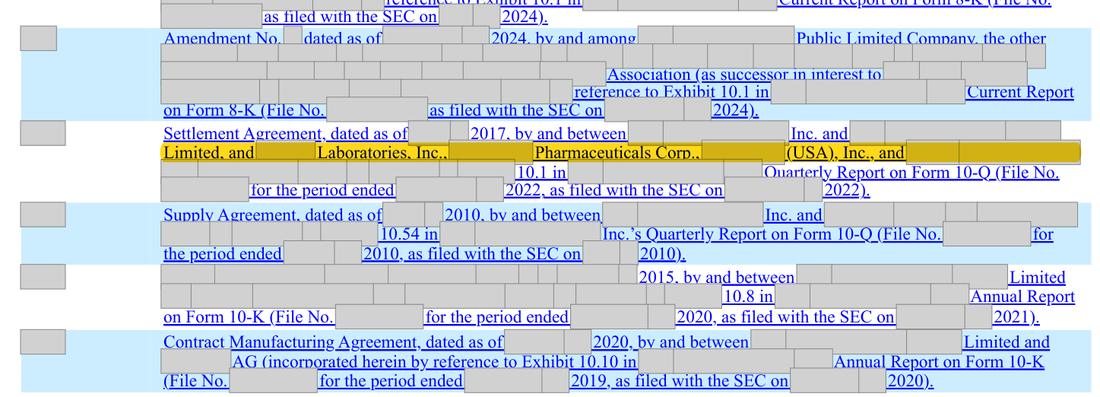
3 further page extracts: screenshot withheld to protect the company’s identity. The rows below say what each shows.
What the filing shows, and what the rule requires
| What the filing shows | What the rule requires |
|---|---|
Exhibit index lists Exhibit 10.[n], the [date] settlement agreement with [counterparty] and its affiliates; no amendment to it and no AG agreement or amendment is filed or incorporated, while the narrative describes amendments effective [date]. | Either the amendments filed (with permitted redactions) as an exhibit to the Form 10-K or the next Form 10-Q, or a reasoned basis that they do not amend a filed exhibit and are not themselves a material contract. |
The rule
Regulation S-K Item 601(a)(4)
Any amendment or modification to a previously filed exhibit to a Form 10, 10-K or 10-Q document shall be filed as an exhibit to a Form 10-Q and Form 10-K. Such amendment or modification need not be filed where such previously filed exhibit would not be currently required.
Version: Text in force at the date of this review · Source: Regulation S-K, 17 CFR 229.601 (as amended by Release 33-10618, 2019; eCFR text)
Why it applies here. Item 601(a)(4) requires any amendment to a previously filed exhibit to be filed with a Form 10-Q or 10-K unless the original exhibit would not currently be required. By keeping Exhibit 10.[n] in the index the company treats the 2017 agreement as still required, so if the AG terms sit in that agreement its amendments had to be filed whatever their size; if they sit in a separate AG agreement, the materiality view the staff did not challenge in 2025 probably answers the point. The answer turns on documents only management holds, so this is a question, not a finding.
Why it matters
If the amendments modify Exhibit 10.[n], the exhibit list is incomplete and investors cannot read the royalty step-downs and termination rights; if they modify a separate, non-material agreement, nothing is missing.
How often the SEC staff raises this. In 1,100 SEC staff comment letters on fiscal 2023 and 2024 Forms 10-K, released January 2025 to October 2026, exhibits and certifications drew 41 of the 1,774 numbered comments (2.3%): topic 13 of 25 by frequency.
Exposure
None while the question is open. If the amendments modify a filed exhibit or form a material contract, the realistic outcome is a staff request to file them with the next periodic report.
Our workings
Item 1 (p.23) and Item 7 (p.89) state that, pursuant to amendments to the AG agreement with [counterparty] effective [date], [counterparty] may sell the AG product until [date], either party may give notice to terminate from [date], and the royalty rate, fixed through 2025, is then subject to specified reductions. Item 1 also says the AG competition arises 'pursuant to a settlement agreement' [wording masked]. The exhibit index (p.112) lists as Exhibit 10.[n] the [date] [wording masked] entities and [counterparty], [counterparty], [counterparty] and [counterparty], incorporated from a 2022 Form 10-Q; nothing else in the index concerns [counterparty]. High-sodium [product] AG royalty revenue, which includes the [counterparty] royalty, was [n] (US$ thousands) in 2025.
[n] / [n] = 4.96% of revenue; [n] / [n] = 33.72% of the absolute pre-tax loss. Staff record: in [date] the SEC staff asked the company to disclose the [counterparty] royalty rate and, separately, to file the license governing another product; the company replied that the [counterparty] royalty revenue had not been and was not expected to be quantitatively material, and the staff closed its review on [date] without asking for the [counterparty] agreements to be filed.
| Measure | Computation | Result |
|---|---|---|
| High-sodium [product] AG royalty, share of 2025 revenue | [n] / [n] = 4.96% | 4.96% |
| Share of absolute 2025 pre-tax loss | [n] / [n] = 33.72% | 33.72% |
Management’s best defense, and our reply
Management would say the AG terms with [counterparty] sit in a separate AG agreement, not in the 2017 settlement agreement, and that this agreement is not a material contract. In its [date] reply to the SEC staff it said the [counterparty] royalty revenue had not been and was not expected to be quantitatively material. The staff closed its review in [date] without asking for the [counterparty] agreements, although in the same review it asked for another product's license to be filed. However, that answers only the materiality limb: if the amended terms are part of Exhibit 10.[n], which the company still lists as a required exhibit, Item 601(a)(4) requires the amendments to be filed whatever their size, and only the documents show which agreement was amended. The defense has real weight, so the point is a low-severity question.
The fix
- Confirm which agreement the [date] amendments modify; if it is Exhibit 10.[n] or another material contract, file the amendments (with Item 601(b)(10)(iv) redactions) with the next Form 10-Q and list them in the next Form 10-K exhibit index.
Question for the company
Do the amendments to the [counterparty] arrangements that took effect on [date] amend the 2017 settlement agreement filed as Exhibit 10.[n], or a related agreement the company treats as material? When were they executed, and on what basis were they not filed under Item 601(a)(4) with this Form 10-K or a 2026 Form 10-Q?
Evidence relied on
| # | What it shows | Type | Where |
|---|---|---|---|
| 1 | Item 1 describes amendments to the [counterparty] agreement effective [date] | Document | Form 10-K 2025, page 23 |
| 2 | The amendments change the economics: the royalty rate falls after 2025 | Document | Form 10-K 2025, page 23 |
| 3 | Exhibit 10.[n]: the only [counterparty] document in the exhibit index, the 2017 settlement agreement, with no amendment listed | Document | Form 10-K 2025, page 112 |
| 4 | Size of the AG royalty revenue line in 2025 | Document | Form 10-K 2025, page 92 |
| 5 | 2025 total revenues (statement of income, page F-4) for the share computation | Document | Form 10-K 2025, financial-statement pages (printed F-n; see folios) |
| 6 | 2025 pre-tax loss used as the materiality benchmark | Document | Form 10-K 2025, financial-statement pages (printed F-n; see folios) |
| 7 | In its [date] review the staff asked for another product's license to be filed; its [counterparty] comment asked only about the royalty rate | Document | |
| 8 | The company's reply to the staff: the [counterparty] royalty revenue is not quantitatively material | Document | |
| 9 | The staff closed its review of the 2024 Form 10-K on [date] without asking for the [counterparty] agreements | Document | |
| 10 | SEC staff letter of [date] on the prior-year 10-K: asked for the [counterparty] authorized-generic royalty rate or a range | Document | |
| 11 | Company reply of [date]: declined, on the ground that authorized-generic royalty revenue was about 5% of total revenue and not material | Document | |
| 12 | Company reply: no undertaking on the [counterparty] point, citing confidentiality and a court sealing order | Document | |
| 13 | Staff closing letter of [date]: no further comment, no undertaking on the [counterparty] agreements | Document |
Absence check
- Document
- Form 10-K 2025
- Where it would appear
- [n]#
- What is missing
- any amendment to the 2017 [counterparty] settlement agreement, or any [counterparty] agreement or amendment, among the exhibits
- Pages looked at
- p.110-115 (exhibit index)
- Result
- 'AG agreement' hits only the narrative of the amendments in Item 1 and Item 7 (p.23, [n]); 'authorized generic' hits only the glossary; '[counterparty]' hits the glossary, business, risk factors, MD&A and notes (p.5, 7, [n], 42-44, [n]) and, in the exhibit index, only Exhibit 10.[n]; 'Amendment to Settlement Agreement' does not hit.
Prepared by Pramanex from the company’s public SEC filings, without the company’s involvement, to show how a 10-K Pre-filing Check reads. The company is not named, and nothing on this page is a statement about any identifiable company. Observations are not an audit, review or other attestation or assurance engagement, and not legal advice. An SEC-style question is a question, not a conclusion.
Want this on your own 10-K, before you file?
Start with three free findings on your latest 10-K, or book a fixed-price 10-K Pre-filing Check.
Your next 10-K will be in draft before the audit is done.
Have it read before you file.
Start with three free findings on your latest 10-K, or book a fixed-price 10-K check. Drafts only under NDA, inside your insider trading policy.