2.08 MD&A does not quantify the reasons for the [amount] fall in clinical costs or the valuation-allowance release behind the larger tax benefit
Company G · a US-listed specialty pharmaceutical company · SEC-style question
In brief
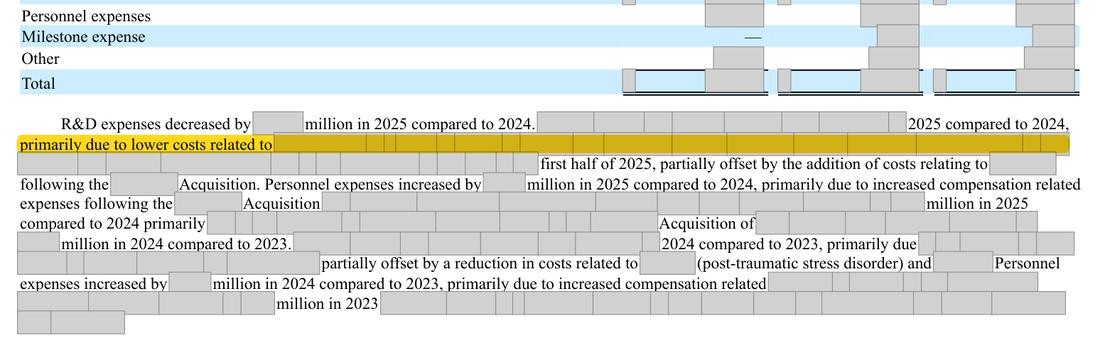
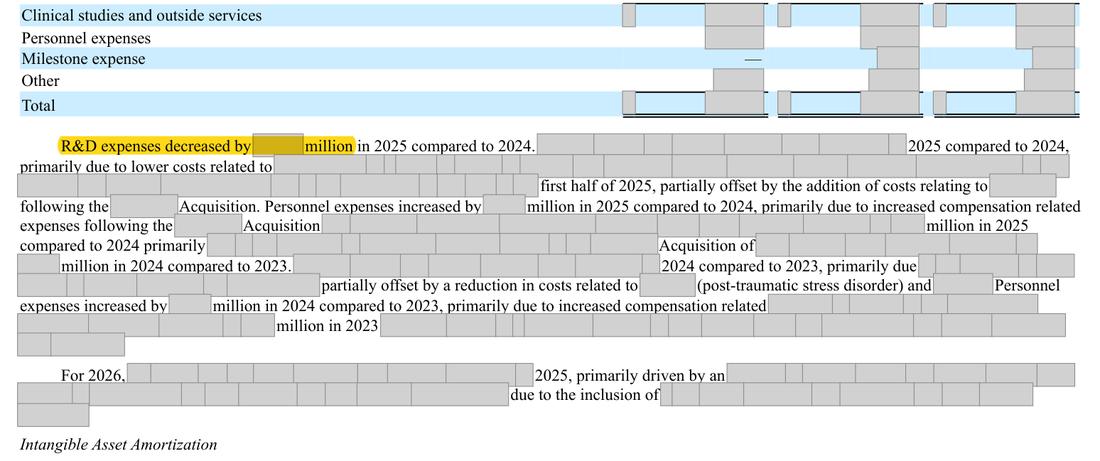
[wording masked] fell from [n] to [n] (US$ thousands), a fall of [n]. Management's Discussion and Analysis (MD&A) names four causes - lower [product] costs, two programs ended and the [product] costs added - but gives an amount for none of them. The income tax benefit rose from [amount] to [amount], and MD&A says this arose primarily from releasing a valuation allowance without saying how much; the tax note gives a net benefit of [amount] from the overall change in the valuation allowance. Management should say whether the individual causes are material and, if so, quantify them in MD&A.
The evidence, as filed

What the filing shows, and what the rule requires
| What the filing shows | What the rule requires |
|---|---|
Clinical cost fall of [n] explained by four unquantified causes; tax benefit increase of [n] attributed 'primarily' to a valuation-allowance reversal with no amount in MD&A (the [amount] appears only in the tax note). | The amount of each material cause of the clinical cost fall ([product] timing, [product code], [product code], [product]), and the [amount] valuation-allowance effect stated in the MD&A income-tax discussion. |
The rule
Regulation S-K Item 303(b)
Where the financial statements reflect material changes from period-to-period in one or more line items, including where material changes within a line item offset one another, describe the underlying reasons for these material changes in quantitative and qualitative terms.
Version: In force from [date] · Source: Regulation S-K, 17 CFR 229.303 (as amended by Release 33-10890, effective [date]; eCFR text)
Why it applies here. Item 303(b) requires the underlying reasons for material changes in a line item to be described in quantitative and qualitative terms, including offsetting changes within the line; Item 303(b)(2)(i) requires the extent to which income was affected by unusual events. The tax amount exists in the same report, and the company may say that some program effects cannot be split; whether the individual causes are material and measurable is for management to say, so this is a question.
Why it matters
Readers cannot tell how much of the [amount] fall in R&D is timing that will reverse in 2026, or how much of the 2025 tax benefit is a one-off release.
How often the SEC staff raises this. In 1,100 SEC staff comment letters on fiscal 2023 and 2024 Forms 10-K, released January 2025 to October 2026, MD&A results of operations drew 239 of the 1,774 numbered comments (13.5%): the third most frequent topic.
Exposure
None while the question is open; MD&A results analysis is the most frequent staff comment theme, so a comment asking for quantification is the realistic outcome if the causes are material.
Our workings
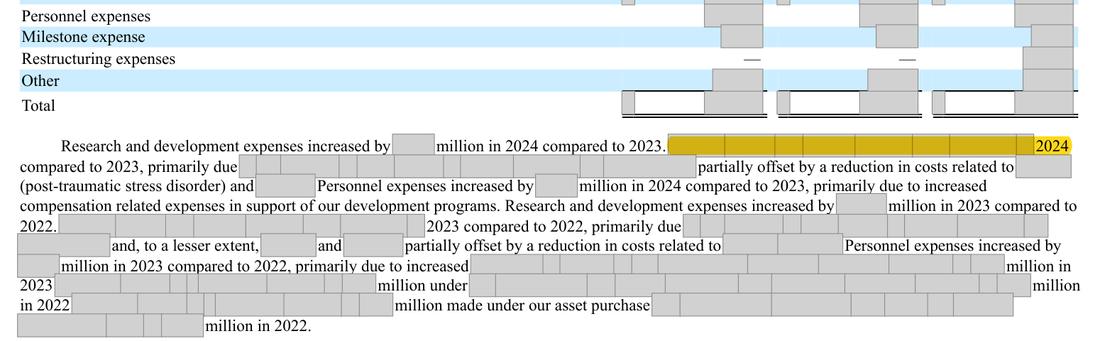
the research and development table in MD&A (p.94) shows [wording masked] of [n] in 2025 and [n] in 2024 (US$ thousands). The text explains the fall by lower [product] costs from trial timing, the discontinued [product code] program and the completed [product code] trial, partly offset by [product] costs after the [acquired business] acquisition, with no amounts; the smaller personnel movement is quantified ([amount]). The income tax benefit was [amount] against [amount]; MD&A attributes the 2025 benefit primarily to the reversal of a valuation allowance on deferred tax assets acquired with [acquired business]. The tax note (page F-47) quantifies that benefit at [amount].
[n] - [n] = [n], which is 21.28% of the absolute 2025 pre-tax loss of [n]; [n] - [n] = [n]; the [amount] release is [n] / [n] = 32.64% of the pre-tax loss and exceeds the whole year-on-year increase.
| Item (US$ thousands) | Computation | Result |
|---|---|---|
| Fall [wording masked] | [n] - [n] = [n] | [n] |
| Share of absolute 2025 pre-tax loss | [n] / [n] = 21.28% | 21.28% |
| Increase in income tax benefit | [n] - [n] = [n] | [n] |
| Valuation-allowance benefit (tax note) | [n] = [n]; [n] / [n] = 32.64% | 32.64% |
Management’s best defense, and our reply
Management could say that clinical costs are managed across programs and timing effects cannot be cleanly separated, that the instruction asks for quantification only of material factors, and that the [amount] is disclosed in the tax note within the same report, which MD&A should supplement rather than repeat. That defense has some force for the tax amount. However, the company already quantifies the smaller personnel and other movements, the named programs are discrete, and a one-off release that exceeds the whole year-on-year increase in the tax benefit is the kind of unusual item whose effect MD&A is meant to state; the open point is whether management regards each cause as material.
The fix
- Quantify each material cause, for example: 'Clinical studies and outside services decreased by [amount], reflecting $X million lower [product] costs, $Y million from [product code] and $Z million from [product code], partially offset by $W million of [product] costs'; and state 'including a [amount] benefit from the release of the valuation allowance' in the income-tax paragraph.
Question for the company
What were the amounts of the [product], [product code], [product code] and [product] effects within the [n] (US$ thousands) fall [wording masked], and why does the MD&A income-tax discussion not state the [amount] valuation-allowance benefit that the tax note gives?
Evidence relied on
| # | What it shows | Type | Where |
|---|---|---|---|
| 1 | [wording masked] fell year on year | Document | Form 10-K 2025, page 94 |
| 2 | The causes of the fall are named but not quantified | Document | Form 10-K 2025, page 94 |
| 3 | The smaller personnel movement is quantified, showing amounts are available | Document | Form 10-K 2025, page 94 |
| 4 | Tax benefit nearly tripled | Document | Form 10-K 2025, page 94 |
| 5 | MD&A names the valuation-allowance release with no amount | Document | Form 10-K 2025, page 94 |
| 6 | 2025 income tax benefit in the MD&A results table | Document | Form 10-K 2025, page 91 |
| 7 | The tax note (page F-47) quantifies the release that MD&A does not | Document | Form 10-K 2025, financial-statement pages (printed F-n; see folios) |
| 8 | 2025 pre-tax loss used as the materiality benchmark | Document | Form 10-K 2025, financial-statement pages (printed F-n; see folios) |
Absence check
- Document
- Form 10-K 2025
- Where it would appear
- R&D expenses decreased by [amount]
- What is missing
- the amount of each cause of the fall [wording masked]
- Pages looked at
- p.93-94 (research and development discussion); p.127-166 (notes)
- Result
- '[product code]' and '[product code]' hit only this paragraph; '[product]' hits program descriptions in Item 1, risk factors and MD&A (p.8, [n], 84-88, [n]) and this paragraph, none with a cost amount; '[n]' hits only an unrelated figure in the share-based compensation note (financial-statement pages (printed F-n; see folios)).
Absence check
- Document
- Form 10-K 2025
- Where it would appear
- Income Tax Benefit
- What is missing
- the amount of the valuation-allowance release in the MD&A income-tax discussion
- Pages looked at
- p.94 (MD&A income tax); p.160-166 (tax note)
- Result
- '[n]' hits only the tax note (financial-statement pages (printed F-n; see folios)); 'reversal of the valuation allowance' hits the MD&A paragraph and the tax note (financial-statement pages (printed F-n; see folios)), neither in MD&A with an amount; 'valuation allowance release' does not hit.
Prepared by Pramanex from the company’s public SEC filings, without the company’s involvement, to show how a 10-K Pre-filing Check reads. The company is not named, and nothing on this page is a statement about any identifiable company. Observations are not an audit, review or other attestation or assurance engagement, and not legal advice. An SEC-style question is a question, not a conclusion.
Want this on your own 10-K, before you file?
Start with three free findings on your latest 10-K, or book a fixed-price 10-K Pre-filing Check.
Your next 10-K will be in draft before the audit is done.
Have it read before you file.
Start with three free findings on your latest 10-K, or book a fixed-price 10-K check. Drafts only under NDA, inside your insider trading policy.