2.07 Prior-year adjustments to sales deductions are no longer called immaterial in MD&A, and neither MD&A nor the revenue note gives their amount
Company G · a US-listed specialty pharmaceutical company · SEC-style question
In brief
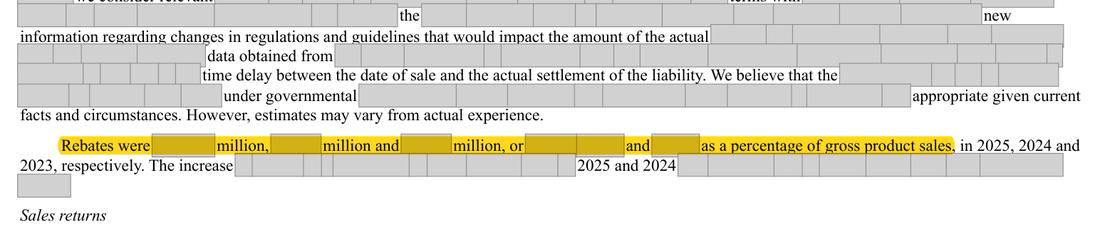
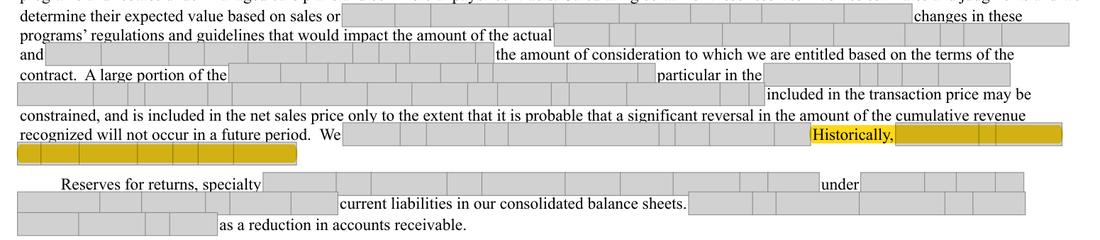
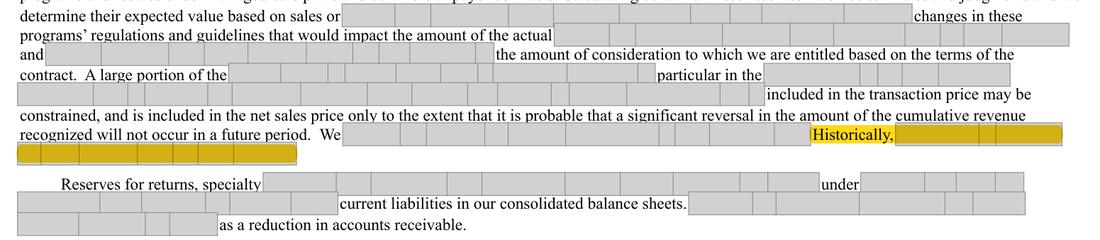
Management's Discussion and Analysis (MD&A) says the [amount] of 2025 sales deductions include adjustments to prior-year sales from changes in estimates. Last year the same sentence called those adjustments immaterial; this year the word is gone and no amount is given. The audited revenue policy note says only that historically, adjustments to estimates for these reserves have not been material, and the revenue note gives no amount of 2025 revenue from obligations satisfied in earlier periods. Rebates rose to [n]% of gross product sales from [n]%, so the size of the true-up of the [date] estimate matters to a reader of this critical accounting estimate.
The evidence, as filed

6 further page extracts: screenshot withheld to protect the company’s identity. The rows below say what each shows.
What the filing shows, and what the rule requires
| What the filing shows | What the rule requires |
|---|---|
MD&A: the [amount] ([n]% of gross product sales) includes [wording masked], with no amount and without the word 'immaterial' used in the prior-year Form 10-K. Revenue policy note (F-14): 'Historically, adjustments to estimates for these reserves have not been material.' Revenue note (F-38): no amount of revenue from performance obligations satisfied in prior periods. | Either the amount of the prior-year adjustments (by category, at least for rebates) for 2025 and 2024, in MD&A and in the revenue note, or a statement that the 2025 adjustments were immaterial, so the reader can judge how much the estimate changed over the period. |
| What we checked. Rollforward of sales-related accruals footed; sentence compared word for word with the prior-year Form 10-K; whole report searched for any quantification | |
The rule
Regulation S-K Item 303(b)(3) - critical accounting estimates
This information should include why each critical accounting estimate is subject to uncertainty and, to the extent the information is material and reasonably available, how much each estimate and/or assumption has changed over a relevant period, and the sensitivity of the reported amount to the methods, assumptions and estimates underlying its calculation.
Version: Text in force at the date of this review · Source: 17 CFR 229.303 (Regulation S-K Item 303), as amended by Release 33-10890
Why it applies here. Item 303(b)(3) asks for how much each critical estimate changed over a relevant period where that is material and reasonably available, and the revenue recognition standard of the Codification asks for revenue recognized in the period from obligations satisfied in previous periods. The company tracks the true-up of each accrual, so the figure is reasonably available. The note's 'historically not material' sentence points to a small amount, but it does not say whether it covers 2025, and MD&A dropped 'immaterial' for 2025; whether the 2025 amount is material is a judgment only management can make.
Why it matters
Readers cannot tell how far the [date] accrual estimate moved, which is the main evidence of how reliable the rebate estimate is; MD&A's dropped 'immaterial' and the note's generic sentence leave the 2025 size unstated.
How often the SEC staff raises this. In 1,100 SEC staff comment letters on fiscal 2023 and 2024 Forms 10-K, released January 2025 to October 2026, critical accounting estimates drew 23 of the 1,774 numbered comments (1.3%): topic 16 of 25 by frequency.
Exposure
None while the point is a question; critical accounting estimates are a frequent staff comment theme, and a comment would ask for the amount and a future-filings undertaking.
Our workings
the 2025 Form 10-K gives [wording masked] of [amounts] ([n]%, [n]% and [n]%), and says these include [wording masked]. The prior-year Form 10-K used the same sentence with the word 'immaterial'. Rebates were [n]% of gross product sales in 2025 against [n]% in 2024. The audited revenue policy note (F-14) says that historically, adjustments to estimates for these reserves have not been material - the same sentence as in the prior-year note - and the revenue note (F-38) gives no amount of revenue recognized from performance obligations satisfied in earlier periods. No page of the report gives the amount of the prior-year adjustments.
total deductions rose by [n] - [n] = [n] and by [n] - [n] = [n] points of gross product sales; 0.5% of the 2025 loss before tax is [n], so a prior-year true-up above that amount would pass the materiality filter used in this review.
| Measure | 2025 | 2024 | Change |
|---|---|---|---|
| Total items deducted ($ million) | [n] | [n] | [n] - [n] = [n] |
| Total items deducted, % of gross product sales | [n]% | [n]% | [n] - [n] = [n] points |
| Rebates, % of gross product sales | [n]% | [n]% | [n] - [n] = [n] points |
| 0.5% of 2025 loss before tax (USD thousand) | [n] x 0.5% = [n] |
Management’s best defense, and our reply
Management could argue that the prior-year adjustments remained small, that the word 'immaterial' was dropped in an editing pass, and that Item 303(b)(3) and the revenue standard call for the amount only where it is material. It could add that the audited note already tells readers that adjustments to these reserves have historically not been material, and that the accrual rollforward shows provisions and payments for three years. However, the rollforward nets current-year provisions with prior-year true-ups in one 'Provision, net' line, the note's sentence is generic and unchanged from last year, and MD&A removed the only [n]-specific indication of size. Because only management knows the amount, the point is put as a question.
The fix
- Add one sentence in MD&A and the revenue note: 'Included in these amounts are [wording masked] of $[x] million in 2025 and $[y] million in 2024, principally in rebates' - or state that the 2025 adjustments were immaterial if that is true.
Question for the company
What was the net amount of adjustments to prior-year sales deductions recognized in 2025 and 2024, by category, does the note's statement that such adjustments have historically not been material cover 2025, and why was the word 'immaterial' removed from this year's MD&A?
Evidence relied on
| # | What it shows | Type | Where |
|---|---|---|---|
| 1 | Total sales deductions and their share of gross product sales for 2025, 2024 and 2023 | Document | Form 10-K 2025, page 101 |
| 2 | The 2025 sentence: prior-year adjustments exist; no amount and no statement that they are immaterial | Document | Form 10-K 2025, page 101 |
| 3 | Rebates, the largest and most judgemental deduction, rose as a share of gross product sales | Document | Form 10-K 2025, page 102 |
| 4 | The prior-year Form 10-K described the same adjustments as immaterial | Document | Form 10-K 2024 (prior year), page 97 |
| 5 | Audited revenue policy (F-14): only a general statement about past adjustments, unchanged from the prior year | Document | Form 10-K 2025, financial-statement pages (printed F-n; see folios) |
| 6 | Prior-year revenue policy note: the same sentence | Document | Form 10-K 2024 (prior year), financial-statement pages (printed F-n; see folios) |
| 7 | Audited revenue policy (F-14): only a general statement about past adjustments | Document | Form 10-K 2025, financial-statement pages (printed F-n; see folios) |
| 8 | MD&A confirms 2025 revenue includes prior-year estimate changes | Document | Form 10-K 2025, page 101 |
Absence check
- Document
- Form 10-K 2025
- Where it would appear
- [wording masked]
- What is missing
- the amount (or a statement of immateriality) of 2025 and 2024 adjustments to prior-year sales deductions
- Pages looked at
- p.101-102 (critical accounting estimates, sales deductions)
- Result
- 'prior-year sales' and 'changes in estimates' hit only the sentence quoted on p.101, which gives no amount; 'changes in estimates' and 'change in estimate' also hit p.104 (income tax estimate narrative) and financial-statement pages (printed F-n; see folios) (income tax rate reconciliation line), which concern income taxes, not sales deductions; 'true-up' has no hit
Absence check
- Document
- Form 10-K 2025
- Where it would appear
- [n]. Revenues
- What is missing
- the amount of revenue recognized in 2025 from performance obligations satisfied in earlier periods (changes in sales-deduction estimates)
- Pages looked at
- p.101-102, 131-132, [n]
- Result
- 'prior-year sales' hits only p.101 (MD&A sentence, no amount); 'changes in estimates' hits p.101 and p.104 (income tax); 'prior period' hits p.72 (tax risk factor) and p.91-92 (table footnotes), none a revenue amount; 'previous periods', 'satisfied in' and 'true-up' have no hits.
Absence check
- Document
- Form 10-K 2025
- Where it would appear
- [n]. Revenues
- What is missing
- The amount of revenue recognized in 2025 from performance obligations satisfied in earlier periods (changes in sales-deduction estimates), which the revenue standard asks for in the notes
- Pages looked at
- p.101-102, 131-132, [n]
- Result
- 'prior-year sales' and 'changes in estimates' hit only p.101 (MD&A, the sentence quoted, no amount) and p.104 (tax); 'prior period' hits p.72 (tax risk) and p.91-92 (table footnotes); 'previous periods' and 'satisfied in' have no hits.
Prepared by Pramanex from the company’s public SEC filings, without the company’s involvement, to show how a 10-K Pre-filing Check reads. The company is not named, and nothing on this page is a statement about any identifiable company. Observations are not an audit, review or other attestation or assurance engagement, and not legal advice. An SEC-style question is a question, not a conclusion.
Want this on your own 10-K, before you file?
Start with three free findings on your latest 10-K, or book a fixed-price 10-K Pre-filing Check.
Your next 10-K will be in draft before the audit is done.
Have it read before you file.
Start with three free findings on your latest 10-K, or book a fixed-price 10-K check. Drafts only under NDA, inside your insider trading policy.