1.02 The share-based payment note gives none of the assumptions behind the Monte Carlo value of performance awards or the purchase plan
Company G · a US-listed specialty pharmaceutical company · Compliance or disclosure gap
In brief
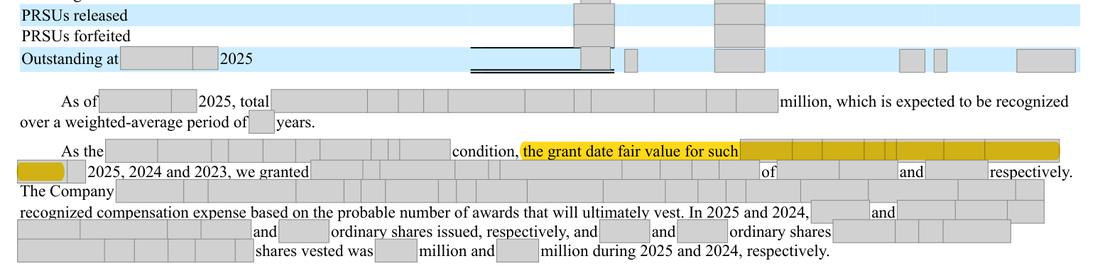
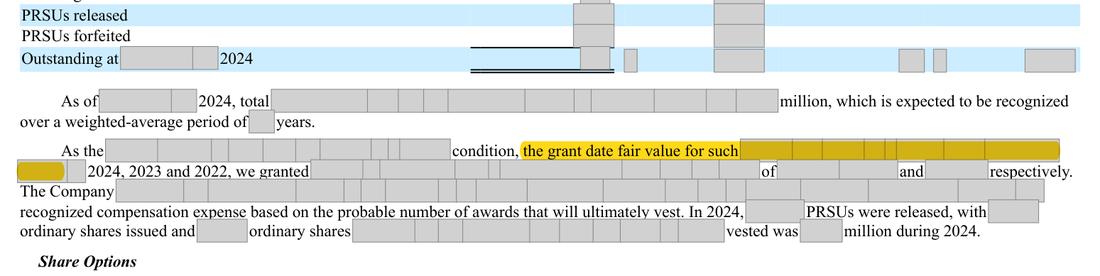
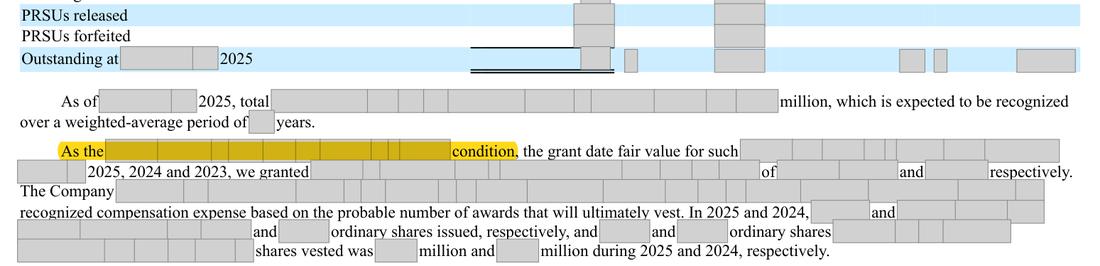
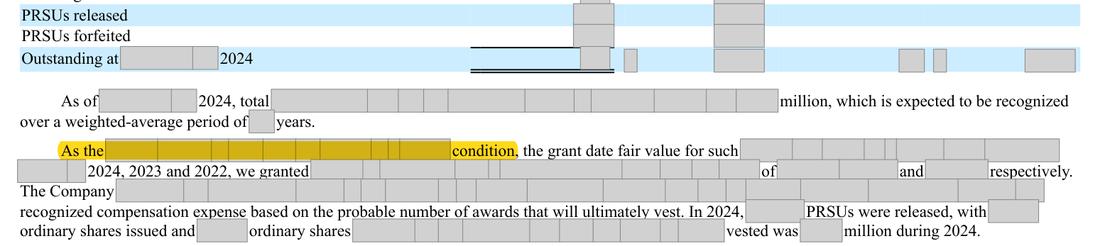
The performance-based restricted stock units (PRSUs) carry a total shareholder return condition and are valued with a Monte Carlo simulation; [n] were granted in 2025 at a weighted-average value of [amount]. The note gives no expected volatility, risk-free rate, dividend yield or term for these awards or for the employee stock purchase plan (ESPP). The share-based payment standard asks for the significant assumptions used in the year, and the prior-year note had the same gap.
The evidence, as filed
What the filing shows, and what the rule requires
| What the filing shows | What the rule requires |
|---|---|
Note 19 says PRSU grant-date fair value 'was based on a Monte Carlo simulation model' and gives the weighted-average value ([n] in 2025); no assumption is disclosed for the PRSUs or the ESPP in either year. | For each year an income statement is presented: the valuation method and the significant assumptions used (expected volatility and how it was estimated, risk-free rate, expected dividends, performance period or expected term, correlation or peer-group inputs) for the PRSUs and for the ESPP purchase rights. |
| What we checked. Note 2 policy, Note 19 and the critical accounting estimates in both [n]-Ks; whole-report search for the assumption words | |
The rule
ASC 718-10-50-1 to 50-2 (share-based payment disclosures; paraphrase, the Codification text is copyrighted)
Summary; FASB/IFRS text is copyrighted Disclose share-based arrangement terms, fair-value methods and assumptions, award activity, compensation cost and tax effects, and unrecognised cost with weighted-average recognition period.
Version: Text as amended up to [date] · Source: FASB Accounting Standards Codification, ASC 718-10-50-1 to 50-2; paraphrase
Regulation S-X Rule 4-01(a)(1)
Financial statements filed with the Commission which are not prepared in accordance with generally accepted accounting principles will be presumed to be misleading or inaccurate, despite footnote or other disclosures
Version: Text in force at the date of this review · Source: Regulation S-X, 17 CFR 210.4-01(a)(1) (eCFR, as amended)
Why it applies here. The 2025 PRSU grant alone is valued at about [amount] ([n] units at [amount]) by a model that rests on the omitted inputs. Restricted stock units valued at the share price need no assumptions and are not part of this point.
Why it matters
- Readers cannot judge whether the grant-date values that drive the PRSU expense are reasonable.
- A staff comment asking for the assumptions in future filings is the realistic outcome; no fine applies and no recognized amount is misstated.
How often the SEC staff raises this. In 1,100 SEC staff comment letters on fiscal 2023 and 2024 Forms 10-K, released January 2025 to October 2026, financial statement presentation drew 254 of the 1,774 numbered comments (14.3%): the second most frequent topic.
Exposure
A staff comment asking for the assumptions in future filings; no fine applies.
Our workings
Note 2 and Note 19 say PRSUs granted in 2024 and 2025 include relative total shareholder return as a metric and are valued with a Monte Carlo model. In 2025 the company granted [n] PRSUs at a weighted-average grant-date fair value of [amount]. The ESPP lets employees buy shares at a 15% discount over a 24-month offering period with four purchase periods, and unrecognised ESPP cost was [amount]. Neither note gives an input to either valuation; the words 'volatility', 'risk-free', 'expected term' and 'dividend yield' do not appear in the notes of either 10-K.
The 2025 PRSU grant is valued at [n] x [n] = [n] (workings).
The share-based payment disclosure paragraphs require, for each year, a description of the method and the significant assumptions used to estimate fair value, including volatility, expected term, dividends and the risk-free rate where applicable. A Monte Carlo value of a market-condition award depends on exactly those inputs, so the omission is not a case of 'not applicable'; the same applies to the ESPP look-back rights. The restricted stock units valued at the market price need no assumptions and are not part of this point.
| Line | Arithmetic (thousands, except per unit) | Source |
|---|---|---|
| PRSUs granted in 2025 at weighted-average grant-date fair value | [n] x [n] = [n] | Note 19, financial-statement pages (printed F-n; see folios) |
| Total share-based compensation expense 2025 | [n] (as printed) | Note 19, financial-statement pages (printed F-n; see folios) |
| Element | Fiscal 2025 (this 10-K) | Fiscal 2024 (prior 10-K) | Status |
|---|---|---|---|
| Valuation method for PRSUs (Monte Carlo) | Given, p.133 and [n] | Given, p.133 and [n] | Given |
| PRSU expected volatility, risk-free rate, dividend yield, performance period | Not given | Not given | Absent |
| ESPP valuation method and assumptions | Not given | Not given | Absent |
| Weighted-average grant-date fair value of awards granted | Given, p.158-159 | Given | Given |
| Unrecognised cost and weighted-average period | Given, p.158-159 | Given | Given |
Management’s best defense, and our reply
Management would argue that the PRSU and ESPP expense is a modest part of total share-based cost, most of which comes from restricted stock units valued at the share price, so the assumptions are not material to a reader. They might add that the proxy statement explains the performance design of the PRSUs. However, the 2025 PRSU grant alone is valued at [n] from a model that rests entirely on the omitted inputs, the requirement applies to each year's significant assumptions regardless of the proxy, and the proxy does not give the valuation inputs either, so the defense does not cure the gap.
The fix
- Add a table to Note 19 giving, for each of the three years, the Monte Carlo inputs for PRSUs (expected volatility of the company and the peer group, risk-free rate, dividend yield, performance period) and the option-pricing inputs for ESPP purchase rights, with one sentence on how volatility is estimated.
Evidence relied on
| # | What it shows | Type | Where |
|---|---|---|---|
| 1 | Note 19 (F-41): PRSUs valued with a Monte Carlo model | Document | Form 10-K 2025, financial-statement pages (printed F-n; see folios) |
| 2 | [n] PRSUs granted in 2025 at [n] | Document | Form 10-K 2025, financial-statement pages (printed F-n; see folios) |
| 3 | Note 19 (F-40): total expense | Document | Form 10-K 2025, financial-statement pages (printed F-n; see folios) |
| 4 | Note 19 (F-39): ESPP terms; a look-back purchase right needs an option-pricing valuation | Document | Form 10-K 2025, financial-statement pages (printed F-n; see folios) |
| 5 | ESPP cost exists but its valuation inputs are not given | Document | Form 10-K 2025, financial-statement pages (printed F-n; see folios) |
| 6 | Prior-year 10-K: same wording, no assumptions | Document | Form 10-K 2024 (prior year), financial-statement pages (printed F-n; see folios) |
Absence check
- Document
- Form 10-K 2025
- Where it would appear
- As the PRSUs granted in each year are subject to a market condition
- What is missing
- The significant assumptions used in the PRSU and ESPP valuations (volatility, risk-free rate, dividends, term)
- Pages looked at
- p.102-103, [n], 156-160
- Result
- 'volatility' hits p.54, [n] (risk factors and MD&A on tariffs, credit markets and exchange rates) and p.105 (Item 7A, share-price effect on the exchangeable notes), none of them a valuation input; 'Monte Carlo' hits financial-statement pages (printed F-n; see folios) (policy) and financial-statement pages (printed F-n; see folios) (the sentence quoted); 'risk-free', 'expected term', 'dividend yield' and 'Black-Scholes' have no hits.
Absence check
- Document
- Form 10-K 2024 (prior year)
- Where it would appear
- As the PRSUs granted in each year are subject to a market condition
- What is missing
- The same assumptions for fiscal 2024 grants
- Pages looked at
- Form 10-K 2024 (prior year) p.133, 159-163
- Result
- 'volatility' hits p.67, [n] and [n] (risk factors and market-risk text), none a valuation input; the other terms have no hits.
Prepared by Pramanex from the company’s public SEC filings, without the company’s involvement, to show how a 10-K Pre-filing Check reads. The company is not named, and nothing on this page is a statement about any identifiable company. Observations are not an audit, review or other attestation or assurance engagement, and not legal advice. An SEC-style question is a question, not a conclusion.
Want this on your own 10-K, before you file?
Start with three free findings on your latest 10-K, or book a fixed-price 10-K Pre-filing Check.
Your next 10-K will be in draft before the audit is done.
Have it read before you file.
Start with three free findings on your latest 10-K, or book a fixed-price 10-K check. Drafts only under NDA, inside your insider trading policy.