3.09 MD&A attributes the [amount] rise in the tax provision 'primarily' to lower stock-compensation tax benefits, which account for about [amount] of it, and quantifies no driver
Company F · a US-listed networking equipment company · SEC-style question
In brief
The provision for income taxes rose by [amount] ([n]%) and the effective tax rate from [n]% to [n]%. The management's discussion and analysis (MD&A) gives one reason, a decrease in tax benefits from equity-based compensation, with no amount. Note 8 shows excess tax benefits fell by [amount]; most of the dollar increase comes from [amount] more pre-tax income and from other rate items (lower research credits, the new tax law at [amount]), none of which the discussion mentions.
The evidence, as filed

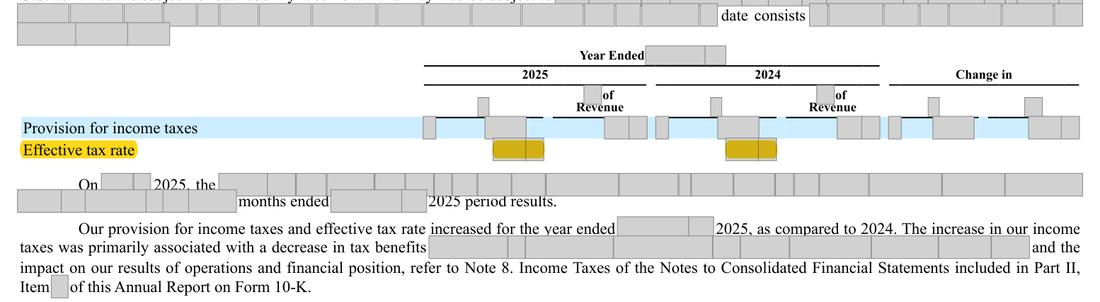
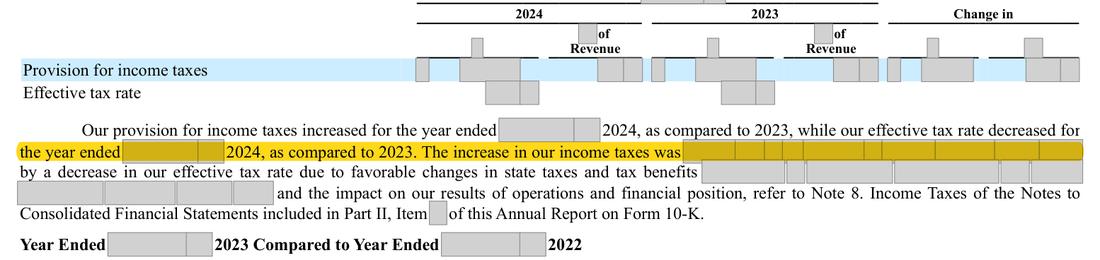
2 further page extracts: screenshot withheld to protect the company’s identity. The rows below say what each shows.
What the filing shows, and what the rule requires
| What the filing shows | What the rule requires |
|---|---|
Provision [amount] against [amount] (up [amount]); effective rate [n]% against [n]%; one reason given, unquantified: 'a decrease in tax benefits attributable to equity-based compensation'. Excess tax benefits [amount] against [amount]. | The main drivers of the increase with amounts: higher pre-tax income (about [amount] at the 2024 rate), the lower stock-compensation benefit, the smaller research and development credit, and the effect of the new tax legislation ([amount] in Note 8), as the 2024 discussion led with the pre-tax income effect. |
The rule
Regulation S-K Item 303(b) (full fiscal years: reasons for material changes)
Where the financial statements reflect material changes from period-to-period in one or more line items, including where material changes within a line item offset one another, describe the underlying reasons for these material changes in quantitative and qualitative terms.
Version: Text in force at the date of this review · Source: 17 CFR 229.303(b), Regulation S-K, as amended by Release 33-10890 (eCFR current text)
Why it applies here. read as an explanation of the rate, 'primarily' is arguable; read as an explanation of the [amount] increase in income taxes, which is what the sentence says, it is not supported. Item 303(b) requires the underlying reasons for material changes in quantitative terms; none is quantified. Because the 2025 and 2024 reconciliations use different categories after the new income-tax disclosure standard, only management can give a like-for-like split, so the point is put as a question.
Why it matters
Investors are pointed to one factor that explains about a sixth of the dollar increase and are given no amount for any factor, including the new tax law, which also affects future cash taxes.
How often the SEC staff raises this. In 1,100 SEC staff comment letters on fiscal 2023 and 2024 Forms 10-K, released January 2025 to October 2026, MD&A results of operations drew 239 of the 1,774 numbered comments (13.5%): the third most frequent topic.
Exposure
None until management answers; if the attribution does not hold, a staff comment asking for quantified drivers in future filings
Our workings
the 2025 discussion reports a provision of [amount] against [amount] and an effective rate of [n]% against [n]%, and says the increase in income taxes was primarily associated with a decrease in tax benefits attributable to equity-based compensation. It also says the new United States tax legislation is reflected in the results, without an amount. Pre-tax income was [amount] against [amount]. Note 8 gives excess tax benefits from stock awards of [amounts], a 2025 rate reconciliation with a stock-based compensation benefit of 2.91%, a research and development credit of 1.29% and new tax law enactment of [amount], and a 2024 reconciliation with stock-based compensation of 4.96% and tax credits of 2.79%. The 2024 discussion in the same filing led with the increase in pre-tax income.
about [amount] of the increase comes from higher pre-tax income at the 2024 rate and about [amount] from the higher rate; the fall in excess tax benefits, [amount], is [n]% of the dollar increase. Measured as a rate, the stock-compensation line moved [n] points of the [n]-point rise ([n]%), or [n] points (58.3%) if excess benefits are taken over pre-tax income.
| Measure ($ million) | Computation | Result |
|---|---|---|
| Increase in provision | [n] - [n] | [n] |
| Effect of higher pre-tax income at the 2024 rate | ([n] - [n]) x [n]% = [n] x [n]% | [n] |
| Effect of the higher rate on 2025 pre-tax income | ([n]% - [n]%) x [n] = 4.72% x [n] | [n] |
| Fall in excess tax benefits | [n] - [n] = [n]; [n] / [n] | [n]% of the increase |
| Stock-compensation line in the rate reconciliation | -[n] - (-[n]) = [n] points; [n] / [n] | [n]% of the rate rise |
| Excess benefits over pre-tax income | [n] / [n] = 6.50%; [n] / [n] = 3.75%; [n] - [n] = [n] points; [n] / [n] | 58.3% of the rate rise |
| Research and development and other credits | -[n] - (-[n]) | [n] points |
Management’s best defense, and our reply
Management would say the sentence explains the rise in the effective rate, and on that reading the stock-compensation benefit is the largest single item, 58% of the rise when excess benefits are measured against pre-tax income. It would add that Note 8 is cross-referenced and quantifies every reconciling item, so investors have the amounts, and that the higher pre-tax income is evident from the statements. That reading is tenable for the rate, which is why this is a question; but the sentence speaks of 'the increase in our income taxes', which was mainly the result of higher pre-tax income, and Item 303(b) asks for the reasons in quantitative terms in MD&A itself rather than by reference to the note.
The fix
- For example: 'The provision increased by [amount], of which approximately [amount] reflects higher pre-tax income and [amount] a higher effective rate: lower excess tax benefits from stock awards ([amount]), a smaller research and development credit, and the effects of the new tax legislation ([amount]).'
Question for the company
What were the amounts of each factor behind the [amount] increase in the provision and the rise in the effective tax rate from [n]% to [n]%, and on what basis is the decrease in stock-compensation tax benefits described as the primary cause?
Evidence relied on
| # | What it shows | Type | Where |
|---|---|---|---|
| 1 | The single, unquantified reason MD&A gives | Document | Form 10-K 2025, page 56 |
| 2 | The provision rose by [amount] | Document | Form 10-K 2025, page 56 |
| 3 | The effective tax rate rose from [n]% to [n]% | Document | Form 10-K 2025, page 56 |
| 4 | Pre-tax income rose by [amount] | Document | Form 10-K 2025, page 69 |
| 5 | Excess tax benefits fell by [amount] | Document | Form 10-K 2025, page 91 |
| 6 | 2025 stock-compensation effect on the rate | Document | Form 10-K 2025, page 91 |
| 7 | 2024 stock-compensation effect on the rate | Document | Form 10-K 2025, page 91 |
| 8 | Effect of the new tax legislation, not given in MD&A | Document | Form 10-K 2025, page 91 |
| 9 | 2025 research and development credit | Document | Form 10-K 2025, page 91 |
| 10 | 2024 tax credits | Document | Form 10-K 2025, page 91 |
| 11 | 2025 effective rate to two decimals | Document | Form 10-K 2025, page 91 |
| 12 | 2024 effective rate to two decimals | Document | Form 10-K 2025, page 91 |
Absence check
- Document
- Form 10-K 2025
- Where it would appear
- Provision for Income Taxes
- What is missing
- any amount for the drivers of the increase, and any mention of the pre-tax income effect, the lower research credit or the amount of the new tax law effect
- Pages looked at
- p.56 (2025 tax discussion), p.58 (2024 tax discussion), p.90-93 (Note 8)
- Result
- 'pre-tax income' hits only p.58 (the 2024 discussion); 'OBBB' hits p.39 (risk factor), p.56 (the statement that the law is reflected, without an amount) and p.91 (Note 8); 'research and development tax credit' and 'excess tax benefit' hit only Note 8 on p.91. '[n]' has no hits. None quantifies a 2025 driver in MD&A.
Prepared by Pramanex from the company’s public SEC filings, without the company’s involvement, to show how a 10-K Pre-filing Check reads. The company is not named, and nothing on this page is a statement about any identifiable company. Observations are not an audit, review or other attestation or assurance engagement, and not legal advice. An SEC-style question is a question, not a conclusion.
Want this on your own 10-K, before you file?
Start with three free findings on your latest 10-K, or book a fixed-price 10-K Pre-filing Check.
Your next 10-K will be in draft before the audit is done.
Have it read before you file.
Start with three free findings on your latest 10-K, or book a fixed-price 10-K check. Drafts only under NDA, inside your insider trading policy.