3.08 The [city] building estimate falls by only [amount] in a year when [amount] was built, and the Form 10-K does not say what the range covers
Company F · a US-listed networking equipment company · SEC-style question
In brief
The prior-year Form 10-K put the [city] building's capital expenditure at [amount] to [amount] through the end of 2026. This Form 10-K gives [amount] to [amount] to the same date, [amount] lower at both ends, with no reason. The company's quarterly reports call this range the 'remaining' spend (for example [amount] to [amount] at [date]), a word the Form 10-K leaves out. Read that way, the remaining estimate fell by only [amount] while construction-in-process rose by [amount], which would mean a total cost up to [amount] higher if that build-up is all for this project. We ask what the range covers and why it changed.
The evidence, as filed

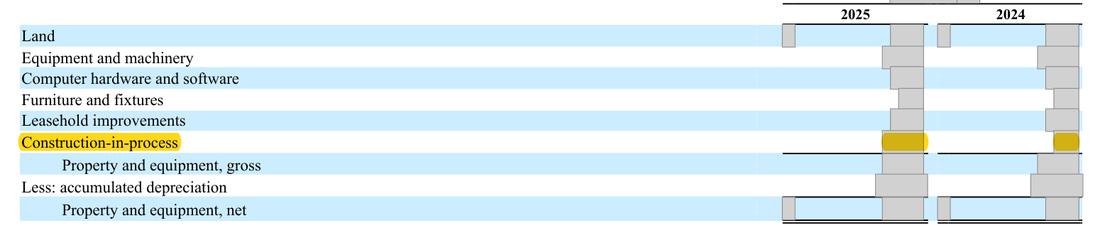

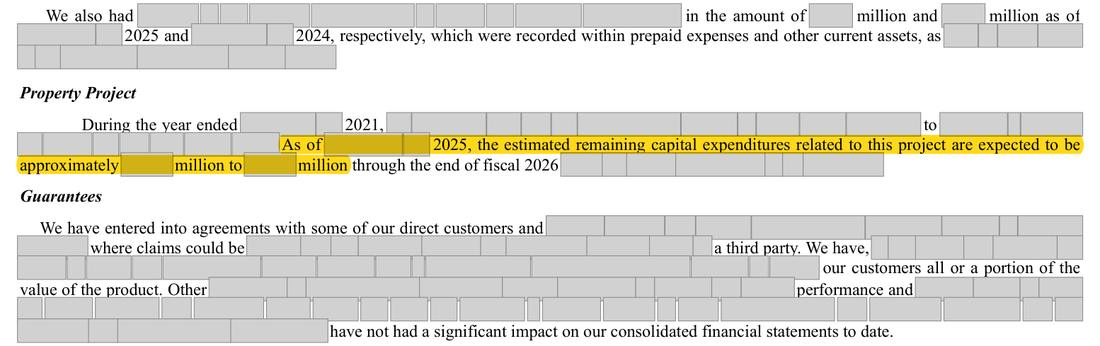
3 further page extracts: screenshot withheld to protect the company’s identity. The rows below say what each shows.
What the filing shows, and what the rule requires
| What the filing shows | What the rule requires |
|---|---|
Note 5 (page 86) and the MD&A (page 60): 'approximately [amount] to [amount] through' the end of 2026; prior year: '[amount] to [amount]' to the same date; no statement whether the range is total or remaining cost, and no reason for the change. | The range described on the same basis as in the quarterly reports (remaining spend), with the total project cost or the reason the estimate changed, as part of the discussion of material cash requirements for capital expenditure. |
The rule
Regulation S-K Item 303(b)(1)(ii)(A) (capital resources: material cash requirements)
Describe the registrant's material cash requirements, including commitments for capital expenditures, as of the end of the latest fiscal period, the anticipated source of funds needed to satisfy such cash requirements and the general purpose of such requirements.
Version: Text in force at the date of this review · Source: Regulation S-K, 17 CFR 229.303
Why it applies here. the Form 10-K alone does not let a reader tell whether the range is total or remaining cost, and on the basis the quarterly reports use, the project appears to cost more than planned a year earlier.
Why it matters
Readers cannot tell whether the building now costs less or more than planned, or how much cash it still needs in 2026.
How often the SEC staff raises this. In 1,100 SEC staff comment letters on fiscal 2023 and 2024 Forms 10-K, released January 2025 to October 2026, MD&A liquidity and capital resources drew 47 of the 1,774 numbered comments (2.6%): topic 12 of 25 by frequency.
Exposure
A question only; at most a staff comment asking the company to clarify its capital-expenditure commitments in future filings.
Our workings
Note 5 (page 86) and the MD&A (page 60) give [amount] to [amount] through the end of fiscal 2026. The prior-year note gave [amount] to [amount] through [date], and the prior-year MD&A said 'for the next two years'. The company's Form 10-Q for the [date] quarter described the figure as the 'estimated remaining capital expenditures' ([amount] to [amount] at [date]), and the Form 10-Q for the [date] quarter uses the same words ([amount] to [amount]); this Form 10-K drops the word 'remaining'. Construction-in-process was [amount] at [date] against [amount] a year earlier, and purchases of property, equipment and intangible assets were [amount] in 2025.
[n] - [n] = [n] and [n] - [n] = [n]; [n] - [n] = [n]; on the remaining-spend reading the total cost moved by [n] - [n] = [n], an increase, if all of the construction-in-process build-up belongs to this project. Law: Regulation S-K Item 303(b)(1)(ii)(A) asks for the registrant's material cash requirements, including commitments for capital expenditures, with their source of funds and general purpose. Grey area: the range, purpose and completion date are given, and the rule does not by its words require the reason for a change in an estimate; construction-in-process may also hold items other than this building.
| Item | Computation | Result |
|---|---|---|
| Change in the range, low and high ends | [n] - [n] = [n]; [n] - [n] = [n] | [n] |
| Construction-in-process built up in 2025 | [n] - [n] = [n] | [n] |
| Implied change in total cost on the remaining-spend reading | [n] - [n] = [n] | [n] increase |
| Change in the range against pre-tax income | [n] / [n] = 1.53% | 1.53% |
Management’s best defense, and our reply
The estimate is a forward-looking range updated as contracts are let, and the quarterly reports already make clear that it is the remaining spend; the Form 10-K gives the range, the purpose and the completion date, which is what the material-cash-requirements rule asks for. Construction-in-process may also include other assets, so the [n] implied increase may overstate any change in the building's cost. The defense is credible, which is why this is a question; but the Form 10-K, read on its own, does not say the range is remaining spend, and a reader who does read it that way finds a total cost apparently higher than a year earlier with no reason given.
The fix
- State the basis, for example: 'We expect remaining capital expenditures of [amount] to [amount] to complete the project in fiscal 2026 (total project cost $X million, compared with our prior estimate of $Y million, because ...).'
Question for the company
Is the [amount] to [amount] range the spend remaining after [date], as the quarterly reports describe it? If so, what is the total project cost now against the estimate a year earlier, and what caused the change?
Evidence relied on
| # | What it shows | Type | Where |
|---|---|---|---|
| 1 | Note 5 gives [amount] to [amount] | Document | Form 10-K 2025, page 86 |
| 2 | The MD&A gives the same range, with no reason for the change | Document | Form 10-K 2025, page 60 |
| 3 | Construction-in-process rose from [amount] to [amount] in 2025 | Document | Form 10-K 2025, page 83 |
| 4 | 2025 spending on property, equipment and intangibles was [amount] | Document | Form 10-K 2025, page 59 |
| 5 | Prior-year note: [amount] to [amount], completion [date] | Document | Form 10-K 2024 (prior year), page 95 |
| 6 | Prior-year MD&A: [amount] to [amount] 'for the next two years' | Document | Form 10-K 2024 (prior year), page 65 |
| 7 | The [date] Form 10-Q calls the range the remaining spend | Document | |
| 8 | The [date] Form 10-Q uses the same 'remaining' basis | Document |
Prepared by Pramanex from the company’s public SEC filings, without the company’s involvement, to show how a 10-K Pre-filing Check reads. The company is not named, and nothing on this page is a statement about any identifiable company. Observations are not an audit, review or other attestation or assurance engagement, and not legal advice. An SEC-style question is a question, not a conclusion.
Want this on your own 10-K, before you file?
Start with three free findings on your latest 10-K, or book a fixed-price 10-K Pre-filing Check.
Your next 10-K will be in draft before the audit is done.
Have it read before you file.
Start with three free findings on your latest 10-K, or book a fixed-price 10-K check. Drafts only under NDA, inside your insider trading policy.