1.02 Customer payments under cancellable contracts are called 'contract liabilities' and counted in the [amount] of remaining performance obligations
Company F · a US-listed networking equipment company · SEC-style question
In brief
The revenue note defines a 'contract liability' as a customer payment received in advance [wording masked], and keeps it apart from deferred revenue. Those [amount] of payments are then added into the [amount] of revenue from remaining performance obligations. Under US GAAP the remaining-performance-obligation figure covers only enforceable contracts, so the note should explain why amounts under cancellable contracts are in it, and whether the payments are refundable.
The evidence, as filed

What the filing shows, and what the rule requires
| What the filing shows | What the rule requires |
|---|---|
Contract liabilities of [amount] (2024: [amount]), defined as advance payments under cancellable contracts, presented outside deferred revenue and included with deferred revenue of [amount] and other performance obligations of [amount] in remaining performance obligations of [amount]. | Remaining performance obligations limited to enforceable contracts, with any advance payments under contracts the customer can cancel shown as customer deposits or refund liabilities and excluded, or an explanation of why the cancellable contracts are enforceable for the amounts paid. |
The rule
ASC 606-10-50-13 (remaining performance obligations)
Summary; FASB/IFRS text is copyrighted Disclose transaction price allocated to unsatisfied performance obligations and expected timing of recognition, or state use of the permitted practical expedients and what is excluded.
Version: Text in force at the date of this review · Source: FASB Accounting Standards Codification, ASC 606-10-50-13 to 50-15 (as amended by ASU 2014-09 and ASU 2015-14); paraphrase
Why it applies here. under the Accounting Standards Codification (ASC), a contract exists only to the extent the parties have enforceable rights and obligations, and the remaining performance obligation disclosure covers transaction price allocated to unsatisfied obligations of such contracts. Deferred revenue is the balance the standard calls a contract liability. A payment the customer can recover by cancelling is a refund liability or deposit rather than a contract liability, and would not belong in remaining performance obligations; a payment the customer forfeits on cancellation may support a contract for that amount. The note does not say which applies.
Why it matters
If the payments are refundable on cancellation, remaining performance obligations are overstated by up to [amount] and the balance-sheet label 'contract liability' is not the ASC 606 meaning; revenue recognition itself is not in question.
How often the SEC staff raises this. In 1,100 SEC staff comment letters on fiscal 2023 and 2024 Forms 10-K, released January 2025 to October 2026, revenue recognition and disclosure drew 68 of the 1,774 numbered comments (3.8%): topic 7 of 25 by frequency.
Exposure
A question for management; if the payments prove refundable, the realistic consequence is a revised disclosure in future filings.
Our workings
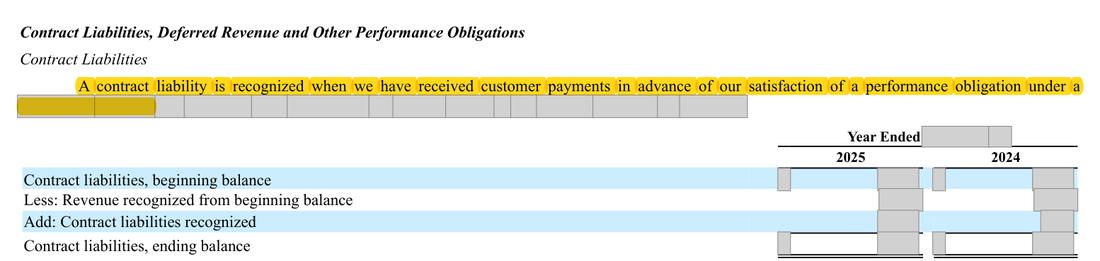
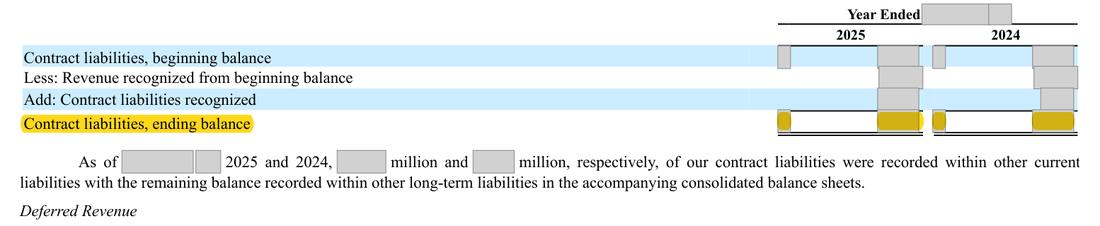
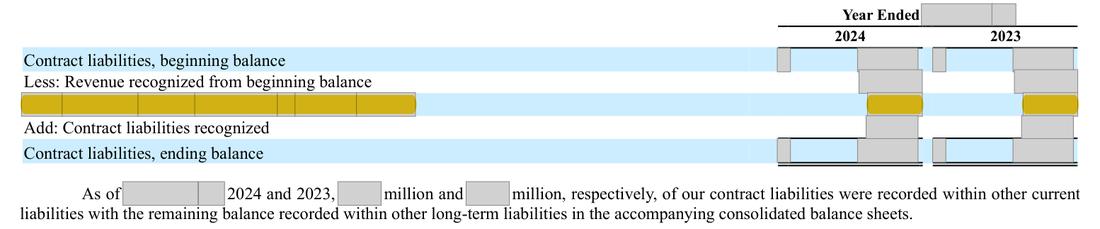
the policy says contract assets sit in other current assets and 'contract liabilities' in other current and other long-term liabilities; Note 3 defines a contract liability as payments received in advance [wording masked] and rolls it forward to [amount], separately from deferred revenue of [amount]. The prior-year roll-forward had a line for balances 'reclassified to deferred revenue', which shows the two are different things: a payment moves to deferred revenue when the contract stops being cancellable. Note 3 then states that total revenue from contract liabilities, deferred revenue and other performance obligations to be recognized in future is [amount].
[n] + [n] + [n] = [n], so the [amount] includes the [amount], 4.08% of the total; the prior year's [amount] was built the same way.
| Line | Arithmetic (USD million) | Source |
|---|---|---|
| Remaining performance obligations built up | [n] + [n] + [n] = [n] (printed as [amount]) | Note 3, p.84 |
| Share from cancellable-contract payments | [n] / [n] = 4.08% | computed |
| Deferred revenue on the balance sheet | [n] + [n] = [n] | Balance sheet p.68; Note 3 p.84 |
| Contract liabilities roll-forward 2025 | [n] - [n] + [n] = [n] | Note 3, p.84 |
| Prior year (thousands to millions) | [n] / [n] = [n]; [n] + [n] + [n] = [n] = [n] (printed [amount]) | Form 10-K 2024 (prior year) p.91 (prior 10-K printed thousands; [n] is the [amount] printed) |
| Size against pre-tax income | [n] / [n] = 5.89% | computed |
Management’s best defense, and our reply
Management would say the payments are non-refundable, so the customer's right to cancel the rest of the order does not undo an enforceable contract for the amount already paid, and that amount is a contract liability and part of the unsatisfied obligation. They would add that the balance is only 4.08% of the total, and that the presentation is unchanged from the prior year. That defense is tenable if the payments are in fact forfeited on cancellation, which the filing does not say; the answer depends on contract terms only management holds, hence a question.
The fix
- Either exclude the cancellable-contract payments from the remaining-performance-obligation figure and call them customer deposits, or add: 'Contract liabilities represent non-refundable payments under contracts the customer may cancel; the payments are enforceable to the extent received and are included in remaining performance obligations.'
Question for the company
Are the [amount] of payments under cancellable contracts refundable if the customer cancels? If so, why are they presented as contract liabilities and included in the [amount] of remaining performance obligations; if not, how do they differ from deferred revenue, and when are they reclassified to it?
Evidence relied on
| # | What it shows | Type | Where |
|---|---|---|---|
| 1 | Policy: 'contract liabilities' are carried outside deferred revenue | Document | Form 10-K 2025, page 78 |
| 2 | Definition: payments [wording masked] | Document | Form 10-K 2025, page 84 |
| 3 | Balance of [n] (2024: [n]) | Document | Form 10-K 2025, page 84 |
| 4 | Deferred revenue rolled forward separately | Document | Form 10-K 2025, page 84 |
| 5 | Third component of the remaining performance obligations | Document | Form 10-K 2025, page 84 |
| 6 | The [n] includes the cancellable-contract balance | Document | Form 10-K 2025, page 84 |
| 7 | Current deferred revenue on the balance sheet | Document | Form 10-K 2025, page 68 |
| 8 | Non-current deferred revenue on the balance sheet | Document | Form 10-K 2025, page 68 |
| 9 | Prior year: balances move to deferred revenue, so the two are distinct | Document | Form 10-K 2024 (prior year), page 91 |
| 10 | Prior year built the same way (thousands in the tables) | Document | Form 10-K 2024 (prior year), page 91 |
Prepared by Pramanex from the company’s public SEC filings, without the company’s involvement, to show how a 10-K Pre-filing Check reads. The company is not named, and nothing on this page is a statement about any identifiable company. Observations are not an audit, review or other attestation or assurance engagement, and not legal advice. An SEC-style question is a question, not a conclusion.
Want this on your own 10-K, before you file?
Start with three free findings on your latest 10-K, or book a fixed-price 10-K Pre-filing Check.
Your next 10-K will be in draft before the audit is done.
Have it read before you file.
Start with three free findings on your latest 10-K, or book a fixed-price 10-K check. Drafts only under NDA, inside your insider trading policy.