1.03 The [acquired business] acquisition note leaves out most business-combination disclosures without saying the deal is immaterial
Company F · a US-listed networking equipment company · SEC-style question
In brief
On [date] the company bought the [acquired business] business for [amount] in cash, and Note 4 gives a three-line 'preliminary' allocation: intangible assets [amount], goodwill [amount] and net tangible liabilities [amount]. It does not give pro forma or post-acquisition revenue and earnings, which items are still provisional and why, what makes up the goodwill, or how much goodwill is tax deductible, and it does not say the deal is immaterial. We ask whether the company judged these disclosures immaterial.
The evidence, as filed


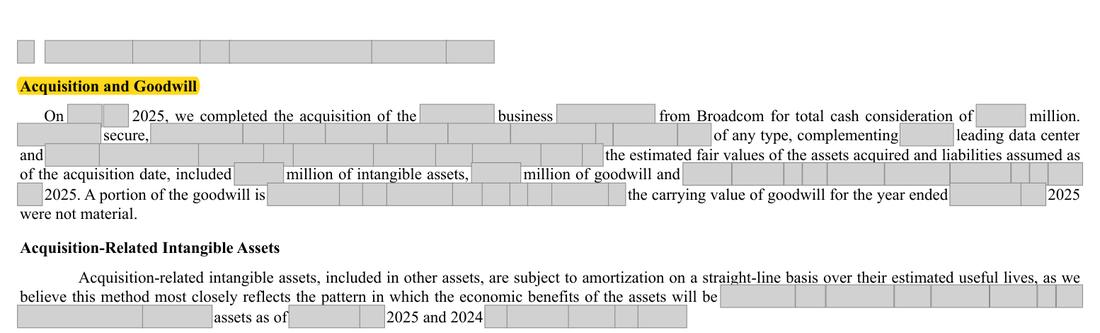

What the filing shows, and what the rule requires
| What the filing shows | What the rule requires |
|---|---|
One paragraph: cash consideration [amount]; preliminary allocation of [amount] intangibles, [amount] goodwill and [amount] net tangible liabilities; 'A portion of the goodwill is deductible for tax purposes.' | For a material acquisition: supplemental pro forma revenue and earnings for 2025 and 2024, revenue and earnings since [date], the provisional items and the reason, the qualitative factors behind goodwill, the deductible goodwill amount, and the acquired intangibles by class with their amortization period; or a statement that the acquisition is not material to the consolidated statements. |
The rule
Regulation S-X Rule 4-01(a)(1), read with FASB ASC paragraphs 805-10-50-2, 805-10-50-6, 805-30-50-1 and 350-30-50-1
Financial statements filed with the Commission which are not prepared in accordance with generally accepted accounting principles will be presumed to be misleading or inaccurate, despite footnote or other disclosures
Version: Text in force at the date of this review · Source: Regulation S-X, 17 CFR 210.4-01
Why it applies here. either the company judged [acquired business] immaterial (then a one-line statement would say so), or several required elements are missing; only the company can say which.
Why it matters
Readers cannot judge what [acquired business] added to 2025 revenue and earnings, what may still change in the allocation, or why [amount] of goodwill arose.
How often the SEC staff raises this. In 1,100 SEC staff comment letters on fiscal 2023 and 2024 Forms 10-K, released January 2025 to October 2026, business combinations and consolidation drew 62 of the 1,774 numbered comments (3.5%): topic 9 of 25 by frequency.
Exposure
A question only; if the deal is material, a staff comment and a future-filings undertaking would be the realistic outcome.
Our workings
Note 4 on page 85 describes the acquisition in one paragraph and calls the allocation 'preliminary'. The words 'pro forma', 'since the acquisition', 'provisional', 'synergies' and 'assembled workforce' appear nowhere in the report. The deal is named in Item 1, the risk factors, the cash-flow discussion, both 2025 earnings releases and the 2026 proxy statement. The prior-year Form 10-K said the company had no material business acquisitions in 2024 or 2023.
[n] + [n] - [n] = [n], so the allocation is complete in total; the intangible-asset table implies additions of [n] (developed technology), [n] (customer relationships) and [n] (trade name), which total [n]. The consideration is 1.54% of total assets and 7.06% of pre-tax income. Law: Financial Accounting Standards Board (FASB) Accounting Standards Codification (ASC) paragraph 805-10-50-2 asks, for each business combination, for the primary reasons and, for a public business entity, supplemental pro forma revenue and earnings and the acquiree's revenue and earnings since the acquisition date (or a statement that they are impracticable); paragraph 805-10-50-6 asks, where the initial accounting is incomplete, for the reasons and the items concerned; paragraph 805-30-50-1 asks for the qualitative factors that make up goodwill and the amount expected to be tax deductible; paragraph 350-30-50-1 asks for acquired intangibles by major class and their weighted-average amortization period. Paragraph 805-10-50-3 lets individually immaterial combinations be aggregated, and the Codification need not be applied to immaterial items.
| Item | Computation | Result |
|---|---|---|
| Allocation total | [n] + [n] - [n] = [n] | equals cash consideration |
| Intangibles added by class (2025 gross less 2024 gross) | ([n] - [n]) + ([n] - [n]) + ([n] - [n]) = [n] + [n] + [n] = [n] | [n] |
| Consideration against total assets | [n] / [n] = 1.54% | 1.54% |
| Consideration against pre-tax income | [n] / [n] = 7.06% | 7.06% |
Management’s best defense, and our reply
[acquired business] cost [amount], 1.54% of total assets, and its revenue is small against consolidated revenue, so the business-combination disclosures may be immaterial and the Codification need not be applied to immaterial items. The company gave the consideration and the allocation totals, and its policy note describes how measurement-period adjustments are handled. The answer: the company presents the deal as significant in Item 1, the risk factors, its earnings releases and its proxy statement, the acquired intangibles more than doubled the gross intangible balance, and the note neither gives the elements nor says the deal is immaterial, as the prior-year 10-K did for its own year. Because immateriality is a judgment a reasonable preparer could make, the point is put as a question.
The fix
- Either add the missing elements in the next Form 10-K or state: 'The acquisition of [acquired business] was not material to our consolidated financial statements; accordingly, pro forma results have not been presented.'
Question for the company
Did the company conclude that the [acquired business] acquisition was not material, so that pro forma and post-acquisition revenue and earnings were not required? Which parts of the 'preliminary' allocation were still provisional at [date] and why, what factors make up the [amount] of goodwill, how much of it is expected to be tax deductible, and over what weighted-average period are the [amount] of acquired intangibles amortized?
Evidence relied on
| # | What it shows | Type | Where |
|---|---|---|---|
| 1 | The business was acquired on [date] for [amount] in cash | Document | Form 10-K 2025, page 85 |
| 2 | The allocation is given in three lines only | Document | Form 10-K 2025, page 85 |
| 3 | The allocation is called preliminary, with no list of provisional items | Document | Form 10-K 2025, page 85 |
| 4 | The deductible goodwill is not quantified | Document | Form 10-K 2025, page 85 |
| 5 | Developed technology gross rose from [amount] to [amount] | Document | Form 10-K 2025, page 85 |
| 6 | Customer relationships gross rose from [amount] to [amount] | Document | Form 10-K 2025, page 85 |
| 7 | Trade name gross rose from [amount] to [amount] | Document | Form 10-K 2025, page 85 |
| 8 | Cash-flow statement: [n] paid for the acquisition in 2025 | Document | Form 10-K 2025, page 72 |
| 9 | MD&A investing cash flows name the acquisition but give no revenue or earnings of the business | Document | Form 10-K 2025, page 59 |
Absence check
- Document
- Form 10-K 2025
- Where it would appear
- Acquisition and Goodwill
- What is missing
- pro forma and post-acquisition revenue and earnings, the provisional items and reasons, the goodwill factors, the deductible goodwill amount, the acquired intangibles by class with amortization period, or a statement that the acquisition is immaterial
- Pages looked at
- p.85 (Note 4), p.76 (business-combination policy), p.4, [n] and [n] (other [acquired business] mentions)
- Result
- 'pro forma', 'since the acquisition', 'provisional', 'synerg' and 'assembled workforce' do not appear in the report. 'measurement period' appears only in the general accounting policy on p.76 (no [acquired business] detail). 'deductible' hits p.37 (insurance deductibles), p.39 (nondeductible compensation risk), p.85 (the unquantified sentence quoted above), p.91 (rate reconciliation) and p.92 (deferred tax reserves): none gives the deductible goodwill amount.
Prepared by Pramanex from the company’s public SEC filings, without the company’s involvement, to show how a 10-K Pre-filing Check reads. The company is not named, and nothing on this page is a statement about any identifiable company. Observations are not an audit, review or other attestation or assurance engagement, and not legal advice. An SEC-style question is a question, not a conclusion.
Want this on your own 10-K, before you file?
Start with three free findings on your latest 10-K, or book a fixed-price 10-K Pre-filing Check.
Your next 10-K will be in draft before the audit is done.
Have it read before you file.
Start with three free findings on your latest 10-K, or book a fixed-price 10-K check. Drafts only under NDA, inside your insider trading policy.