3.03 Item 7A still names strategic equity investments as a primary market risk, but the section that described them has been removed
Company F · a US-listed networking equipment company · Presentation point
In brief
Item 7A opens by saying the company's market risk exposure is primarily a result of foreign currency rates, interest rates and strategic equity investments. It then discusses only foreign currency and interest rates. The fiscal 2024 Form 10-K had a 'Strategic Equity Investments' section giving the carrying amount of investments in privately-held companies ([amount] at the end of 2024) and how they are evaluated; that section, and the carrying amount, are gone from the fiscal 2025 filing.
The evidence, as filed


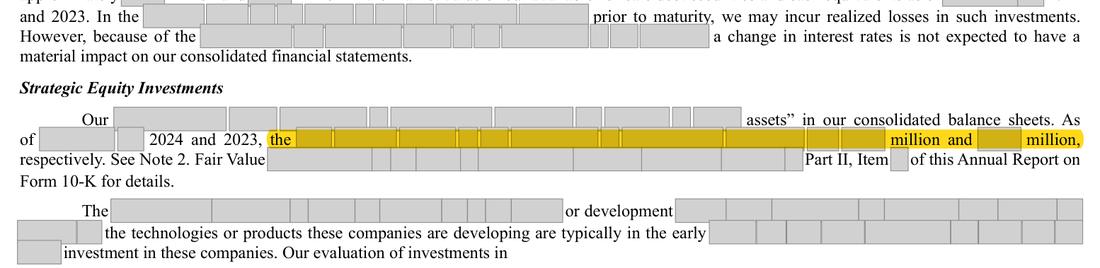
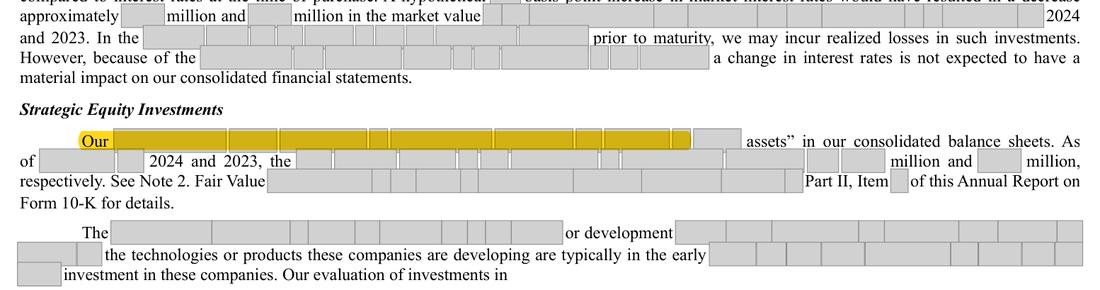
1 further page extract: screenshot withheld to protect the company’s identity. The rows below say what each shows.
What the filing shows, and what the rule requires
| What the filing shows | What the rule requires |
|---|---|
Opening paragraph names three primary exposures, including strategic equity investments; the Item covers only foreign currency exchange risk and interest rate sensitivity; no carrying amount, risk description or management approach for the equity investments (fiscal 2024: [amounts] at the two year ends). | Either a short section on the privately-held equity investments (carrying amount at [date], the risk of loss, how they are evaluated and managed, and the change from 2024), or, if management now judges the exposure immaterial, an opening paragraph that no longer lists it as a primary exposure. |
The rule
Regulation S-K Item 305(b)(1)(iii) (qualitative information about market risk)
Changes in either the registrant's primary market risk exposures or how those exposures are managed, when compared to what was in effect during the most recently completed fiscal year
Version: Text in force at the date of this review · Source: 17 CFR 229.305(b)(1), Regulation S-K (eCFR current text)
Regulation S-K Item 305, Instruction 1.A to paragraph (b)
The following categories of market risk: interest rate risk, foreign currency exchange rate risk, commodity price risk, and other relevant market rate or price risks (e.g., equity price risk)
Version: Text in force at the date of this review · Source: 17 CFR 229.305, Instructions to paragraph 305(b), Regulation S-K (eCFR current text)
Why it applies here. The Item names an exposure it does not describe. If the investments are no longer material, the opening sentence is the part to change; the last disclosed amount, [amount], is 1.91% of fiscal 2025 pre-tax income.
Why it matters
- Investors are told an exposure is primary but given nothing to size it.
- At most a staff comment asking for the description or a corrected opening sentence; no fine.
Exposure
A possible staff comment asking for the missing description or a corrected opening sentence; no fine
Our workings
the first paragraph of Item 7A says market risk exposure is primarily a result of fluctuations in foreign currency exchange rates, interest rates, and strategic equity investments. The Item contains two sub-sections, Foreign Currency Exchange Risk and Interest Rate Sensitivity, and ends on the same page. In the fiscal 2024 Form 10-K (Form 10-K 2024 (prior year) p.68-69) the same opening sentence was followed by a third sub-section, Strategic Equity Investments, giving carrying amounts of [amounts] and explaining that the company could lose its entire investment. In fiscal 2025 the only references to these investments are a risk factor, the impairment policy heading and the long-lived asset footnote; none gives an amount.
the last disclosed carrying amount, [amount], would be 1.91% of fiscal 2025 pre-tax income.
Item 305(b)(1) asks, to the extent material, for the primary market risk exposures, how they are managed and how they changed from the prior year. The company still identifies these investments as a primary exposure, so the description of them, and of any change since 2024, should follow; the Item as written contradicts itself. Whether the investments remain material is for management; if not, the opening sentence is the part to change.
| Item | Fiscal 2024 Form 10-K | Fiscal 2025 Form 10-K |
|---|---|---|
| Strategic equity investments named as a primary exposure | Yes | Yes |
| Sub-section describing them, with carrying amount | Yes: [n] and [n] | Absent |
| Last disclosed carrying amount against fiscal 2025 pre-tax income | [n] / [n] = 1.91% |
Management’s best defense, and our reply
Management would say the investments are small, under 2% of pre-tax income on the last disclosed amount, are not market risk sensitive instruments because they have no readily determinable fair value, and so need no Item 305 disclosure; the risk of loss is already described in the risk factors. It would add that the opening sentence is harmless carry-over wording. However, the company itself chose to list these investments as one of only three primary exposures, and Item 305(b)(1) asks for the change in primary exposures compared with the prior year; removing the section while keeping the sentence leaves the Item contradicting itself. The point is a presentation inconsistency rather than a missing required disclosure, and is graded that way.
The fix
- Restore a 'Strategic Equity Investments' paragraph: 'As of [date] and 2024, the carrying amount of our investments in privately-held companies was $[x] million and [amount] ...', or delete 'and strategic equity investments' from the opening sentence if the exposure is no longer material.
Evidence relied on
| # | What it shows | Type | Where |
|---|---|---|---|
| 1 | Item 7A names strategic equity investments as a primary market risk exposure | Document | Form 10-K 2025, page 63 |
| 2 | Item 7A ends after the interest rate sub-section, with nothing on the equity investments | Document | Form 10-K 2025, page 63 |
| 3 | The company still holds investments in privately-held companies | Document | Form 10-K 2025, page 76 |
| 4 | The fiscal 2024 Item 7A gave the carrying amounts | Document | Form 10-K 2024 (prior year), page 68 |
| 5 | Item 7A names strategic equity investments as one of three primary market risk exposures | Document | Form 10-K 2025, page 63 |
| 6 | Item 7A quantifies only the interest-rate exposure; the section ends after this paragraph with no equity-investment sub-section | Document | Form 10-K 2025, page 63 |
| 7 | The accounting-policy note still refers to investments in privately-held companies, so the holdings continue | Document | Form 10-K 2025, page 76 |
| 8 | Prior-year Item 7A gave the carrying amount at [date] and 2023 under a Strategic Equity Investments heading | Document | Form 10-K 2024 (prior year), page 68 |
| 9 | Prior-year Item 7A described the risk of loss on these investments | Document | Form 10-K 2024 (prior year), page 68 |
Absence check
- Document
- Form 10-K 2025
- Where it would appear
- Interest Rate Sensitivity
- What is missing
- the strategic equity investments sub-section (carrying amount, risk of loss, how managed, change from 2024)
- Pages looked at
- p.63-64 (Item 7A and the start of Item 8), p.76, 81-83 (Note 1 and Note 2)
- Result
- 'strategic equity' hits only the opening sentence on p.63; 'privately-held' hits p.23 (risk factor on acquisitions and investments), p.76 (impairment policy heading) and p.94 (long-lived assets footnote excluding these investments); none gives an amount or a market-risk description. 'equity price' and 'non-marketable' have no hits.
Absence check
- Document
- Form 10-K 2025
- Where it would appear
- Item 7A. Quantitative and Qualitative Disclosures About Market Risk
- What is missing
- any description, carrying amount or prior-year comparison for the strategic equity investments that the opening sentence names as a primary market risk exposure
- Pages looked at
- p.63-64 (all of Item 7A to the start of Item 8); p.76 (accounting policies); p.94 (long-lived assets by location)
- Result
- 'strategic equity' hits only the opening sentence on this page. 'privately-held' hits p.76 (impairment policy wording, no amount) and p.94 (a long-lived assets table that excludes these investments); the risk factor on p.23 uses 'privately held' to describe start-up investing risk, with no amount. None gives the carrying amount or a market-risk description. The other terms have no hits.
Prepared by Pramanex from the company’s public SEC filings, without the company’s involvement, to show how a 10-K Pre-filing Check reads. The company is not named, and nothing on this page is a statement about any identifiable company. Observations are not an audit, review or other attestation or assurance engagement, and not legal advice. An SEC-style question is a question, not a conclusion.
Want this on your own 10-K, before you file?
Start with three free findings on your latest 10-K, or book a fixed-price 10-K Pre-filing Check.
Your next 10-K will be in draft before the audit is done.
Have it read before you file.
Start with three free findings on your latest 10-K, or book a fixed-price 10-K check. Drafts only under NDA, inside your insider trading policy.