4.05 MD&A says the rise in income tax was 'primarily due to higher income before taxes', but higher pre-tax income explains less than a tenth of it
Company E · a US-listed home furnishings retailer · Presentation point
In brief
Income tax expense rose from [n] to [n] and the effective tax rate from [n]% to [n]%, while income before taxes rose only from [n] to [n]. The MD&A attributes the increase 'primarily' to higher income before taxes, but at the statutory rate that explains [n] of the [n] increase; the audited rate reconciliation puts most of it in smaller research and development credits and 'other adjustments'.
The evidence, as filed


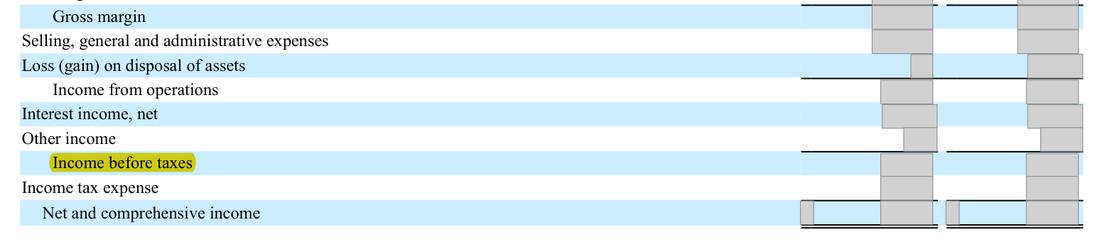
1 further page extract: screenshot withheld to protect the company’s identity. The rows below say what each shows.
What the filing shows, and what the rule requires
| What the filing shows | What the rule requires |
|---|---|
MD&A (p.48): 'The increase was primarily due to higher income before taxes.' Rate reconciliation (p.81): the statutory-rate line rose from [n] to [n]; research and development credits fell from ([n]) to ([n]); other adjustments moved from ([n]) to [n]. | An MD&A explanation that names and quantifies the main reasons for the higher effective rate (the lower research and development credits and the other adjustments, saying what those were), with higher income before taxes shown as a minor factor. |
| What we checked. MD&A income tax paragraph (p.48); income statement (p.47); income tax note rate reconciliation (p.81). | |
The rule
Regulation S-K Item 303(b), full fiscal years
Where the financial statements reflect material changes from period-to-period in one or more line items, including where material changes within a line item offset one another, describe the underlying reasons for these material changes in quantitative and qualitative terms.
Version: Text in force at the date of this review · Source: Regulation S-K, 17 CFR 229.303(b), as amended by Release 33-10890 (2020)
Why it applies here. Item 303(b) asks for the underlying reasons for material changes; the reason the MD&A gives is contradicted by the company's own reconciliation, in which the lower credits and the other adjustments carry most of the rise, and the other adjustments are not described anywhere.
Why it matters
Readers are told the tax rise reflects higher profit, when it reflects a higher effective rate driven by smaller credits and unexplained other adjustments; the rate trend is the information investors need for forecasting.
Exposure
A possible staff comment asking for the drivers of the effective-rate change; no fine applies.
Our workings
the MD&A attributes the 2025 rise in income tax expense primarily to higher income before taxes and gives effective rates of [n]% and [n]%. The audited rate reconciliation shows tax at the federal statutory rate of [n] and [n], research and development credits of ([n]) and ([n]), and other adjustments of [n] and ([n]).
the increase is [n], of which higher income before taxes at the statutory rate explains [n], or 9.5% (workings).
| Step | Computation | Result |
|---|---|---|
| Increase in income tax expense | [n] - [n] | [n] |
| Part explained by higher income before taxes (statutory-rate line) | [n] - [n] | [n] |
| Share of the increase explained by higher income before taxes | [n] / [n] | 9.5% |
Management’s best defense, and our reply
Management would say income before taxes did increase, the sentence is literally true as a direction, and the rate reconciliation in the notes gives readers every component, so nothing is hidden. It may add that the dollar change is small in the context of the business. However, the word 'primarily' attributes most of a [n] increase to a factor that explains [n], and Item 303(b) asks the MD&A to give the underlying reasons; the audited reconciliation shows those reasons are the credits and other adjustments, which the MD&A does not mention.
The fix
- Replace with: 'Income tax expense increased [n] dollars, and our effective tax rate rose to [n]% from [n]%, primarily due to lower research and development tax credits ([n] dollars) and other adjustments of [n] dollars [describe], with higher income before taxes contributing [n] dollars.'
Evidence relied on
| # | What it shows | Type | Where |
|---|---|---|---|
| 1 | the MD&A attributes the increase to higher pre-tax income | Document | Form 10-K 2025, page 48 |
| 2 | the effective rate rose [n] points | Document | Form 10-K 2025, page 48 |
| 3 | pre-tax income barely changed | Document | Form 10-K 2025, page 47 |
| 4 | income tax expense in both years | Document | Form 10-K 2025, page 47 |
| 5 | statutory tax rose [n] | Document | Form 10-K 2025, page 81 |
| 6 | credits fell by [n] | Document | Form 10-K 2025, page 81 |
| 7 | other adjustments moved by [n], the largest driver | Document | Form 10-K 2025, page 81 |
Prepared by Pramanex from the company’s public SEC filings, without the company’s involvement, to show how a 10-K Pre-filing Check reads. The company is not named, and nothing on this page is a statement about any identifiable company. Observations are not an audit, review or other attestation or assurance engagement, and not legal advice. An SEC-style question is a question, not a conclusion.
Want this on your own 10-K, before you file?
Start with three free findings on your latest 10-K, or book a fixed-price 10-K Pre-filing Check.
Your next 10-K will be in draft before the audit is done.
Have it read before you file.
Start with three free findings on your latest 10-K, or book a fixed-price 10-K check. Drafts only under NDA, inside your insider trading policy.