4.04 'Total capital expenditures, net of landlord contributions' is built from net investing cash flows, so 2024 capital spending is understated by [n] dollars of asset-sale proceeds
Company E · a US-listed home furnishings retailer · Compliance or disclosure gap
In brief
The MD&A computes 'total capital expenditures, net of landlord contributions' by deducting landlord contributions from net cash used in investing activities. Net investing cash flow is not capital spending: in 2024 it is reduced by [n] of proceeds from selling property. On the cash-flow statement's own purchases line, 2024 capital spending net of landlord contributions is [n], not [n], and the 2025 decline is [n], not the [n] dollars stated. The measure is not identified as a non-GAAP measure and has no usefulness statement; the 2024 Form 10-K used the same construction.
The evidence, as filed

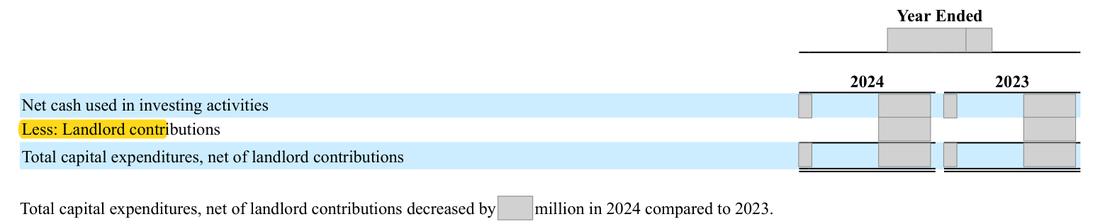

1 further page extract: screenshot withheld to protect the company’s identity. The rows below say what each shows.
What the filing shows, and what the rule requires
| What the filing shows | What the rule requires |
|---|---|
Capital expenditures table: [n] and [n] [wording masked] [n] and [n], gives [n] and [n]; narrative: 'decreased by [amount] in 2025 compared to 2024'; the 2026 guidance range is given on the same basis. | Capital expenditures taken from 'Purchases of property, furniture and equipment' ([n] and [n]), giving [n] and [n] net of landlord contributions and a decline of [n]; the measure labelled as non-GAAP, reconciled to the purchases line, with a statement of why it is useful and where landlord contributions sit in the cash-flow statement. |
| What we checked. MD&A capital expenditure table and narrative; cash-flow statement investing lines; income before taxes; the 2024 Form 10-K capital expenditure table. | |
The rule
Regulation S-K Item 10(e)(1)(ii)(E)
Use titles or descriptions of non-GAAP financial measures that are the same as, or confusingly similar to, titles or descriptions used for GAAP financial measures; and
Version: Text in force at the date of this review · Source: Regulation S-K, 17 CFR 229.10(e), as adopted by Release 33-8176 (2003)
Regulation S-K Item 10(e)(1)(i)(C)
A statement disclosing the reasons why the registrant's management believes that presentation of the non-GAAP financial measure provides useful information to investors regarding the registrant's financial condition and results of operations;
Version: Text in force at the date of this review · Source: Regulation S-K, 17 CFR 229.10(e), as adopted by Release 33-8176 (2003)
Why it applies here. proceeds from selling assets are not a reduction of capital expenditure, so the 2024 figure is understated and the narrative under-reports the fall in capital spending by almost half. Because the measure combines an investing outflow with landlord contributions that do not appear as a line in the investing section, it is a non-GAAP measure under Item 10(e); its title is confusingly similar to the GAAP purchases line, and the 10-K gives no statement of its usefulness. The 2024 Form 10-K built the same measure the same way.
Why it matters
Readers comparing capital spending between years see a decline of [n] dollars where the purchases line shows [n] dollars, and the 2026 guidance range is set on a basis that nets asset sales into capital spending.
Exposure
A staff comment on the title and construction of the measure and an undertaking to revise it in future filings; no fine applies.
Our workings
the MD&A table starts from net cash used in investing activities, [n] (2025) and [n] (2024), deducts landlord contributions of [n] and [n], and calls the result 'Total capital expenditures, net of landlord contributions'. The cash-flow statement shows that net investing cash flow equals purchases of property, furniture and equipment of [n] and [n] less sale proceeds of [n] and [n].
on the purchases basis the measure is [n] - [n] = [n] (2025) and [n] - [n] = [n] (2024); the 2024 figure reported is lower by [n] - [n] = -[n]; the decline is [n] - [n] = [n] against the [n] - [n] = [n] reported as [n] dollars.
| Year | Purchases of PP&E | Landlord contributions | Correct measure | Reported | Difference |
|---|---|---|---|---|---|
| 2025 | [n] | [n] | [n] - [n] = [n] | [n] | [n] - [n] = -54 |
| 2024 | [n] | [n] | [n] - [n] = [n] | [n] | [n] - [n] = -[n] |
| Decline 2024 to 2025 | [n] - [n] = [n] | [n] - [n] = [n] | |||
| Materiality | [n] / [n] = [n]% of 2024 pre-tax income | [n] / [n] = 10.6% of the line | |||
| Reported 2024 | [n] | ||||
| Correct 2024: [n] - [n] | [n] | ||||
| Difference: [n] - [n] | -[n] |
Management’s best defense, and our reply
The company would say the table shows exactly how the figure is built, starting from a GAAP subtotal, so no reader is misled; that the proceeds in 2025 were only [n]; and that the measure is a long-standing operating metric used in its guidance. However, the title says 'capital expenditures', and in 2024 the figure includes [n] of asset-sale proceeds that are not capital spending, which changes the stated year-on-year decline from [n] dollars to [n] dollars; transparency of the arithmetic does not cure a measure whose label does not describe what it measures.
The fix
- Start the table from 'Purchases of property, furniture and equipment' ([n]; [n]), deduct landlord contributions, label the result 'capital expenditures, net of landlord contributions (non-GAAP)', state where landlord contributions are classified in the cash-flow statement and why the measure is useful, and restate the narrative decline as [n] dollars.
Evidence relied on
| # | What it shows | Type | Where |
|---|---|---|---|
| 1 | the measure starts from net investing cash flow, not capital purchases | Document | Form 10-K 2025, page 50 |
| 2 | landlord contributions deducted | Document | Form 10-K 2025, page 50 |
| 3 | reported measure, 2024 column understated | Document | Form 10-K 2025, page 50 |
| 4 | the narrative decline rests on the understated 2024 figure | Document | Form 10-K 2025, page 51 |
| 5 | the GAAP capital purchases line | Document | Form 10-K 2025, page 59 |
| 6 | 2024 sale proceeds of [n] are netted inside the measure | Document | Form 10-K 2025, page 59 |
| 7 | pre-tax income used for materiality | Document | Form 10-K 2025, page 47 |
| 8 | the 2024 Form 10-K built the same measure from net investing cash flow | Document | Form 10-K 2024 (prior year), page 53 |
| 9 | The table is presented as capital expenditures | Document | Form 10-K 2025, page 50 |
| 10 | The measure starts from total net investing cash flows, 2025 and 2024 | Document | Form 10-K 2025, page 50 |
| 11 | Landlord contributions deducted | Document | Form 10-K 2025, page 50 |
| 12 | The resulting measure, 2025 and 2024 | Document | Form 10-K 2025, page 50 |
| 13 | The year-on-year change is discussed on the measure | Document | Form 10-K 2025, page 51 |
| 14 | Forward-looking range with no reconciliation or exception statement | Document | Form 10-K 2025, page 51 |
| 15 | The cash flow statement's capital expenditure line, 2025, 2024, 2023 | Document | Form 10-K 2025, page 59 |
| 16 | Asset-sale proceeds netted into net investing cash flows; no landlord-contribution line in investing activities | Document | Form 10-K 2025, page 59 |
| 17 | Net investing total used as the table's starting point | Document | Form 10-K 2025, page 59 |
Absence check
- Document
- Form 10-K 2025
- Where it would appear
- Capital Expenditures
- What is missing
- Identification of the measure as non-GAAP and a statement of why management believes it is useful to investors
- Pages looked at
- p.44-46 (non-GAAP section), p.50-51 (Capital Expenditures)
- Result
- 'non-GAAP' hits only p.44, where the listed measures are adjusted EBITDA and free cash flow; 'useful' hits p.44-46 for those two measures and p.65/70 for asset useful lives; 'net of landlord' and 'landlord contributions' hit only p.50-51, the measure itself, with no non-GAAP label or usefulness statement.
Absence check
- Document
- Form 10-K 2025
- Where it would appear
- We anticipate our total capital expenditures
- What is missing
- A reconciliation of the 2026 range to expected net cash used in investing activities, or a statement of reliance on the unreasonable-efforts exception naming the unavailable information
- Pages looked at
- p.44-46, 50-51
- Result
- 'unreasonable' has no hit; 'anticipate our total capital expenditures' and 'fiscal year 2026' hit only the outlook sentence on p.51; 'reconciliation' hits the adjusted EBITDA and free cash flow reconciliations on p.45-46 and notes unrelated to this measure.
Prepared by Pramanex from the company’s public SEC filings, without the company’s involvement, to show how a 10-K Pre-filing Check reads. The company is not named, and nothing on this page is a statement about any identifiable company. Observations are not an audit, review or other attestation or assurance engagement, and not legal advice. An SEC-style question is a question, not a conclusion.
Want this on your own 10-K, before you file?
Start with three free findings on your latest 10-K, or book a fixed-price 10-K Pre-filing Check.
Your next 10-K will be in draft before the audit is done.
Have it read before you file.
Start with three free findings on your latest 10-K, or book a fixed-price 10-K check. Drafts only under NDA, inside your insider trading policy.