4.03 The liquidity discussion does not analyze lease obligations of [n] dollars and gives no long-term view of how its cash requirements will be met
Company E · a US-listed home furnishings retailer · Compliance or disclosure gap
In brief
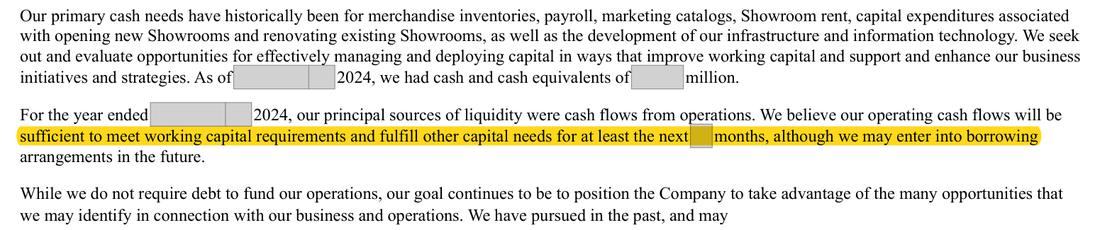
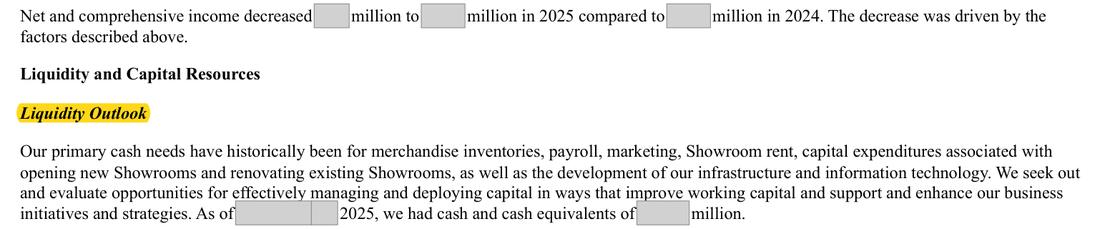
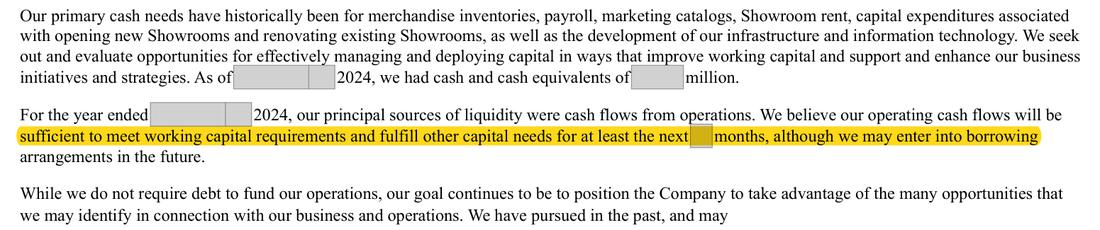
The liquidity section names 'Showroom rent' among the company's cash needs and concludes that operating cash flows will suffice 'for at least the next 12 months'. It does not state the amount or timing of its lease commitments, which the lease note shows as [n] of undiscounted payments ([n] due in 2026) plus about [n] dollars for leases signed but not yet started. Apart from a year-by-year schedule for the new systems program, it gives no analysis of cash requirements and their funding beyond 12 months. The 2024 Form 10-K had the same structure.
The evidence, as filed

What the filing shows, and what the rule requires
| What the filing shows | What the rule requires |
|---|---|
Liquidity Outlook gives a 12-month sufficiency statement only; lease obligations are mentioned as 'Showroom rent' with no amount, timing or cross-reference; the only multi-year figures are the systems program outflows (about [n] dollars in 2026 and [n] dollars in 2027). The lease note shows total lease payments of [n] and [n] dollars of leases not yet commenced. | A short-term and a separate long-term analysis of cash requirements, specifying the material known contractual obligations by type and time period (lease payments by year or period, leases not yet commenced, the systems program already described), and the sources expected to meet them. |
| What we checked. Item 7 liquidity, credit facility, cash-flow and capital expenditure sections; lease note maturity table and unstarted leases; commitments note; the 2024 Form 10-K liquidity section. | |
The rule
Regulation S-K Item 303(b)(1), liquidity and capital resources
Analyze the registrant's ability to generate and obtain adequate amounts of cash to meet its requirements and its plans for cash in the short-term (i.e., the next 12 months from the most recent fiscal period end required to be presented) and separately in the long-term (i.e., beyond the next 12 months). The discussion should analyze material cash requirements from known contractual and other obligations. Such disclosures must specify the type of obligation and the relevant time period for the related cash requirements.
Version: Text in force at the date of this review · Source: Regulation S-K, 17 CFR 229.303(b)(1), as amended by Release 33-10890 (2020)
Regulation S-K Item 303(b), Instruction 4
For the liquidity and capital resources disclosure, discussion of material cash requirements from known contractual obligations may include, for example, lease obligations, purchase obligations, or other liabilities reflected on the registrant's balance sheet.
Version: Text in force at the date of this review · Source: Regulation S-K, 17 CFR 229.303, Instructions to paragraph (b), as amended by Release 33-10890 (2020)
Why it applies here. Item 303(b)(1) requires the analysis separately for the next 12 months and beyond, and states that the disclosure 'must specify the type of obligation and the relevant time period'; Instruction 4 names lease obligations as the first example. The systems-program schedule shows the company can give such a time-phased analysis, but it covers a cash need of a few tens of millions while the lease commitments, many times larger, are not analyzed or even cross-referred. The lease note's table does not discharge the MD&A requirement on its own because the MD&A neither analyses it nor refers to it, and the not-yet-commenced leases sit outside the balance sheet altogether. The 2020 amendments removed the contractual-obligations table, not the obligation to discuss material cash requirements.
Why it matters
Investors are not shown in the MD&A the company's largest fixed cash commitment, which grows with each Showroom opening, or management's view of liquidity beyond one year.
Exposure
A staff comment letter requesting expanded liquidity disclosure in future filings; no fine applies.
Our workings
the liquidity section lists 'Showroom rent' among primary cash needs and states that operating cash flows will meet requirements 'for at least the next 12 months'. It quantifies the new systems program year by year (p.49: about [n] dollars in 2026 and [n] dollars in 2027, tapering in 2028) and the 2026 capital expenditure range, but gives no lease amount and no statement on liquidity beyond 12 months. The lease note shows undiscounted payments of [n] in 2026 and [n] in total, and leases not yet commenced with minimum rentals of about [n] dollars.
payments due after 2026 are [n] - [n] = [n].
| Lease cash requirement | Thousand dollars |
|---|---|
| Due in 2026 (operating and finance) | [n] |
| Due after 2026: [n] - [n] | [n] |
| Total undiscounted lease payments | [n] |
| Leases signed, not yet commenced (minimum rentals) | [n] dollars |
| Discussed in MD&A liquidity | None of the above |
Management’s best defense, and our reply
Management would say the lease maturity table in Note 7 already gives the amounts by year, that Instruction 3 discourages duplicating the notes, and that the debt-free balance sheet, [n] dollars of cash and an undrawn revolver make liquidity a non-issue. It could add that 'Showroom rent' is named as a primary cash need and that the multi-year systems schedule is a long-term analysis. However, Item 303(b)(1) requires the MD&A itself to analyze material cash requirements by type and period and to address the long term separately; a cross-reference with analysis would satisfy Instruction 3, but the section has neither for leases, its largest obligation, and the [n] dollars of unstarted leases appear only in a note sentence.
The fix
- Add a 'Material Cash Requirements' paragraph: 'As of [date] our lease obligations totalled [n] dollars, of which [n] dollars is due in 2026 (Note 7); we have also signed leases not yet commenced with minimum rentals of about [n] dollars. We expect to fund these from operating cash flows ...', with a separate long-term statement.
Evidence relied on
| # | What it shows | Type | Where |
|---|---|---|---|
| 1 | rent is named as a cash need with no amount or timing | Document | Form 10-K 2025, page 48 |
| 2 | the sufficiency analysis covers the next 12 months only | Document | Form 10-K 2025, page 48 |
| 3 | the only multi-year cash requirement the liquidity section quantifies is the systems program | Document | Form 10-K 2025, page 49 |
| 4 | lease payments due within 12 months | Document | Form 10-K 2025, page 74 |
| 5 | total undiscounted lease payments | Document | Form 10-K 2025, page 74 |
| 6 | leases signed but not yet commenced, outside the balance sheet | Document | Form 10-K 2025, page 74 |
| 7 | the 2024 Form 10-K had the same 12-month-only analysis | Document | Form 10-K 2024 (prior year), page 51 |
Absence check
- Document
- Form 10-K 2025
- Where it would appear
- Liquidity Outlook
- What is missing
- the amount and timing of lease obligations (or a cross-reference to them), and a long-term view of how cash requirements will be met
- Pages looked at
- p.42-52 (Item 7)
- Result
- 'material cash requirement' and 'beyond the next 12 months' do not appear anywhere; 'contractual obligation' hits only p.28, [n] and [n] (privacy risk factors); 'lease obligation' hits p.24 (a risk factor on lease burden) and p.61, [n] and [n] (accounting policy and supplemental lease notes), none of them in the liquidity analysis; 'long-term' hits in Item 7 relate to lease liabilities in cash-flow wording, not a long-term liquidity analysis.
Prepared by Pramanex from the company’s public SEC filings, without the company’s involvement, to show how a 10-K Pre-filing Check reads. The company is not named, and nothing on this page is a statement about any identifiable company. Observations are not an audit, review or other attestation or assurance engagement, and not legal advice. An SEC-style question is a question, not a conclusion.
Want this on your own 10-K, before you file?
Start with three free findings on your latest 10-K, or book a fixed-price 10-K Pre-filing Check.
Your next 10-K will be in draft before the audit is done.
Have it read before you file.
Start with three free findings on your latest 10-K, or book a fixed-price 10-K check. Drafts only under NDA, inside your insider trading policy.