4.02 Adjusted EBITDA is said to remove 'non-recurring items', but its adjustments are equity compensation and asset-disposal results that recur every year
Company E · a US-listed home furnishings retailer · Compliance or disclosure gap
In brief
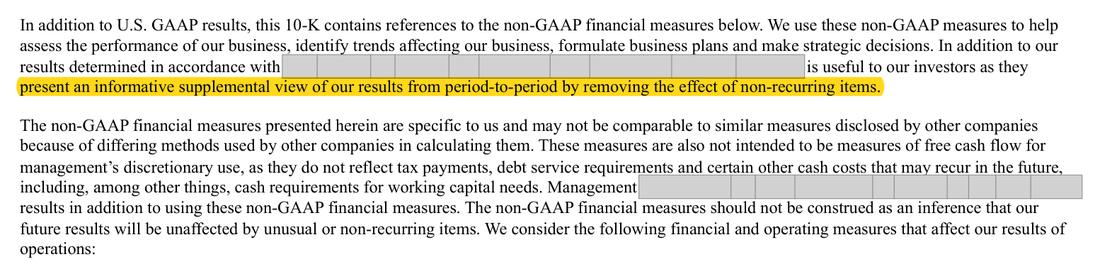
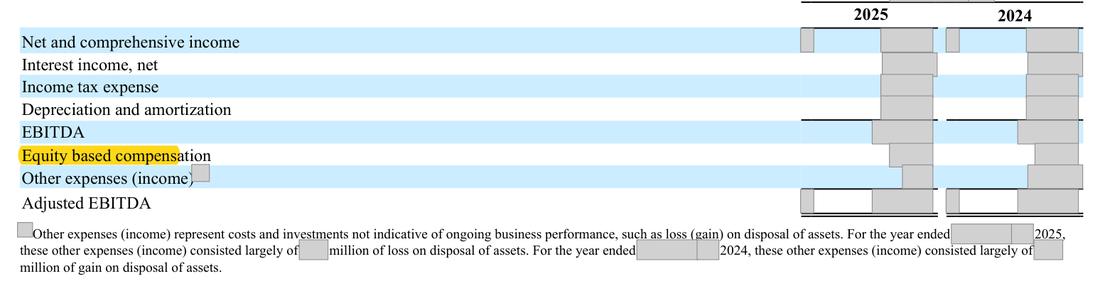
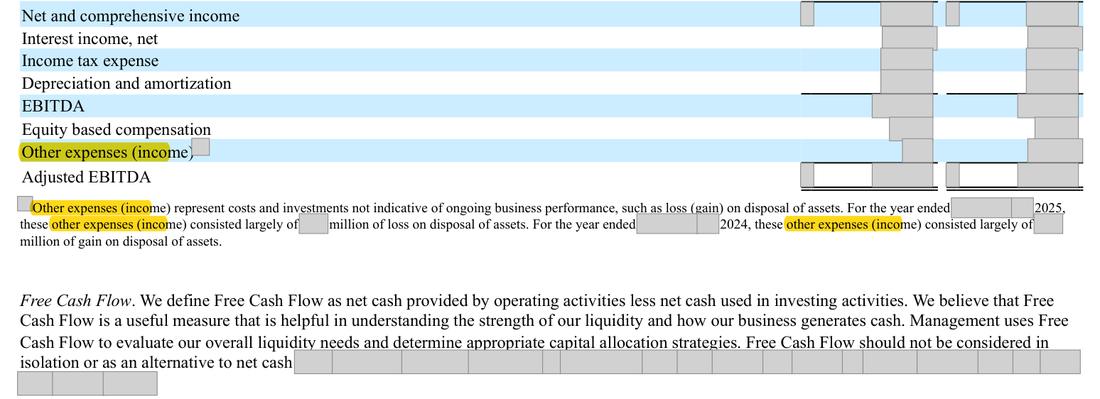
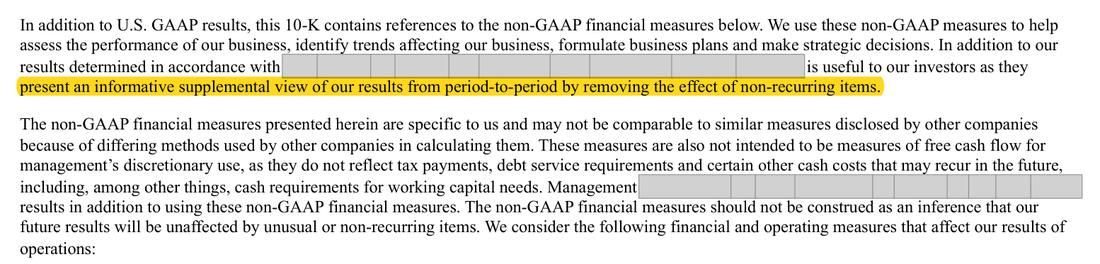
The 10-K says its non-GAAP financial measures are useful because they remove 'the effect of non-recurring items'. The only adjustments from EBITDA to adjusted EBITDA are equity based compensation ([n] in 2025, [n] in 2024) and other expenses (income) driven by asset-disposal gains and losses. Both recur: equity compensation was charged in each of the last three years and disposal results arose in both 2024 and 2025. The 2024 Form 10-K used the same sentence.
The evidence, as filed
What the filing shows, and what the rule requires
| What the filing shows | What the rule requires |
|---|---|
Usefulness statement: measures present a view 'by removing the effect of non-recurring items'; reconciliation adjusts for equity based compensation [n] and other expenses (income) [n], of which only [n] is identified as a loss on disposal. | Adjustments described for what they are (non-cash equity compensation; gains and losses on asset disposals) with no 'non-recurring' label, a usefulness statement specific to each measure, and the composition of 'other expenses (income)' explained in full. |
| What we checked. MD&A non-GAAP section and reconciliation; cash-flow statement for the recurrence of the adjusted items; the 2024 Form 10-K; the year-end earnings release furnished on Form 8-K on [date]. | |
The rule
Regulation S-K Item 10(e)(1)(ii)(B)
Adjust a non-GAAP performance measure to eliminate or smooth items identified as non-recurring, infrequent or unusual, when the nature of the charge or gain is such that it is reasonably likely to recur within two years or there was a similar charge or gain within the prior two years;
Version: Text in force at the date of this review · Source: Regulation S-K, 17 CFR 229.10(e), as adopted by Release 33-8176 (2003)
Regulation S-K Item 10(e)(1)(i)(C)
A statement disclosing the reasons why the registrant's management believes that presentation of the non-GAAP financial measure provides useful information to investors regarding the registrant's financial condition and results of operations;
Version: Text in force at the date of this review · Source: Regulation S-K, 17 CFR 229.10(e), as adopted by Release 33-8176 (2003)
Why it applies here. Item 10(e)(1)(ii)(B) prohibits adjusting a non-GAAP performance measure to eliminate items identified as non-recurring when a similar charge or gain arose in the prior two years. The staff's non-GAAP interpretations (Question [n]) make clear the prohibition turns on the description: the adjustments themselves may be acceptable, but they may not be called non-recurring. Here every adjusted item recurs within the two-year window, so the description is the breach. The generic usefulness statement also covers all measures at once rather than each measure, which the staff frequently questions under Item 10(e)(1)(i)(C).
Why it matters
Describing recurring charges as non-recurring is a prohibited practice for non-GAAP measures in filed documents; non-GAAP presentation is the most frequent staff comment theme.
Exposure
A staff comment letter and an undertaking to revise the description in future filings and earnings releases; no fine applies.
Our workings
the 10-K presents EBITDA and adjusted EBITDA and adjusted EBITDA as a percentage of net revenue. The usefulness statement says the measures are useful because they remove 'the effect of non-recurring items'. The reconciliation adds back equity based compensation of [n] (2024: [n]) and other expenses (income) of [n] (2024: ([n]) thousand), described as costs not indicative of ongoing performance, 'such as loss (gain) on disposal of assets'. The cash-flow statement shows equity based compensation of [n] in 2025, 2024 and 2023 and disposal results in 2025 ([n]) and 2024 (([n])).
total adjustments [n] + [n] = [n]; the 2025 'other' line exceeds the identified disposal loss by [n] - [n] = [n], which is not explained.
| Adjusted item | 2025 | 2024 | 2023 | Recurs within two years? |
|---|---|---|---|---|
| Equity based compensation (p.46, [n]) | [n] | [n] | [n] | Yes, every year |
| Loss (gain) on disposal of assets | [n] | ([n]) | nil | Yes, 2024 and 2025 |
| Total adjustments 2025: [n] + [n] = [n] | ||||
| Unexplained part of 'other' 2025: [n] - [n] = [n] |
Management’s best defense, and our reply
The company could argue that the sentence is a general description of why non-GAAP measures are offered, that the reconciliation itself describes each adjustment accurately, and that the same section warns readers that future results may include unusual or non-recurring items. It could add that excluding equity compensation is common and accepted by the staff. However, the 10-K expressly ties usefulness to 'removing the effect of non-recurring items', and the staff's interpretation is that the prohibition turns on that description; the adjustments can stay, but the label cannot, because each adjusted item recurred within two years.
The fix
- Replace the sentence with a measure-specific statement, e.g. 'Adjusted EBITDA excludes non-cash equity based compensation and gains and losses on the disposal of assets, which management excludes when comparing operating performance between periods', and list every component of 'other expenses (income)'.
Evidence relied on
| # | What it shows | Type | Where |
|---|---|---|---|
| 1 | the usefulness statement describes the adjustments as non-recurring items | Document | Form 10-K 2025, page 44 |
| 2 | equity based compensation is added back in both years | Document | Form 10-K 2025, page 46 |
| 3 | other expenses (income) adjusted in both years | Document | Form 10-K 2025, page 46 |
| 4 | the 2025 'other' adjustment is only partly identified | Document | Form 10-K 2025, page 46 |
| 5 | equity compensation was charged in each of the three years | Document | Form 10-K 2025, page 59 |
| 6 | disposal results arose in 2025 and 2024 | Document | Form 10-K 2025, page 59 |
| 7 | the 2024 Form 10-K used the same description | Document | Form 10-K 2024 (prior year), page 48 |
| 8 | the purpose statement describes the non-GAAP measures as removing non-recurring items | Document | Form 10-K 2025, page 44 |
| 9 | equity-based compensation adjusted in both years | Document | Form 10-K 2025, page 46 |
| 10 | EBITDA before the two adjustments | Document | Form 10-K 2025, page 46 |
| 11 | adjusted EBITDA after the two adjustments | Document | Form 10-K 2025, page 46 |
| 12 | 2025 other expenses mainly a loss on asset disposals | Document | Form 10-K 2025, page 46 |
| 13 | prior-year Form 10-K: equity-based compensation also adjusted for 2023 | Document | Form 10-K 2024 (prior year), page 49 |
| 14 | prior-year Form 10-K used the same purpose statement | Document | Form 10-K 2024 (prior year), page 48 |
Prepared by Pramanex from the company’s public SEC filings, without the company’s involvement, to show how a 10-K Pre-filing Check reads. The company is not named, and nothing on this page is a statement about any identifiable company. Observations are not an audit, review or other attestation or assurance engagement, and not legal advice. An SEC-style question is a question, not a conclusion.
Want this on your own 10-K, before you file?
Start with three free findings on your latest 10-K, or book a fixed-price 10-K Pre-filing Check.
Your next 10-K will be in draft before the audit is done.
Have it read before you file.
Start with three free findings on your latest 10-K, or book a fixed-price 10-K check. Drafts only under NDA, inside your insider trading policy.