4.01 The only critical accounting estimate in the MD&A repeats the impairment policy note and gives no uncertainty, change or sensitivity analysis
Company E · a US-listed home furnishings retailer · Compliance or disclosure gap
In brief
The management's discussion and analysis (MD&A) names one critical accounting estimate, the impairment of long-lived assets, and describes it in words that repeat the accounting-policy note almost sentence for sentence. It does not say why the estimate is uncertain, which assumptions drive it, how it has changed or how sensitive the carried amounts are. The same text appeared in the 2024 Form 10-K.
The evidence, as filed
What the filing shows, and what the rule requires
| What the filing shows | What the rule requires |
|---|---|
Critical Accounting Policies and Estimates describes the impairment test for long-lived assets in policy terms only; the key sentence is the same as Note 2. No uncertainty, change or sensitivity information is given for property of [n] and leased assets of [n]. | For each critical accounting estimate: why it is subject to uncertainty (for example the [name] cash-flow forecasts and discount rates), how much the estimate or its assumptions changed over a relevant period, and the sensitivity of the carried amounts, to the extent material and reasonably available, written to supplement rather than repeat the policy note. |
| What we checked. MD&A pages p.42-52 read in full; Note 2 policy; balance amounts in Notes 3 and 7 (p.71, [n]); the 2024 Form 10-K MD&A; the whole 10-K searched for sensitivity language. | |
The rule
Regulation S-K Item 303(b)(3), critical accounting estimates
This information should include why each critical accounting estimate is subject to uncertainty and, to the extent the information is material and reasonably available, how much each estimate and/or assumption has changed over a relevant period, and the sensitivity of the reported amount to the methods, assumptions and estimates underlying its calculation.
Version: Text in force at the date of this review · Source: Regulation S-K, 17 CFR 229.303(b)(3), as amended by Release 33-10890 (2020)
Regulation S-K Item 303(b), Instruction 3
For critical accounting estimates, this disclosure must supplement, but not duplicate, the description of accounting policies or other disclosures in the notes to the financial statements.
Version: Text in force at the date of this review · Source: Regulation S-K, 17 CFR 229.303, Instructions to paragraph (b), as amended by Release 33-10890 (2020)
Why it applies here. Item 303(b)(3) asks for the reason each estimate is uncertain without the separate 'material and reasonably available' condition it attaches to the change and sensitivity elements (and an estimate the company itself designates as critical is material by the paragraph's own definition), and for change and sensitivity information where material and reasonably available; Instruction 3 to Item 303(b) says the disclosure must supplement, not duplicate, the policy note. A description that restates the policy meets neither limb. The Commission's 2020 MD&A release and later staff comment letters treat a critical-estimate section that copies the policy note as the standard failure under this paragraph.
Why it matters
The section does not tell investors how exposed the Showroom asset base is to a change in forecasts, which is the purpose of the critical-estimate disclosure; critical-estimate sections that repeat the policy note are a recurring staff comment theme.
Exposure
A staff comment letter asking for revised disclosure in future filings is the realistic consequence; no fine applies. The staff's 2025 review of the 2024 Form 10-K, which carried the same text, raised only a revenue-analysis comment; that is not a clearance of this point, but it lowers the likelihood of a comment.
Our workings
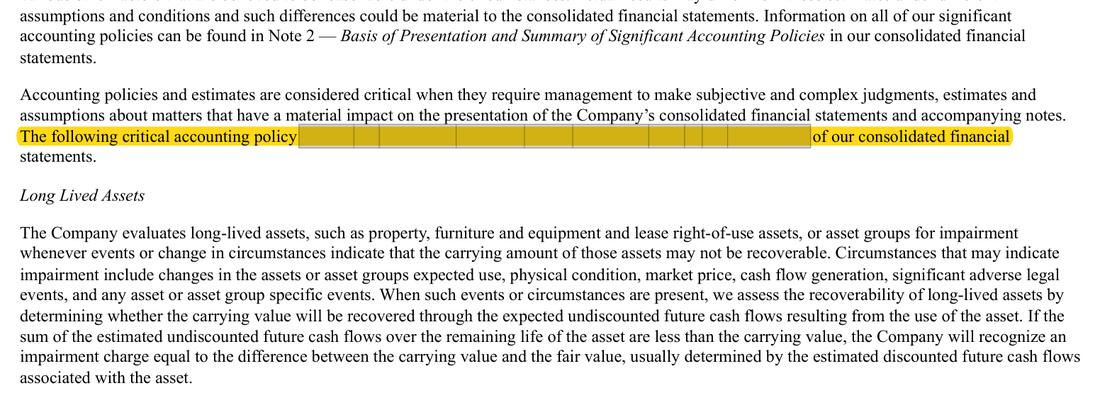
Item 7 lists a single critical accounting estimate, long-lived assets. Its text describes the indicators, the undiscounted cash-flow recoverability test and the fair-value measurement of a loss. Note 2 contains the same test in the same words, and states that no long-lived asset impairment was recorded in 2025, 2024 or 2023. The 2024 Form 10-K carried the identical critical-estimate text.
the assets exposed to the estimate are property, furniture and equipment of [n] and leased assets of [n], together [n] (workings).
| Item 303(b)(3) element | Where given | Status |
|---|---|---|
| Estimate identified: impairment of long-lived assets | p.51 | Given |
| Why the estimate is uncertain (key assumptions) | Nowhere in the 10-K | Absent |
| How the estimate or assumptions changed over a relevant period | Nowhere in the 10-K | Absent |
| Sensitivity of the carried amounts | Nowhere in the 10-K | Absent |
| Supplements rather than duplicates the policy note | p.51 repeats p.67 | Absent |
| Assets exposed: [n] + [n] = [n] | p.71, [n] | Computed |
Management’s best defense, and our reply
Management would say no impairment was recorded in 2025, 2024 or 2023, so there was no change in the estimate to report and no quantitative sensitivity was material and reasonably available; the quantitative limbs of Item 303(b)(3) are expressly conditional. It may add that the indicators and the [name] test are themselves the qualitative description of the uncertainty. However, the reason the estimate is uncertain is not separately conditioned in the way the change and sensitivity elements are, and Instruction 3 forbids repeating the policy note, which is what the section does; even with no impairment the company can state its key assumptions and how close its asset groups came to failing the test.
The fix
- Rewrite the estimate for the next Form 10-K: state the key assumptions (Showroom sales growth, contribution margin, discount rate), whether any asset group showed indicators in the year, how the assumptions moved, and a sensitivity, e.g. 'a 10% fall in forecast Showroom cash flows would not result in an impairment of any asset group' or the amount it would.
Evidence relied on
| # | What it shows | Type | Where |
|---|---|---|---|
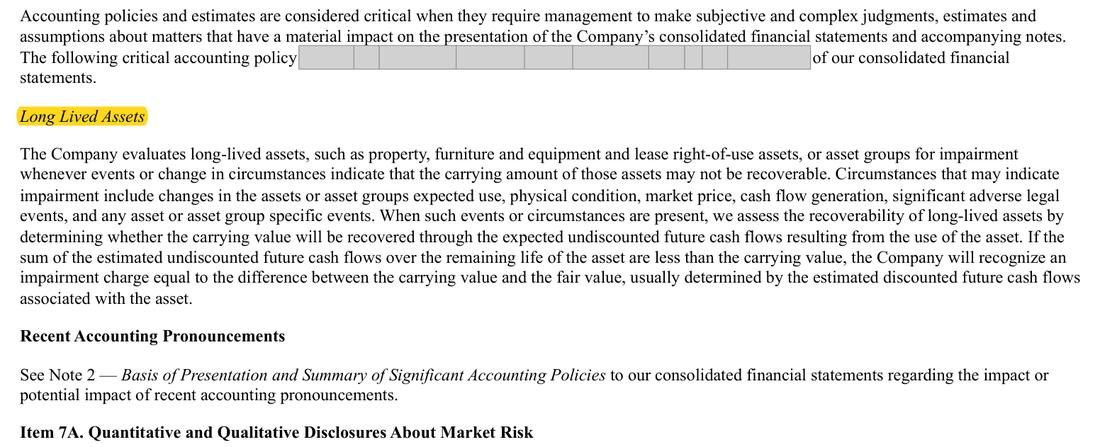
| 1 | MD&A names a single critical accounting estimate | Document | Form 10-K 2025, page 51 |
| 2 | the critical-estimate text describes the recoverability test only | Document | Form 10-K 2025, page 51 |
| 3 | Note 2 policy carries the same sentence: the MD&A text duplicates the note | Document | Form 10-K 2025, page 67 |
| 4 | no impairment recorded in three years; the MD&A does not say how close any asset group came | Document | Form 10-K 2025, page 67 |
| 5 | property carried at [n] is subject to the estimate | Document | Form 10-K 2025, page 71 |
| 6 | right-of-use assets of [n] are subject to the estimate | Document | Form 10-K 2025, page 73 |
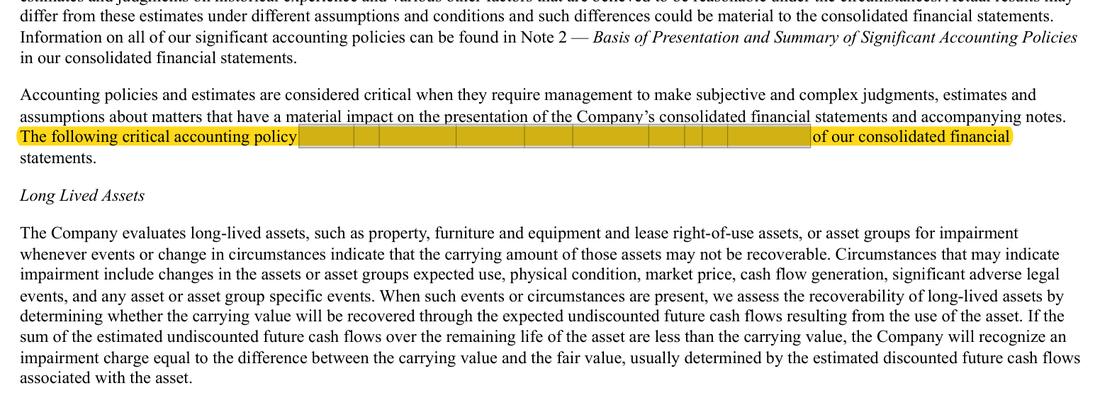
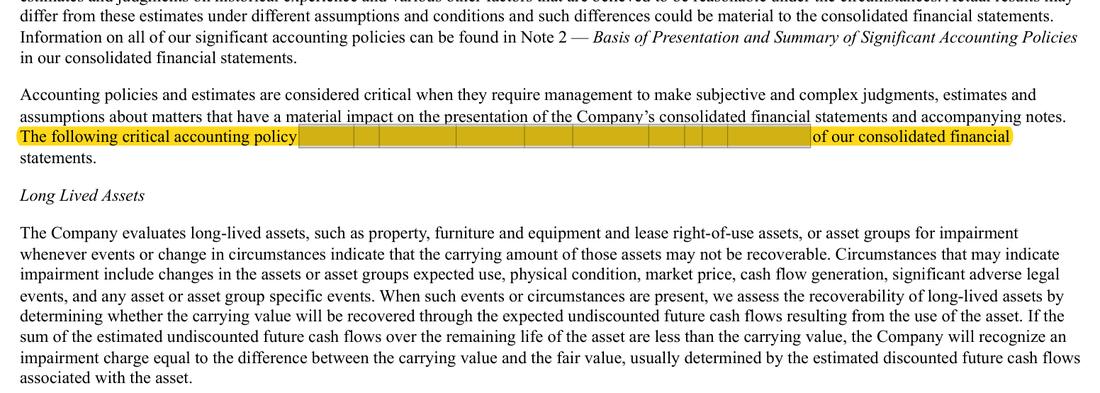
| 7 | the 2024 Form 10-K carried the same single critical estimate in the same words | Document | Form 10-K 2024 (prior year), page 54 |
| 8 | One critical estimate is named | Document | Form 10-K 2025, page 51 |
| 9 | The critical estimate text: the impairment steps | Document | Form 10-K 2025, page 51 |
| 10 | Note 2 policy: the same sentence | Document | Form 10-K 2025, page 67 |
| 11 | No impairment recognized in the three years | Document | Form 10-K 2025, page 67 |
| 12 | Operating right-of-use assets | Document | Form 10-K 2025, page 56 |
| 13 | Financing right-of-use assets | Document | Form 10-K 2025, page 56 |
| 14 | Property, furniture and equipment | Document | Form 10-K 2025, page 56 |
| 15 | Total assets | Document | Form 10-K 2025, page 56 |
Absence check
- Document
- Form 10-K 2025
- Where it would appear
- Long Lived Assets
- What is missing
- why the impairment estimate is uncertain, the key assumptions, how they changed and the sensitivity of the carried amounts
- Pages looked at
- p.42-52 (Item 7) and p.66-67 (Note 2)
- Result
- 'reasonably possible' hits only p.66, in the goodwill policy of Note 2 (fair value of the single reporting unit), not the long-lived asset estimate; 'sensitivity', 'hypothetical' and 'headroom' do not appear anywhere in the 10-K.
Absence check
- Document
- Form 10-K 2025
- Where it would appear
- Long Lived Assets
- What is missing
- Why the estimate is subject to uncertainty, its key assumptions, how they changed, and the sensitivity of the carrying amounts (or a statement that no asset group was at risk)
- Pages looked at
- p.51 (critical accounting estimates), p.66-67 (Note 2 long-lived assets)
- Result
- 'sensitivity', 'estimation uncertainty' and 'hypothetical' have no hit anywhere in the 10-K; 'Long Lived Assets' hits only the heading on p.51; 'asset group' hits the p.51 paragraph itself and the Note 2 policy on p.66-67, which list impairment triggers and the asset-group level but give no uncertainty or sensitivity information.
Prepared by Pramanex from the company’s public SEC filings, without the company’s involvement, to show how a 10-K Pre-filing Check reads. The company is not named, and nothing on this page is a statement about any identifiable company. Observations are not an audit, review or other attestation or assurance engagement, and not legal advice. An SEC-style question is a question, not a conclusion.
Want this on your own 10-K, before you file?
Start with three free findings on your latest 10-K, or book a fixed-price 10-K Pre-filing Check.
Your next 10-K will be in draft before the audit is done.
Have it read before you file.
Start with three free findings on your latest 10-K, or book a fixed-price 10-K check. Drafts only under NDA, inside your insider trading policy.