6.04 Front part, Item 1 and Item 1A: nine drafting slips (a Form 10-Q heading, a wrong contents page, typing slips and an accolade count)
Company D · a US-listed cloud communications software company · Drafting slip
In brief
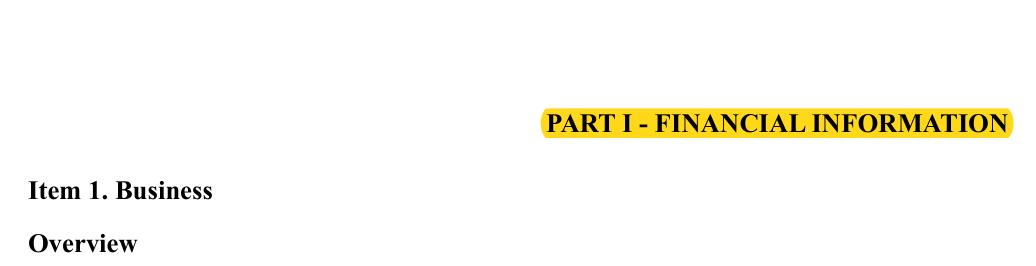
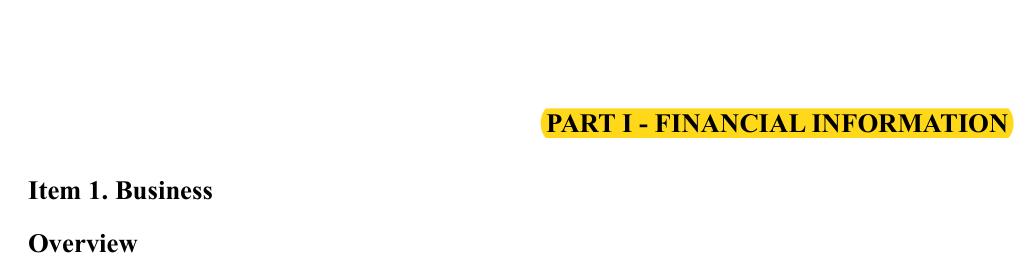
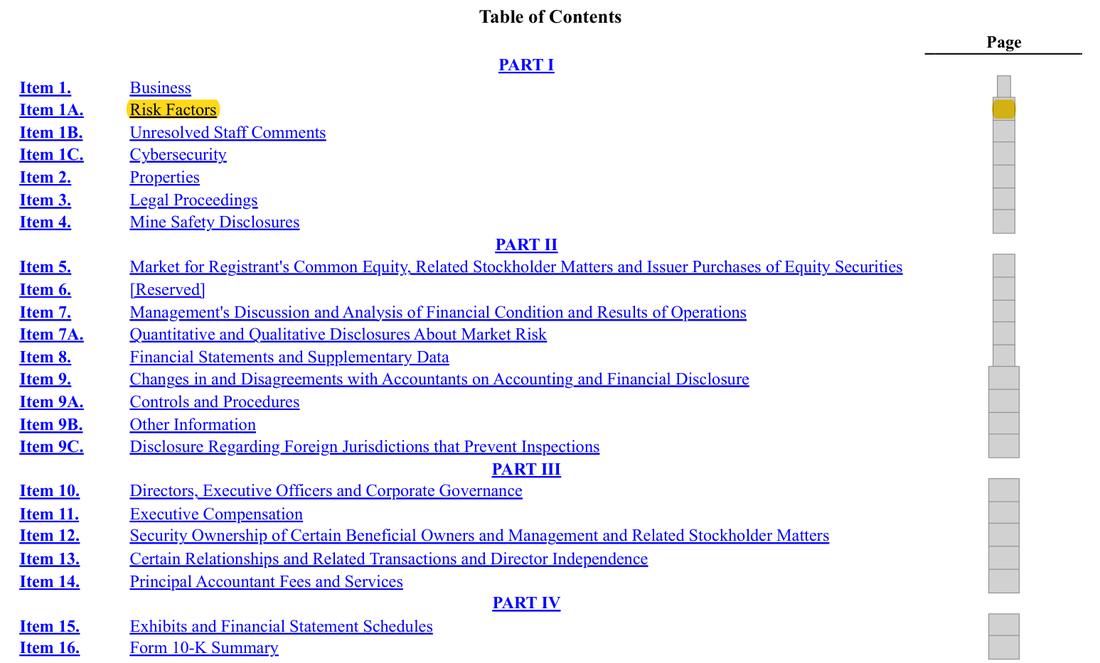
Part I of this annual report is headed 'PART I - FINANCIAL INFORMATION', the caption Form 10-Q uses for its financial-statement part; Part I of a Form 10-K is Business, Risk Factors and related items. The contents page sends the reader to page 18 for Item 1A, which starts on page 19. Three typing slips and a marketing count that does not follow from last year's report follow, and Item 1A adds three more slips: the audited annual statements called 'unaudited condensed' (new this year), a repeated word and a stray full stop.
The evidence, as filed
What the filing shows, and what the rule requires
| What the filing shows | What the rule requires |
|---|---|
Part I headed 'PART I - FINANCIAL INFORMATION' (both years); contents page gives Item 1A at page 18, heading printed on page 19; '(e.g.0, rules around suballocation'; '[wording masked]'; '...financial condition then we may be unable to increase...'; customer-review-platform Leader 'for [n] consecutive quarters' against [n] in the prior-year 10-K; Item 1A: 'the unaudited condensed consolidated financial statements' (p.46; the prior-year 10-K read 'the consolidated financial statements'), 'require that that personal data' (p.34, both years) and a mid-list bullet ending in a full stop (p.27; the prior-year list had a semicolon). | 'PART I'; Item 1A at page 19; '(e.g., rules around suballocation'; 'the General Data Protection Regulation and the ePrivacy Directive'; '...financial condition, and we may be unable to increase...'; a review-platform count that follows on from the prior-year figure, or a note of how it is counted; 'the consolidated financial statements'; 'require that personal data'; a semicolon at the end of the bullet. |
| What we checked. Every contents-page reference against the page where the Item heading is printed; the Part I heading against the Form 10-K structure; each sentence on the page images of both years' reports. | |
Why it matters
None of the slips changes a required disclosure. Together they read as carried-forward text that was not proofread against the current-year layout, which a careful reader of the front part notices first.
Exposure
Drafting only; no regulatory consequence.
Our workings
the heading on p.6 reads 'PART I - FINANCIAL INFORMATION' in this report and in the prior-year report; Form 10-K Part I contains Items 1 to 4 (business, risk factors, unresolved staff comments, cybersecurity, properties, legal proceedings, mine safety), and 'Financial Information' is the caption of Part I of Form 10-Q.
the contents page gives Item 1A at page 18; p.18 is the end of Item 1 (Available Information) and Item 1A begins at the top of p.19. The prior-year report's contents page also gave [n], and there Item 1A did start on page 18, so the reference was not updated when Item 1 grew.
the European regulatory paragraph prints 'e.g.0' and calls the GDPR 'the General Data Protection' without 'Regulation' (the latter in both years).
a risk factor on p.22 runs two clauses together without a conjunction (both years).
the customer-review-platform sentence reads [n] consecutive quarters; the prior-year [n], filed a year earlier, read [n].
a run of consecutive quarters should lengthen by about four in one year, not six; either count may be wrong or the counting basis changed.
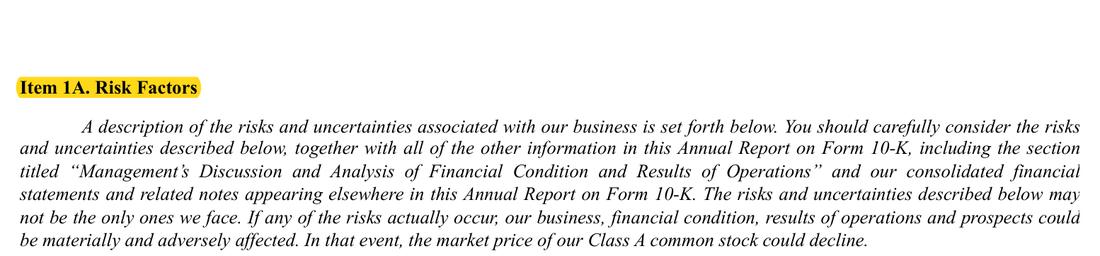
Item 1A adds three more. The critical-accounting-estimates risk factor on p.46 refers to 'the unaudited condensed consolidated financial statements', Form 10-Q wording for statements that in this report are audited and complete; the prior-year 10-K read 'the consolidated financial statements' in the same sentence. The data-protection risk factor on p.34 reads 'require that that personal data' (both years). In the international-risks list on p.27 a bullet in the middle ends with a full stop instead of a semicolon (the prior-year list had a semicolon). All nine are drafting matters; no required disclosure is affected.
Management’s best defense, and our reply
Management would say these are cosmetic: the contents entries are hyperlinks that take an online reader to the right place whatever page number is printed, the Part I heading is a template legacy that no one reads as a claim, and the review-platform count is marketing text outside any disclosure requirement. That is right as to consequence, which is why each is listed only as a drafting slip; the corrections still cost minutes and remove avoidable errors from the front of the filing.
The fix
- Change the Part I heading to 'PART I'; correct the contents entry for Item 1A to page 19; read 'e.g.,' and 'General Data Protection Regulation'; insert ', and' before 'then we may be unable'; confirm the review-platform count from the platform's report history and correct it or state the basis.
Evidence relied on
| # | What it shows | Type | Where |
|---|---|---|---|
| 1 | Part I of the Form 10-K carries the Form 10-Q caption 'Financial Information' | Document | Form 10-K 2025, page 6 |
| 2 | the same heading in the prior-year 10-K | Document | Form 10-K 2024 (prior year), page 6 |
| 3 | contents page gives Item 1A at page 18 | Document | Form 10-K 2025, page 1 |
| 4 | the Item 1A heading is printed at the top of page 19 | Document | Form 10-K 2025, page 19 |
| 5 | typing slip 'e.g.0' | Document | Form 10-K 2025, page 17 |
| 6 | the word 'Regulation' is missing after 'General Data Protection' | Document | Form 10-K 2025, page 18 |
| 7 | two clauses run together without a conjunction | Document | Form 10-K 2025, page 22 |
| 8 | review-platform count in this report: [n] | Document | Form 10-K 2025, page 12 |
| 9 | review-platform count in the prior-year 10-K: [n] | Document | Form 10-K 2024 (prior year), page 12 |
| 10 | Quarterly-report wording in the critical-accounting-estimates risk factor describes the audited annual statements as unaudited and condensed | Document | Form 10-K 2025, page 46 |
| 11 | The prior-year Form 10-K used the correct wording in the same sentence, so the slip is new this year | Document | Form 10-K 2024 (prior year), page 45 |
| 12 | Duplicated word 'that' in the data-protection risk factor (also in the prior-year Form 10-K) | Document | Form 10-K 2025, page 34 |
| 13 | A bullet in the middle of the international-risks list ends with a full stop instead of a semicolon (the prior-year list had a semicolon) | Document | Form 10-K 2025, page 27 |
Prepared by Pramanex from the company’s public SEC filings, without the company’s involvement, to show how a 10-K Pre-filing Check reads. The company is not named, and nothing on this page is a statement about any identifiable company. Observations are not an audit, review or other attestation or assurance engagement, and not legal advice. An SEC-style question is a question, not a conclusion.
Want this on your own 10-K, before you file?
Start with three free findings on your latest 10-K, or book a fixed-price 10-K Pre-filing Check.
Your next 10-K will be in draft before the audit is done.
Have it read before you file.
Start with three free findings on your latest 10-K, or book a fixed-price 10-K check. Drafts only under NDA, inside your insider trading policy.