4.08 Both years: liquidity and capital resources gives a 12-month view only, with no separate long-term analysis of how the [amount] of 2028 convertible notes and the early end of the credit facility will be met
Company D · a US-listed cloud communications software company · SEC-style question
In brief
In both years management's discussion and analysis (MD&A) concludes that cash and operating cash flow will cover needs for at least the next 12 months and gives no separate conclusion beyond that period. At [date] the [amount] 2028 convertible notes, due [date] and intended to be settled in cash, exceeded cash and marketable securities of [amount], and the [amount] credit facility ends 91 days before that maturity while any of those notes are outstanding. MD&A says the company may repurchase the notes and may need outside financing, but does not analyze the long-term position separately. Does management consider that this meets the separate long-term analysis that Item 303(b)(1) of Regulation S-K asks for?
The evidence, as filed
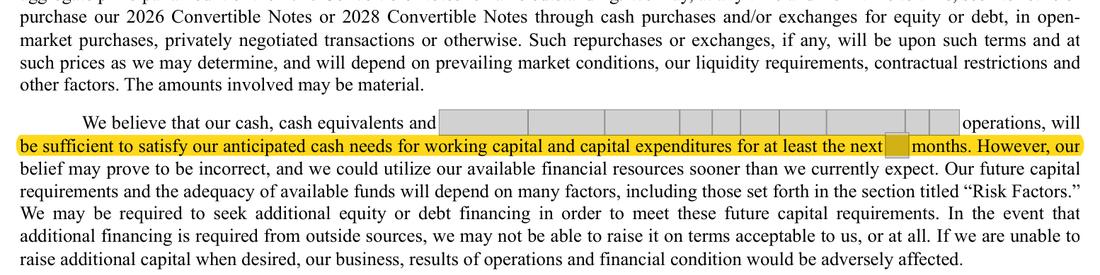
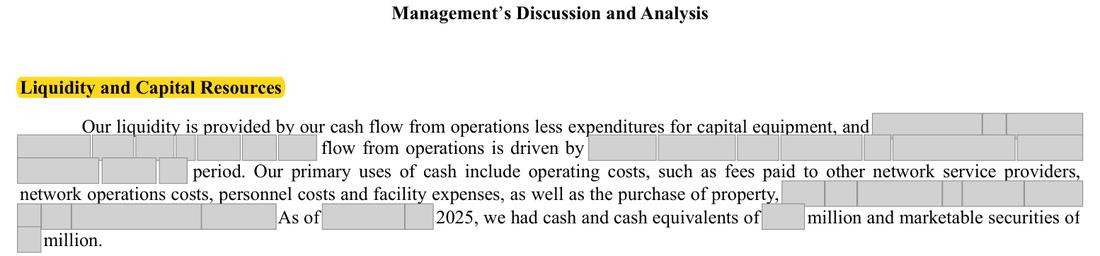
2 further page extracts: screenshot withheld to protect the company’s identity. The rows below say what each shows.
What the filing shows, and what the rule requires
| What the filing shows | What the rule requires |
|---|---|
A 12-month sufficiency statement only; the [amount] of convertible notes listed among principal commitments with a cross-reference to the notes; generic statements that the notes may be repurchased and that outside financing may be needed; no analysis of how the [amount] due [date] compares with [amount] of cash and marketable securities, and no mention in MD&A that the credit facility would end on [date] if those notes were still outstanding | A separate long-term (beyond 12 months) liquidity analysis: the [date] maturity of the [amount] notes, the intended sources of repayment (cash on hand, operating cash flow, repurchases, refinancing or equity), and the credit facility's earlier end date while those notes remain outstanding |
The rule
Regulation S-K Item 303(b)(1) (liquidity and capital resources)
Analyze the registrant's ability to generate and obtain adequate amounts of cash to meet its requirements and its plans for cash in the short-term (i.e., the next 12 months from the most recent fiscal period end required to be presented) and separately in the long-term (i.e., beyond the next 12 months). The discussion should analyze material cash requirements from known contractual and other obligations. Such disclosures must specify the type of obligation and the relevant time period for the related cash requirements.
Version: Text in force at the date of this review · Source: 17 CFR 229.303(b)(1), Regulation S-K, as amended by Release 33-10890 (eCFR current text)
Why it applies here. Item 303(b)(1) asks for the short-term analysis and, separately, the long-term analysis. The largest known cash requirement beyond the next 12 months is listed and its possible routes are named in general terms, but it is not analyzed against the company's resources, and MD&A does not say that the committed facility ends before it. Whether the general statements amount to the required long-term analysis is a matter of judgment, which is why this is put as a question.
Why it matters
Readers are not given management's analysis of how a cash maturity larger than year-end liquid resources will be met, at a time when the committed facility would end first; long-term liquidity analysis is a recurring subject of staff comments on MD&A.
Exposure
Possible staff comment asking for a separate long-term liquidity analysis in future filings; no fine
Our workings
the liquidity section states that cash, marketable securities and operating cash flow will be sufficient for at least the next 12 months and lists principal future commitments including [amount] of convertible notes, with a cross-reference to the debt note. The same page says the company may seek to retire or purchase the 2026 or 2028 notes for cash or in exchange for equity or debt, and that it may be required to seek additional equity or debt financing to meet future capital requirements. Item 7A gives cash of [amount], marketable securities of [amounts] of 2028 notes outstanding. Note 7 states that the 2028 notes mature on [date], that the company intends to settle principal in cash, and that the [amount] credit facility matures on the earlier of [date] and 91 days before the scheduled maturity of any outstanding 2028 notes. The 2024 Form 10-K had the same 12-month-only structure (Form 10-K 2024 (prior year) p.71).
cash and marketable securities [amount] against [amount] due in [date], a [amount] difference before future operating cash flow; the facility end date, if any 2028 notes remain outstanding, is [date].
| Item | Computation | Result |
|---|---|---|
| Cash and marketable securities at [date] ($ million) | [n] + 8 | [n] |
| 2028 notes principal less cash and marketable securities ($ million) | [n] - [n] | [n] |
| Credit facility end date if 2028 notes are outstanding (91 days before [date]) | 31 days (March) + 29 days ([date]) + 31 days (January) = [n] | [date] |
Management’s best defense, and our reply
The company would say that MD&A already tells readers it may repurchase or exchange the 2028 notes for cash, equity or debt in amounts that may be material, and that it may need outside equity or debt financing for future capital requirements; the maturity, the cash-settlement intent and the facility's terms are all in the debt note to which MD&A cross-refers. It would add that the 2028 maturity was more than two years after year-end, that operating cash flow was [amount] in 2025, and that the staff reviewed MD&A in the fiscal 2023 Form 10-K in a letter of [date], commented on other MD&A items but not on liquidity, and completed its review on [date] with the same 12-month structure in place. That defense has merit, so the point is put as a question rather than as a settled omission. However, Item 303(b)(1) asks MD&A itself to analyze the long-term position separately, and general statements that the notes may be repurchased and financing may be needed do not compare the largest known requirement with the resources to meet it; the staff's completed review does not confirm that the disclosure is adequate.
The fix
- If management agrees: add a long-term liquidity paragraph to the next Form 10-K covering each material maturity beyond 12 months (now the convertible notes due 2032), the intended sources of repayment and the end date of the credit facility.
Question for the company
Does management consider that the liquidity section gives the separate long-term analysis Item 303(b)(1) asks for, given the [amount] of 2028 notes due [date] against [amount] of cash and marketable securities and the credit facility's end date 91 days before that maturity; if not, will the next Form 10-K add one?
Evidence relied on
| # | What it shows | Type | Where |
|---|---|---|---|
| 1 | The liquidity analysis covers the next 12 months only | Document | Form 10-K 2025, page 68 |
| 2 | The [amount] of convertible notes is listed among principal commitments, with a cross-reference to the debt note | Document | Form 10-K 2025, page 68 |
| 3 | MD&A says in general terms that the notes may be repurchased or exchanged (the company's best answer) | Document | Form 10-K 2025, page 68 |
| 4 | MD&A says outside financing may be needed, without analyzing the 2028 maturity | Document | Form 10-K 2025, page 68 |
| 5 | Year-end cash and marketable securities | Document | Form 10-K 2025, page 78 |
| 6 | [amount] of 2028 notes outstanding | Document | Form 10-K 2025, page 78 |
| 7 | Maturity date of the 2028 notes | Document | Form 10-K 2025, page 110 |
| 8 | Principal is to be settled in cash | Document | Form 10-K 2025, page 111 |
| 9 | The credit facility ends 91 days before the 2028 notes mature | Document | Form 10-K 2025, page 109 |
| 10 | Size of the credit facility | Document | Form 10-K 2025, page 68 |
| 11 | The 2024 Form 10-K had the same structure: a 12-month statement and a list of commitments, no separate long-term analysis | Document | Form 10-K 2024 (prior year), page 71 |
| 12 | Operating cash flow for 2025, relied on in the company's defense | Document | Form 10-K 2025, page 69 |
Absence check
- Document
- Form 10-K 2025
- Where it would appear
- Liquidity and Capital Resources
- What is missing
- a separate long-term (beyond 12 months) analysis, including how the [amount] due [date] will be met and the credit facility's end date while those notes are outstanding
- Pages looked at
- p.61-77 (Item 7), p.78-79 (Item 7A), p.109-113 (Note 7)
- Result
- '[date]' hits p.50 (a risk factor naming the notes), p.110 (Note 7, the maturity term), p.113 (Note 7, the capped call expiry) and p.128 (exhibit index); '91 days' hits only p.109 (Note 7, the credit facility term); 'refinanc' hits p.19 and [n] (generic risk factors on the ability to refinance); 'beyond the next 12 months' and 'long-term liquidity' have no hits. None of these is an analysis in MD&A of the long-term cash requirement or its funding.
Prepared by Pramanex from the company’s public SEC filings, without the company’s involvement, to show how a 10-K Pre-filing Check reads. The company is not named, and nothing on this page is a statement about any identifiable company. Observations are not an audit, review or other attestation or assurance engagement, and not legal advice. An SEC-style question is a question, not a conclusion.
Want this on your own 10-K, before you file?
Start with three free findings on your latest 10-K, or book a fixed-price 10-K Pre-filing Check.
Your next 10-K will be in draft before the audit is done.
Have it read before you file.
Start with three free findings on your latest 10-K, or book a fixed-price 10-K check. Drafts only under NDA, inside your insider trading policy.