4.09 A risk factor says usage reductions 'may cause' the net retention rate to decline, while MD&A shows it fell from [n]% to [n]% in 2025
Company D · a US-listed cloud communications software company · SEC-style question
In brief
The risk factor on customer retention says that the loss of customers or reductions in their usage 'may cause our net retention rate to decline in the future'. MD&A in the same report gives the net retention rate as [n]% for 2025 against [n]% for 2024, and explains the fall by lower political messaging after the 2024 election. The risk factor carries the prior-year words unchanged and does not say that the decline it describes has happened.
The evidence, as filed

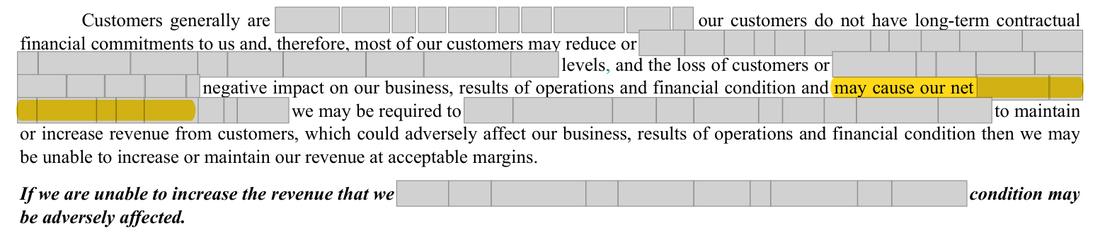
2 further page extracts: screenshot withheld to protect the company’s identity. The rows below say what each shows.
What the filing shows, and what the rule requires
| What the filing shows | What the rule requires |
|---|---|
Risk factor (p.22): usage reductions 'may cause our net retention rate to decline in the future'. MD&A (p.62): net retention rate 'was [n]%, [n]% and [n]%' for 2025, 2024 and 2023, the 2025 fall driven by lower political messaging revenue. | Either the risk factor says that the net retention rate fell to [n]% in 2025 as customers' political-messaging usage fell away, and explains the continuing risk, or management confirms why it regards the 2025 fall as outside the risk described. |
| What we checked. The risk factor in this report and the prior-year report on the page images; the MD&A key performance indicator section and its definition of the rate; the risk-factor summary bullet. | |
The rule
Regulation S-K Item 105(b) (17 CFR 229.105(b))
Concisely explain how each risk affects the registrant or the securities being offered.
Version: Text in force at the date of this review · Source: 17 CFR 229.105, eCFR text as amended by Release 33-10825
Exchange Act Rule 12b-20 (17 CFR 240.12b-20)
there shall be added such further material information, if any, as may be necessary to make the required statements, in the light of the circumstances under which they are made not misleading
Version: Text in force at the date of this review · Source: 17 CFR 240.12b-20, eCFR text
Why it applies here. the event the risk factor describes as possible - a fall in the rate caused by reduced customer usage - occurred in the year reported. SEC staff regularly ask registrants to revise risk factors that present as hypothetical a risk that has already materialised. Whether the cyclical election effect is the kind of usage reduction the risk factor means is a judgment for management, which is why this is a question.
Why it matters
Presenting as a possibility a decline that the same report shows has happened is a recurring subject of SEC staff comments on Item 1A; the reader of the risk factor alone is not told that the company's key metric fell below 100% in the year.
Exposure
A question for management; if the staff took the same view it would ask for the risk factor to be revised in future filings.
Our workings
the risk factor says customers generally pay by usage, most can reduce or stop use at any time, and that losses or reductions in usage 'may cause our net retention rate to decline in the future'; the prior-year 10-K used the same words.
MD&A presents the net retention rate as the company's key performance indicator: [n]% for 2025, [n]% for 2024 and [n]% for 2023, and says the rate decreases when cohort customers cease or reduce usage. It attributes the 2025 fall to lower political messaging revenue after the 2024 election cycle.
Management’s best defense, and our reply
Management would say the 2025 decline was a known election-cycle effect, fully explained in MD&A, and not the loss of customers or erosion of usage that the risk factor warns about. Risk factors look forward, and the factor accurately describes a continuing risk; repeating MD&A history in Item 1A would lengthen a section the SEC asks to keep concise. That is a reasonable reading, which is why the point is put as a question; but the factor names usage reductions as the cause and MD&A says the rate falls when customers reduce usage, so a reader could fairly expect the factor to acknowledge the 2025 fall.
The fix
- Add to the risk factor: 'For example, our net retention rate declined to [n]% for 2025 from [n]% for 2024, primarily as political messaging volumes fell after the 2024 election cycle.'
Question for the company
Does management regard the fall in the net retention rate from [n]% in 2024 to [n]% in 2025 as an occurrence of the risk this factor describes, and if so will the factor say so in the next Form 10-K?
Evidence relied on
| # | What it shows | Type | Where |
|---|---|---|---|
| 1 | the risk factor presents a decline in the net retention rate as a future possibility | Document | Form 10-K 2025, page 22 |
| 2 | MD&A: the rate fell from [n]% in 2024 to [n]% in 2025 | Document | Form 10-K 2025, page 62 |
| 3 | MD&A attributes the 2025 fall to lower political messaging usage | Document | Form 10-K 2025, page 62 |
| 4 | the rate falls when cohort customers reduce usage - the mechanism the risk factor describes | Document | Form 10-K 2025, page 62 |
| 5 | the same words in the prior-year 10-K, written when the rate stood at [n]% | Document | Form 10-K 2024 (prior year), page 22 |
Prepared by Pramanex from the company’s public SEC filings, without the company’s involvement, to show how a 10-K Pre-filing Check reads. The company is not named, and nothing on this page is a statement about any identifiable company. Observations are not an audit, review or other attestation or assurance engagement, and not legal advice. An SEC-style question is a question, not a conclusion.
Want this on your own 10-K, before you file?
Start with three free findings on your latest 10-K, or book a fixed-price 10-K Pre-filing Check.
Your next 10-K will be in draft before the audit is done.
Have it read before you file.
Start with three free findings on your latest 10-K, or book a fixed-price 10-K check. Drafts only under NDA, inside your insider trading policy.