4.10 Risks that could apply to any company sit among the business-specific risks, and Item 1A has no 'General Risk Factors' caption
Company D · a US-listed cloud communications software company · SEC-style question
In brief
Item 1A groups its risk factors under three headings only: risks related to the business, to the convertible notes and to ownership of the Class A common stock. Several risk factors read as risks any registrant faces (ordinary-course litigation and insurance, hiring and retaining staff, natural disasters and other catastrophic events), yet they sit inside the business section and the section ends at Item 1B with no 'General Risk Factors' caption. Regulation S-K Item 105(a) requires any generic risk factors that are presented to be placed at the end under that caption. Whether these risk factors are generic is a judgment for management, so the point is put as a question.
The evidence, as filed
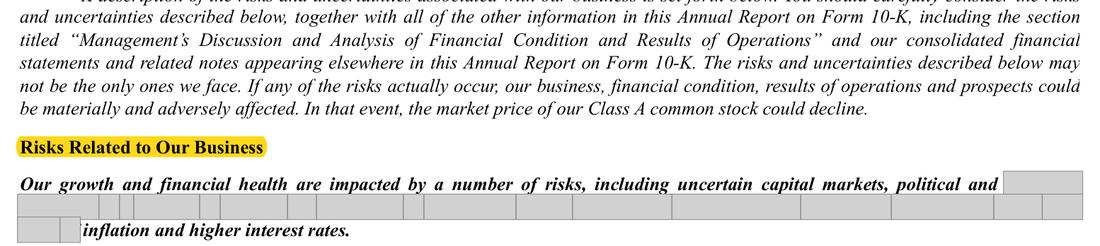
3 further page extracts: screenshot withheld to protect the company’s identity. The rows below say what each shows.
What the filing shows, and what the rule requires
| What the filing shows | What the rule requires |
|---|---|
Generic-type risk factors (ordinary-course litigation, hiring and retention, natural disasters and other significant events) are presented under 'Risks Related to Our Business'; no 'General Risk Factors' caption appears anywhere in Item 1A, which ends at Item 1B. The analyst-coverage risk factor (p.53), which would read the same for any listed company, sits under 'Risks Related to Ownership of Our Class A Common Stock' rather than under a general caption. The prior-year Form 10-K had the same layout. | Either (a) move risk factors that could apply to any registrant to the end of Item 1A under the caption 'General Risk Factors', or (b) tailor them so that each explains how the risk affects this company specifically. |
| What we checked. Item 1A headings, the end of the section at Item 1B, the risk factor summary and the prior-year Form 10-K | |
The rule
Regulation S-K Item 105(a) (17 CFR 229.105(a)); Form 10-K Item 1A
The presentation of risks that could apply generically to any registrant or any offering is discouraged, but to the extent generic risk factors are presented, disclose them at the end of the risk factor section under the caption “General Risk Factors.”
Version: In force from [date] · Source: Regulation S-K, 17 CFR 229.105, as amended effective [date]
Why it applies here. the 2020 amendments to Item 105 of Regulation S-K discourage generic risk factors and, where a registrant chooses to keep them, require them at the end of the section under the 'General Risk Factors' caption so that investors can separate company-specific risks from boilerplate. The three risk factors named above contain some company detail (a cross-reference to Item 3, the [city], [state] labor market, the geopolitical conflict), so whether they are generic is a judgment; the staff of the Securities and Exchange Commission (SEC) has asked registrants in comment letters to relocate such risks or to explain why they are company-specific.
Why it matters
Investors reading Item 1A cannot tell which risks the company regards as specific to it and which are boilerplate, which is the purpose of the caption; the staff may comment on the layout in a review of the filing.
Exposure
No penalty: at most a staff comment letter asking for generic risks to be moved or tailored in future filings.
Our workings
Item 1A opens with the heading 'Risks Related to Our Business' and later uses 'Risks Related to the Convertible Notes' and 'Risks Related to Ownership of Our Class A Common Stock'; the section ends with Item 1B. No caption 'General Risk Factors' appears in the document. Within the business section, sub-captions describe risks of ordinary-course litigation and insurance, hiring and retaining qualified personnel, and [wording masked], terrorism, war and civil unrest.
under 'Risks Related to Ownership of Our Class A Common Stock', the risk factor on p.53 says that if an analyst who covers the company ceased coverage it could lose visibility in the financial markets, and the risk summary on p.5 lists the same factor under that caption (the prior-year Form 10-K carried both).
Management’s best defense, and our reply
Management would say that none of its risk factors is generic: each is drafted for a communications platform provider, the litigation risk points to the [n] tax cases in Item 3, the hiring risk names the [city], [state] labor market and remote-working reactions, and the catastrophe risk names the geopolitical conflict. Item 105(a) only requires the caption 'to the extent generic risk factors are presented', so a registrant that tailors every risk has no caption to give, and the staff did not comment on the same layout in earlier years. That defense is tenable, which is why the point is a question; however, the core of each of these three risk factors would read the same for any listed company, and the company-specific detail is a sentence or a clause, so a review could reasonably treat them as generic.
The fix
- In the fiscal 2026 Form 10-K, add a final sub-section 'General Risk Factors' and move into it the risks that could apply to any registrant (for example ordinary-course litigation, hiring and retention, natural disasters and catastrophic events), or tailor each so it explains the company-specific effect.
Question for the company
Does management regard the risk factors on ordinary-course litigation and insurance, hiring and retention of personnel, and natural disasters and other significant events as specific to the company? If not, would it present them at the end of Item 1A under the caption 'General Risk Factors' in the next Form 10-K?
Evidence relied on
| # | What it shows | Type | Where |
|---|---|---|---|
| 1 | The first of the three headings that organize Item 1A; the business section holds all the risk factors cited below | Document | Form 10-K 2025, page 19 |
| 2 | Ordinary-course litigation and insurance risk presented within the business section | Document | Form 10-K 2025, page 31 |
| 3 | Hiring and retention risk presented within the business section | Document | Form 10-K 2025, page 43 |
| 4 | Natural disaster and catastrophic event risk presented within the business section | Document | Form 10-K 2025, page 47 |
| 5 | The last heading of Item 1A; no further heading follows before Item 1B | Document | Form 10-K 2025, page 51 |
| 6 | the analyst-coverage factor contains nothing that would differ for any other listed company | Document | Form 10-K 2025, page 53 |
| 7 | the risk summary carries the same factor under the stock-ownership caption, the last of three, with no general group | Document | Form 10-K 2025, page 5 |
Absence check
- Document
- Form 10-K 2025
- Where it would appear
- Item 1B. Unresolved Staff Comments
- What is missing
- A 'General Risk Factors' caption at the end of the risk factor section, immediately before Item 1B
- Pages looked at
- p.19, [n] and [n] (Item 1A headings and the end of the section) and p.4 (risk factor summary); Form 10-K 2024 (prior year) p.55
- Result
- Only 'generic' hits, once, on p.37, where a trademark risk factor says trademarks may 'become generic'; that is not a caption. The other three terms do not appear anywhere in the document.
Prepared by Pramanex from the company’s public SEC filings, without the company’s involvement, to show how a 10-K Pre-filing Check reads. The company is not named, and nothing on this page is a statement about any identifiable company. Observations are not an audit, review or other attestation or assurance engagement, and not legal advice. An SEC-style question is a question, not a conclusion.
Want this on your own 10-K, before you file?
Start with three free findings on your latest 10-K, or book a fixed-price 10-K Pre-filing Check.
Your next 10-K will be in draft before the audit is done.
Have it read before you file.
Start with three free findings on your latest 10-K, or book a fixed-price 10-K check. Drafts only under NDA, inside your insider trading policy.