4.07 MD&A explains the cloud communications revenue change by three offerings' growth rates with no dollar amounts, and leaves part of the cost of revenue change unexplained
Company D · a US-listed cloud communications software company · SEC-style question
In brief
Cloud communications revenue rose by [amount]. MD&A attributes the change to three offerings: [product line 1] up [n]%, [product line 2] down [n]% and [product line 3] up 21%, but gives no revenue for any of them, so a reader cannot tell how much each contributed or how the fall offsets the rises. Cost of revenue fell by [amount], explained by a [amount] fall in messaging cost; the offsetting rise of about [n] dollars elsewhere in cost of revenue is not described. In [date] the company told the staff it would quantify each factor, including offsetting factors, from the 2024 Form 10-K.
The evidence, as filed
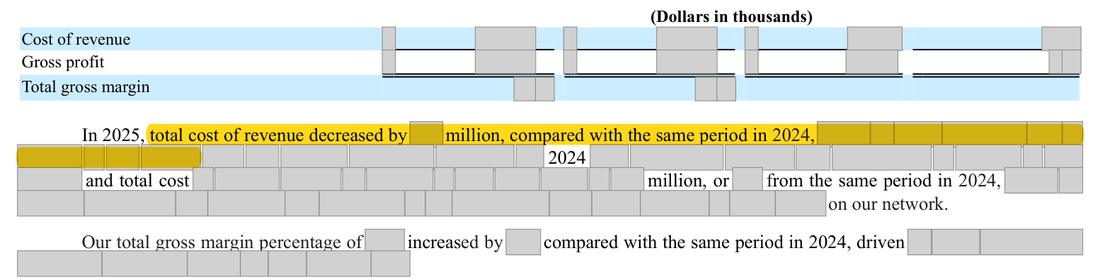
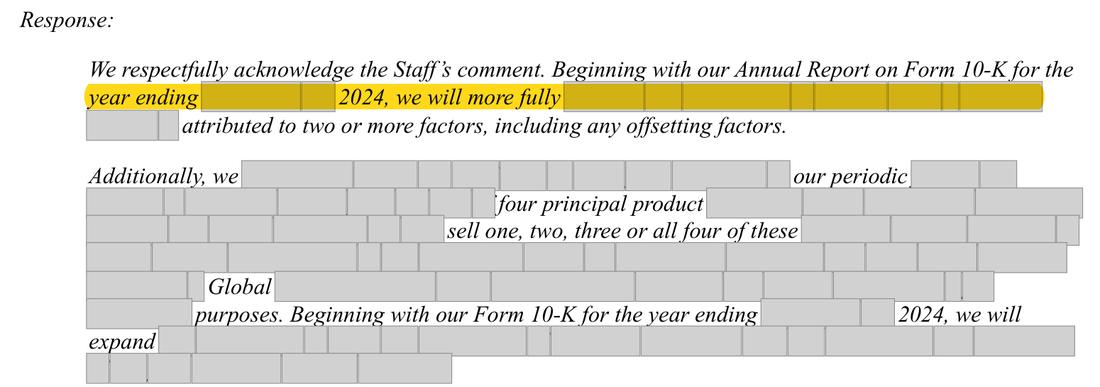
8 further page extracts: screenshot withheld to protect the company’s identity. The rows below say what each shows.
What the filing shows, and what the rule requires
| What the filing shows | What the rule requires |
|---|---|
Three offering growth rates ([n]%, -[n]%, 21%) with no dollar base; cost of revenue change of ([n]) explained only by the [amount] messaging cost fall | The dollar change of each offering (or its revenue in both years) adding to the [n] change, and the other components of the cost of revenue change |
The rule
Regulation S-K Item 303(b)
Where the financial statements reflect material changes from period-to-period in one or more line items, including where material changes within a line item offset one another, describe the underlying reasons for these material changes in quantitative and qualitative terms.
Version: Text in force at the date of this review · Source: Regulation S-K, 17 CFR 229.303(b), as amended by Release 33-10890
Regulation S-K Item 303(b)(2)(iii)
describe the extent to which such changes are attributable to changes in prices or to changes in the volume or amount of goods or services being sold or to the introduction of new products or services.
Version: Text in force at the date of this review · Source: Regulation S-K, 17 CFR 229.303(b)(2)(iii), as amended by Release 33-10890
Why it applies here. the item requires the reasons for a material change, including offsetting changes within a line item, in quantitative terms; growth rates without a base do not let a reader size the offsetting fall in [product line 2] against the voice growth.
Why it matters
A reader cannot size the drivers of the largest revenue line or see how much the fall in political messaging offset voice growth; MD&A results discussion is the staff's most frequent comment theme and the same point was raised in 2024.
Exposure
A question for management; if the staff reviews the filing, a further comment and an undertaking are the realistic outcome
Our workings
the revenue table shows cloud communications revenue of [n] against [n] (in thousands). The narrative names three offerings with growth rates only; no table or note in the 10-K gives their revenue. The cost of revenue table shows a fall of [n], and the narrative names one driver of [amount]. In its reply to the staff's [date] letter the company said it would 'more fully quantify' changes attributed to two or more factors, including offsetting factors, and align its customer categories with its [wording masked], phone numbers).
the offering contributions cannot be computed; the cost of revenue residual is [n] - [n] = [n] (thousand).
| Item | Amount ($ thousand) |
|---|---|
| Cloud communications revenue change: [n] - [n] | [n] |
| Contribution of each offering ([n]%, -[n]%, 21%) | not determinable: no revenue base disclosed |
| Cost of revenue change: [n] - [n] | ([n]) |
| Messaging cost of revenue fall stated in MD&A: [n] x [n] = [n] | [n] |
| Other cost of revenue change not described: [n] - [n] = [n] | [n] |
| Gross profit change: [n] - [n] | [n] |
Management’s best defense, and our reply
Management would say growth rates are quantitative terms, the offerings are descriptive groupings rather than line items or reportable segments, and dollar revenue by offering is commercially sensitive. It would add that the unexplained cost of revenue residual is under 1% of the line and not material. The cost point is fairly answered by that; the revenue point is not, because the company itself undertook to quantify the contribution of each factor and growth rates without a base cannot show contribution, but whether dollar amounts are needed is a judgment the company can explain.
The fix
- Give a short table of revenue by offering for both years (or the dollar change of each) and name and size the other cost of revenue movements.
Question for the company
What were the dollar contributions of [product line 1], [product line 2] and [product line 3] to the [n] increase in cloud communications revenue (or their revenue in 2025 and 2024), how do these offerings map to the four product solutions described to the staff, and what offset the [amount] fall in messaging cost of revenue?
Evidence relied on
| # | What it shows | Type | Where |
|---|---|---|---|
| 1 | cloud communications revenue and its change | Document | Form 10-K 2025, page 66 |
| 2 | the change described in the narrative | Document | Form 10-K 2025, page 66 |
| 3 | first offering: growth rate only | Document | Form 10-K 2025, page 66 |
| 4 | offsetting fall: growth rate only | Document | Form 10-K 2025, page 66 |
| 5 | third offering: growth rate only | Document | Form 10-K 2025, page 66 |
| 6 | cost of revenue and its change | Document | Form 10-K 2025, page 66 |
| 7 | one driver named, larger than the net change | Document | Form 10-K 2025, page 66 |
| 8 | gross profit change | Document | Form 10-K 2025, page 66 |
| 9 | the staff's comment on the 2023 Form 10-K | Document | |
| 10 | the company's undertaking, from the 2024 Form 10-K | Document | |
| 11 | the company's undertaking to align categories with its product solutions | Document | |
| 12 | the prior-year 10-K used the same growth-rate-only form | Document | Form 10-K 2024 (prior year), page 66 |
| 13 | the later Form 10-Q keeps the same form | Document | |
| 14 | Undertaking to the SEC staff to quantify each factor behind a material change | Document |
Prepared by Pramanex from the company’s public SEC filings, without the company’s involvement, to show how a 10-K Pre-filing Check reads. The company is not named, and nothing on this page is a statement about any identifiable company. Observations are not an audit, review or other attestation or assurance engagement, and not legal advice. An SEC-style question is a question, not a conclusion.
Want this on your own 10-K, before you file?
Start with three free findings on your latest 10-K, or book a fixed-price 10-K Pre-filing Check.
Your next 10-K will be in draft before the audit is done.
Have it read before you file.
Start with three free findings on your latest 10-K, or book a fixed-price 10-K check. Drafts only under NDA, inside your insider trading policy.