4.05 Item 1 still describes the FCC [n] outage-notification rules as a future requirement, though Item 1A says they took effect in [date]
Company D · a US-listed cloud communications software company · Presentation point
In brief
The regulatory section of Item 1 says that by [date] the company and its customers 'will be required' to comply with the Federal Communications Commission's (FCC) new [n] outage reporting rules, and that the company cannot yet predict the impact. That is the prior-year sentence carried forward unchanged into a report for the year ended [date]. Two risk factors in the same report say the rules went into effect on [date] and already require notifications.
The evidence, as filed
5 further page extracts: screenshot withheld to protect the company’s identity. The rows below say what each shows.
What the filing shows, and what the rule requires
| What the filing shows | What the rule requires |
|---|---|
Item 1: 'By [date], the Company and its service provider customers will be required to comply with the FCC's new [n] outage reporting requirements. We expect that this will impact our business, but cannot predict the extent of that impact at this time.' Item 1A: 'As of [date], providers are required to provide a [n] outage notification' and the rules 'went into effect on [date]'. | Item 1 states that the [n] outage-notification rules took effect on [date], describes what the company now does to comply, and gives the material effect of compliance on capital expenditure, earnings and competitive position (or says it has not been material). |
| What we checked. The Item 1 regulatory section and both Item 1A references on the page images; the prior-year 10-K's Item 1 for the same sentence; the cover page for the fiscal period. | |
The rule
Regulation S-K Item 101(c)(2)(i) (17 CFR 229.101(c)(2)(i))
The material effects that compliance with government regulations, including environmental regulations, may have upon the capital expenditures, earnings and competitive position of the registrant and its subsidiaries
Version: Text in force at the date of this review · Source: 17 CFR 229.101, eCFR text as amended by Release 33-10825
Why it applies here. the Item 1 sentence was not updated; it describes as future a requirement that had applied for most of the fiscal year, and it contradicts Item 1A. Item 101(c)(2)(i) asks for the material effects of compliance with government regulation; the company has now operated under this rule, so 'cannot predict' is no longer the natural description.
Why it matters
A reader of Item 1 is told that a [n] obligation is still to come and its effect unknown, while Item 1A of the same report says it has applied since [date]. Stale regulatory text of this kind is a routine staff comment.
Exposure
At most a staff comment asking for the regulatory description to be updated, answered by revision in future filings; no amendment is likely. No penal provision applies, because Item 1A of the same report states the correct position.
Our workings
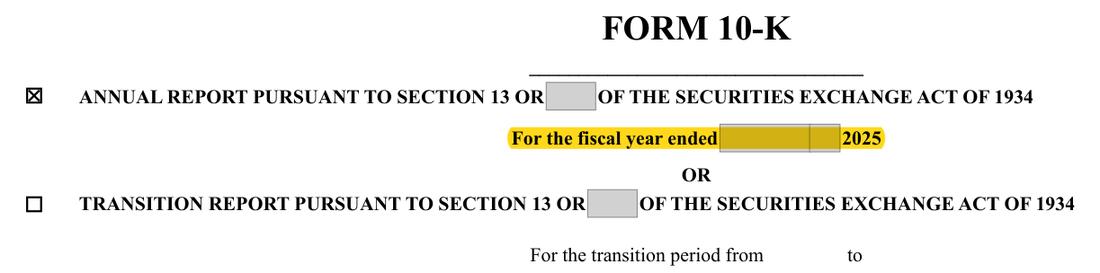
the 10-K covers the fiscal year ended [date].
Item 1 (p.17) says that by [date] the company 'will be required' to comply with the FCC's new [n] outage reporting requirements and that it cannot predict the extent of the impact.
the prior-year 10-K (p.16) carried the same words, written when the date was still ahead.
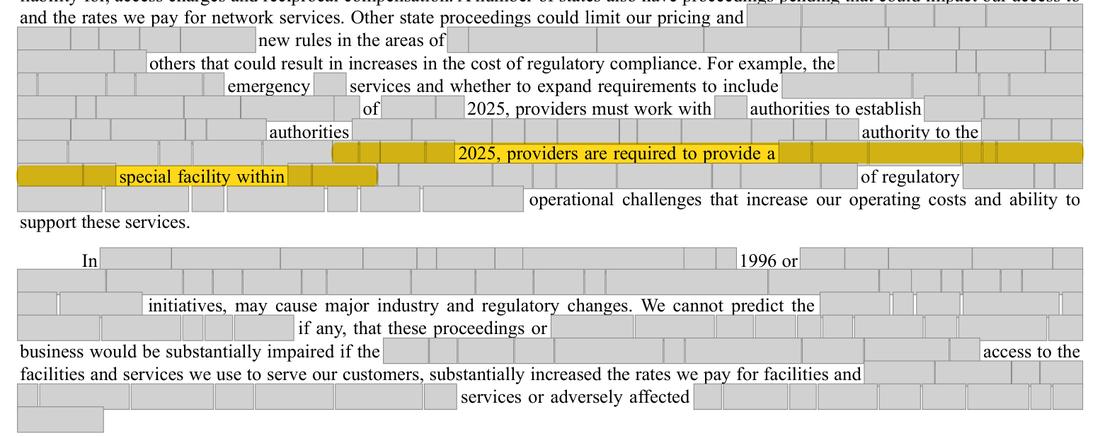
Item 1A says that as of [date] providers are required to notify a potentially affected [n] special facility within [n] minutes of discovering an outage (p.32), and that the rules 'went into effect on [date]' (p.40).
Management’s best defense, and our reply
Management would say the 10-K read as a whole is accurate: Item 1A tells the reader twice, in more detail, that the rules took effect on [date], and the Item 1 paragraph is general regulatory background rather than a statement about the year. It would add that the long-run effect of the rules is uncertain, so the closing words are accurate. Its auditors and counsel would also note that no rule requires the same fact to be repeated in two Items. However, the regulatory section of Item 1 is where Item 101(c)(2)(i) places the effects of compliance, and a sentence that calls a past date a future requirement is simply out of date; Item 1A helps a reader who reads on but does not remove the inconsistency, which a one-sentence update cures.
The fix
- Replace the two sentences with: 'The FCC's [n] outage-notification rules took effect on [date] and require us to notify potentially affected [n] special facilities within [n] minutes of discovering an outage. Compliance has not had a material effect on our capital expenditures, earnings or competitive position' (or describe the effects if it has).
Evidence relied on
| # | What it shows | Type | Where |
|---|---|---|---|
| 1 | the report covers the year ended [date] | Document | Form 10-K 2025, unnumbered page |
| 2 | Item 1 describes the rule as a future requirement | Document | Form 10-K 2025, page 17 |
| 3 | Item 1 says the effect cannot yet be predicted | Document | Form 10-K 2025, page 17 |
| 4 | Item 1A says the requirement applies from [date] | Document | Form 10-K 2025, page 32 |
| 5 | Item 1A says the rules went into effect on [date] | Document | Form 10-K 2025, page 40 |
| 6 | the same sentence in the prior-year 10-K, when the date was still ahead | Document | Form 10-K 2024 (prior year), page 16 |
Prepared by Pramanex from the company’s public SEC filings, without the company’s involvement, to show how a 10-K Pre-filing Check reads. The company is not named, and nothing on this page is a statement about any identifiable company. Observations are not an audit, review or other attestation or assurance engagement, and not legal advice. An SEC-style question is a question, not a conclusion.
Want this on your own 10-K, before you file?
Start with three free findings on your latest 10-K, or book a fixed-price 10-K Pre-filing Check.
Your next 10-K will be in draft before the audit is done.
Have it read before you file.
Start with three free findings on your latest 10-K, or book a fixed-price 10-K check. Drafts only under NDA, inside your insider trading policy.