1.06 Carrier messaging surcharges that the company calls pass-through are reported gross as revenue, but the notes give no principal-versus-agent judgment
Company D · a US-listed cloud communications software company · SEC-style question
In brief
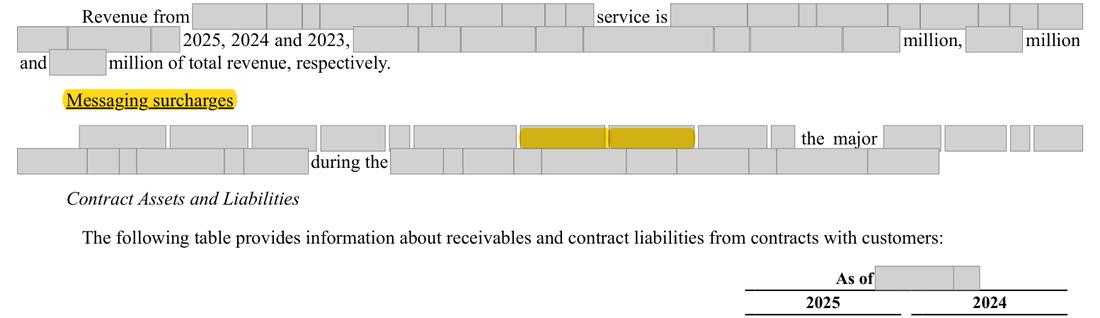
Revenue for 2025 includes [amount] of messaging surcharges, 25.5% of total revenue of [amount]. The notes call them pass-through [wording masked], and the company told the Securities and Exchange Commission staff in 2022 that it passes them on in the amount the carriers assess, shown separately on invoices. Reporting them gross requires the company to be the principal for them, but neither the revenue policy nor any other part of the annual report states that conclusion or the judgment behind it.
The evidence, as filed

4 further page extracts: screenshot withheld to protect the company’s identity. The rows below say what each shows.
What the filing shows, and what the rule requires
| What the filing shows | What the rule requires |
|---|---|
The Note 1 revenue table shows messaging surcharges of [amount] (2024: [amount]; 2023: [amount]) inside total revenue of [amount], described as pass-through messaging [wording masked]. No statement says whether the Company acts as principal or agent for them, or why. | A statement in the revenue policy that the Company is the principal (or the agent) for carrier messaging surcharges, with the control analysis behind it (who is primarily responsible for the service, who bears the risk, who sets the price); or, if the analysis shows the Company is an agent, presentation net of the carrier charge. |
| What we checked. Revenue policy and revenue table (Note 1), contract balances, the discussion of revenue and gross margin in Management's discussion and analysis, the non-GAAP gross margin definition, the statement of operations, the prior-year report, the 2022 staff correspondence and the two later quarterly reports | |
The rule
FASB ASC 606-10-50-12, 50-17 to 50-20; 606-10-55-36 to 55-40 (paraphrase; the Codification text is copyrighted)
Summary; FASB/IFRS text is copyrighted Describe performance obligations, when satisfied, payment terms, principal-versus-agent nature, and significant judgments on timing, transaction price, variable consideration and allocation.
Version: Text in force at the date of this review · Source: FASB Accounting Standards Codification, ASC 606-10-50-12, 50-17 to 50-20 and 606-10-55-36 to 55-40 (as issued by ASU 2014-09 and amended by ASU 2016-08)
Regulation S-X Rule 4-01(a)
The information required with respect to any statement shall be furnished as a minimum requirement to which shall be added such further material information as is necessary to make the required statements, in the light of the circumstances under which they are made, not misleading.
Version: Text in force at the date of this review · Source: Regulation S-X, 17 CFR 210.4-01(a)
Why it applies here. under the Codification's principal-versus-agent guidance the company is principal only if it controls the specified service before it is transferred, and the indicators include primary responsibility, risk and discretion in setting the price. A charge passed on at exactly the amount the carrier sets points away from pricing discretion. Gross reporting can still be right if the specified service is the company's own message delivery and the surcharge is simply a cost of providing it, but that is a significant judgment over a quarter of revenue and the notes do not disclose it. The answer depends on the contracts and the control analysis, so the point is put as a question.
Why it matters
If the Company is an agent for the surcharges, revenue and cost of revenue are each overstated by the surcharge amount ([amount] in 2025) and the revenue trend is distorted, although operating loss and net loss are unaffected. If it is the principal, a significant revenue judgment is left undisclosed. The realistic result is a staff comment asking for the analysis and a future-filings undertaking.
Exposure
A question for management. The realistic consequence is a staff comment and a future-filings disclosure; only if the agent view prevailed would revenue and cost of revenue have to be recast, with no change to net loss.
Our workings
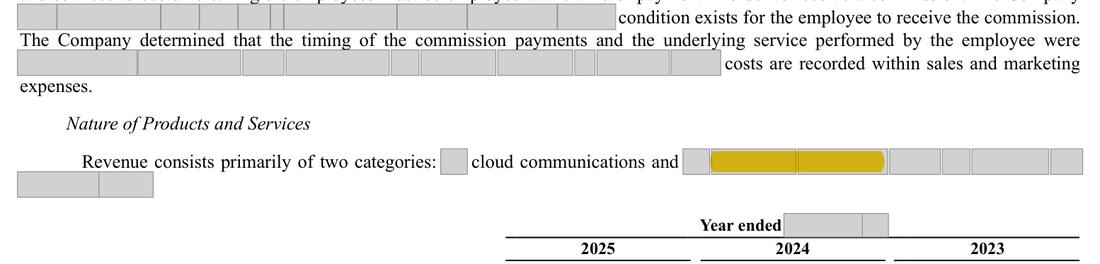
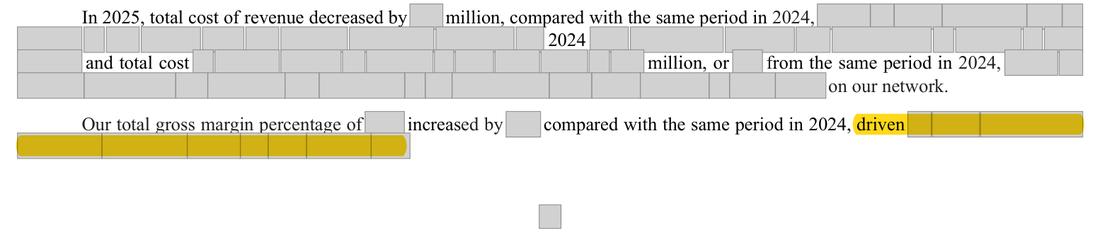
the revenue policy splits revenue into cloud communications and messaging surcharges and describes the surcharges as pass-through charges imposed by the major mobile carriers, recognized when the messaging traffic crosses the network. Management's discussion and analysis says they are invoiced and passed through to customers, explains the rise in gross margin by lower pass-through surcharges in the revenue mix, and excludes them from non-GAAP gross profit. In its [date] reply to a staff comment the company said it passes the surcharges through in the amount assessed by the destination carriers, shown separately on customer invoices, with revenue and cost equal and offsetting.
surcharges were 25.5% of 2025 revenue (27.9% in 2024). Reported net, 2025 revenue would be [amount] and gross margin 52.6% instead of 39.1%; operating loss and net loss would not change.
| Item | Amount (USD thousand) or ratio | Source |
|---|---|---|
| Messaging surcharges, 2025 | [n] | Note 1 revenue table |
| Total revenue, 2025 | [n] | Note 1 revenue table |
| Share of revenue, 2025 | [n] / [n] = 25.5% | computed |
| Share of revenue, 2024 | [n] / [n] = 27.9% | computed |
| Revenue if surcharges were reported net, 2025 | [n] - [n] = [n] | computed (equals cloud communications revenue) |
| Gross margin as reported, 2025 | [n] / [n] = 39.1% | computed |
| Gross margin if reported net, 2025 | [n] / [n] = 52.6% | computed |
Management’s best defense, and our reply
The finance team will say the service the customer buys is the company's own business message delivery, which it controls end to end on its network; the carrier surcharge is a cost the company incurs to fulfil that service, not a separate service it arranges, so it forms part of the price of the company's own performance obligation and gross reporting follows. They may add that the staff looked at the surcharges in 2022 and closed its review without asking for net presentation. That case is tenable, which is why this is a question and not a finding. However, the notes do not set out that analysis at all, the company itself calls the charges pass-through at the amount the carrier assesses, and the 2022 exchange concerned a non-GAAP gross margin measure, not the gross-versus-net conclusion; a judgment over a quarter of reported revenue should be disclosed.
The fix
- Add to the revenue policy: 'The Company is the principal for messaging surcharges because it is primarily responsible for delivering the messaging service and controls that service before transfer; surcharges are therefore presented gross in revenue, with the related carrier charges in cost of revenue.' If the analysis shows the Company is an agent, present the surcharges net.
Question for the company
Does the Company act as principal or as agent for the carrier messaging surcharges it passes on to customers, what control analysis supports reporting [amount] of 2025 surcharges as revenue, and will the revenue policy disclose that judgment?
Evidence relied on
| # | What it shows | Type | Where |
|---|---|---|---|
| 1 | Messaging surcharges reported inside revenue: [amount] (2025), [amount] (2024), [amount] (2023) | Document | Form 10-K 2025, page 91 |
| 2 | Total revenue the surcharges are part of | Document | Form 10-K 2025, page 91 |
| 3 | The policy calls the surcharges pass-through charges imposed by the carriers and says nothing on principal or agent | Document | Form 10-K 2025, page 92 |
| 4 | Management's discussion and analysis: fees imposed by carriers, invoiced and passed through to customers | Document | Form 10-K 2025, page 63 |
| 5 | Gross margin moves with the surcharge share, consistent with surcharges carrying no margin | Document | Form 10-K 2025, page 66 |
| 6 | Gross profit used in the gross-margin computation | Document | Form 10-K 2025, page 85 |
| 7 | The company's own description to the staff: passed through at the carrier's assessed amount and shown separately on invoices | Document | |
| 8 | Revenue and cost of the surcharges are equal, so gross reporting changes revenue but not profit | Document |
Absence check
- Document
- Form 10-K 2025
- Where it would appear
- Messaging surcharges
- What is missing
- a statement whether the Company acts as principal or as agent for carrier messaging surcharges, and the judgment that supports reporting them gross
- Pages looked at
- p.63, [n], 75-76, [n], 90-92 (revenue policy, critical accounting estimates, revenue discussion, non-GAAP gross margin, statement of operations)
- Result
- None of the five terms appears anywhere in the report. The single words 'principal' and 'agent' appear only in unrelated senses (principal executive offices, principal risks, principal amount of the notes; Automated agents, the administrative agent of the credit facility, the transfer agent).
Prepared by Pramanex from the company’s public SEC filings, without the company’s involvement, to show how a 10-K Pre-filing Check reads. The company is not named, and nothing on this page is a statement about any identifiable company. Observations are not an audit, review or other attestation or assurance engagement, and not legal advice. An SEC-style question is a question, not a conclusion.
Want this on your own 10-K, before you file?
Start with three free findings on your latest 10-K, or book a fixed-price 10-K Pre-filing Check.
Your next 10-K will be in draft before the audit is done.
Have it read before you file.
Start with three free findings on your latest 10-K, or book a fixed-price 10-K check. Drafts only under NDA, inside your insider trading policy.