4.01 The critical accounting estimates restate the accounting policies with no specific estimation uncertainty, change or sensitivity, and the goodwill sensitivity given last year has been dropped
Company D · a US-listed cloud communications software company · Compliance or disclosure gap
In brief
Management's discussion and analysis (MD&A) names three critical accounting estimates: revenue, goodwill and intangible assets, and income taxes. Each is a description of the accounting policy; the goodwill text repeats the Note 1 policy almost word for word, and the income-tax text says only in general terms that judgment about future profitability is needed. None explains the specific assumptions that make the estimate uncertain, how they moved, or how sensitive the [amount] of goodwill or the [amount] valuation allowance is to them. The 2024 Form 10-K gave a 10% goodwill sensitivity; the 2025 Form 10-K drops it, although the company told the Securities and Exchange Commission (SEC) staff in [date] that it would add this kind of information where material.
The evidence, as filed
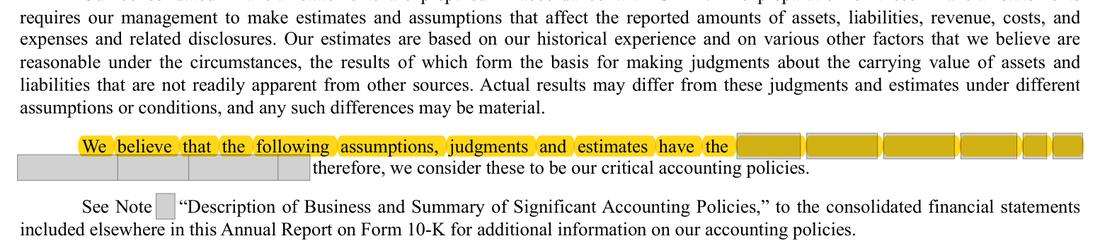
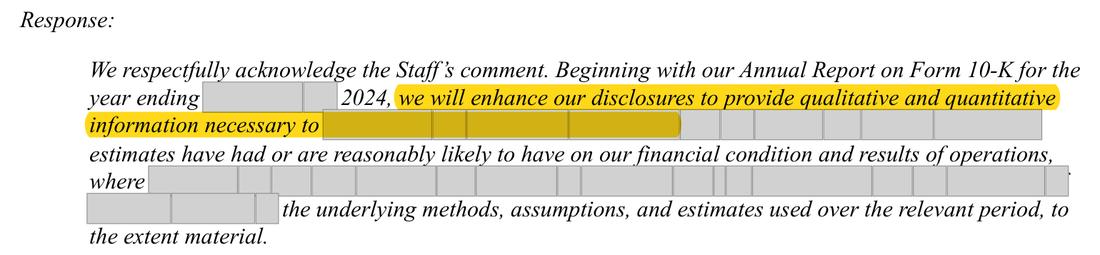

1 further page extract: screenshot withheld to protect the company’s identity. The rows below say what each shows.
What the filing shows, and what the rule requires
| What the filing shows | What the rule requires |
|---|---|
Critical accounting estimates for revenue, goodwill ([amount]) and income taxes ([amount] valuation allowance) that restate the policies, with no statement of why each is uncertain, no change over a period and no sensitivity; the 10% goodwill sensitivity of the prior year is gone | For each critical accounting estimate: why it is uncertain (for goodwill, the judgments behind the qualitative conclusion for the single reporting unit and the margin by which fair value last exceeded carrying value), how the key assumptions changed over a relevant period, and the sensitivity of the reported amount (for example the valuation allowance against the forecast taxable income it rests on) - text that supplements, not duplicates, Note 1 |
The rule
Regulation S-K Item 303(b)(3) (critical accounting estimates)
Provide qualitative and quantitative information necessary to understand the estimation uncertainty and the impact the critical accounting estimate has had or is reasonably likely to have on financial condition or results of operations to the extent the information is material and reasonably available. This information should include why each critical accounting estimate is subject to uncertainty and, to the extent the information is material and reasonably available, how much each estimate and/or assumption has changed over a relevant period, and the sensitivity of the reported amount to the methods, assumptions and estimates underlying its calculation.
Version: Text in force at the date of this review · Source: 17 CFR 229.303(b)(3), Regulation S-K, as amended by Release 33-10890 (eCFR current text)
Why it applies here. Item 303(b)(3) asks for the information needed to understand estimation uncertainty to the extent it is material and reasonably available, and says it should include why each estimate is uncertain, how it changed over a relevant period and its sensitivity. Materiality is not in doubt for goodwill at a third of total assets and a valuation allowance against all United States deferred tax assets, and the information is reasonably available: the company holds a fair value from its last quantitative test and gave a sensitivity from it a year earlier. A description that repeats Note 1 does not supply these elements.
Why it matters
Investors cannot judge how close goodwill is to impairment or how much the valuation allowance depends on forecasts; the staff has already raised this exact point with the company, so a repeat comment and a request to improve future filings is the realistic outcome.
Exposure
Staff comment letter repeating the 2024 critical-accounting-estimate comment and a further future-filings undertaking; no fine
Our workings
Item 7 lists revenue recognition, goodwill and intangible assets, and income taxes as the estimates with the greatest potential financial impact. The goodwill paragraphs state the impairment-test policy and the qualitative conclusion; Note 1 carries the same qualitative-assessment wording. The income-tax paragraphs describe the asset-and-liability method, say in general terms that recoverability 'requires judgment in assessing future profitability', and state the valuation allowance of [amount]. The revenue paragraphs describe the policy and call the sales-credit reserve not significant. The 2024 Form 10-K (Form 10-K 2024 (prior year) p.80) carried a sentence that a hypothetical 10% decrease in the reporting unit's fair value, from the last quantitative test, would not have changed the conclusion; no such sentence or other sensitivity appears in 2025. In its [date] reply to the staff, the company said it would, from the 2024 Form 10-K, provide qualitative and quantitative information on estimation uncertainty and, to the extent material, changes and sensitivity.
goodwill is 33.9% of total assets (workings).
| Critical accounting estimate | Why uncertain | Change over a period | Sensitivity | Supplements Note 1? |
|---|---|---|---|---|
| Revenue recognition and deferred revenue | Absent - policy text only; reserve called not significant | Absent | Absent | No - policy restated |
| Goodwill [amount] | Absent - states the qualitative conclusion only | Absent | Absent (10% sensitivity given in Form 10-K 2024 (prior year) p.80, dropped) | No - same wording as Note 1, p.96 |
| Income taxes: valuation allowance [amount] | Partial - generic 'requires judgment in assessing future profitability'; no forecast assumptions named | Partial - amounts [amounts] only | Absent | Largely policy |
| Goodwill share of total assets | [n] / [n] = 33.9% |
Management’s best defense, and our reply
Management would say the 2024 and 2025 goodwill tests were qualitative, so no current fair value was computed and a sensitivity was not reasonably available; that the qualitative factors listed in MD&A explain the uncertainty; that the sales-credit reserve is immaterial; and that the valuation allowance covers all United States deferred tax assets, so no sensitivity of the reported amount is meaningful. It would add that its undertaking to the staff was limited to information that is material, and that the staff closed its review in [date] without further comment. However, Item 303(b)(3) asks for the reasons for uncertainty specific to each estimate, and a list of the factors any qualitative test considers is not that; the company had a fair value from its last quantitative test and gave a sensitivity from it a year earlier, so the information was available; goodwill at 33.9% of total assets is material on any view; and the staff's closing letter says expressly that the company remains responsible for its disclosure. The defense narrows the income-tax limb but does not answer the goodwill limb.
The fix
- Rewrite each critical accounting estimate: state why it is uncertain, the key assumptions and how they moved, and a sensitivity (e.g. 'a 10% decline in the fair value of our single reporting unit would / would not result in impairment; fair value exceeded carrying value by x% at the last quantitative test'); remove text that repeats Note 1.
Evidence relied on
| # | What it shows | Type | Where |
|---|---|---|---|
| 1 | Item 7 introduces revenue, goodwill and income taxes as the critical accounting estimates | Document | Form 10-K 2025, page 75 |
| 2 | The goodwill estimate is described by its qualitative conclusion only | Document | Form 10-K 2025, page 76 |
| 3 | Goodwill of [amount] carried on the estimate | Document | Form 10-K 2025, page 76 |
| 4 | The revenue estimate is described as not significant, with no uncertainty or sensitivity | Document | Form 10-K 2025, page 76 |
| 5 | Note 1 carries the same wording as the MD&A goodwill estimate | Document | Form 10-K 2025, page 96 |
| 6 | The income-tax estimate gives the valuation allowance amounts but no assumptions or sensitivity | Document | Form 10-K 2025, page 77 |
| 7 | Total assets of [amount] used for the goodwill share (figure read on the balance sheet image) | Document | Form 10-K 2025, page 84 |
| 8 | The company's [date] reply to the SEC staff undertook to add this information from the 2024 Form 10-K | Document | |
| 9 | Revenue estimate: the sales-credit reserve is described but neither its amount nor its sensitivity is given | Document | Form 10-K 2025, page 76 |
| 10 | Goodwill estimate: qualitative assessment only in both years, with no headroom or sensitivity information | Document | Form 10-K 2025, page 76 |
| 11 | Income taxes: the only quantification in the section is the balance, with no change analysis or sensitivity | Document | Form 10-K 2025, page 77 |
| 12 | The prior-year Form 10-K carried a goodwill sensitivity (from the 2023 quantitative test); the 2025 section has no sensitivity for any estimate | Document | Form 10-K 2024 (prior year), page 80 |
| 13 | The company's [date] undertaking to the staff on critical accounting estimates, starting with the fiscal 2024 Form 10-K | Document | |
| 14 | Undertaking to the SEC staff on critical accounting estimates, from the 2024 Form 10-K onward | Document | |
| 15 | The undertaking includes changes in estimates and sensitivity, where material | Document |
Absence check
- Document
- Form 10-K 2025
- Where it would appear
- Goodwill and Intangible Assets
- What is missing
- why the goodwill estimate is uncertain, how its key assumptions changed, and the sensitivity of the [amount] to them
- Pages looked at
- p.75-77 (critical accounting estimates), p.96 (Note 1 goodwill policy)
- Result
- 'sensitiv' hits only p.24, [n] and [n] ('sensitive data' in risk factors); 'hypothetical' hits only p.78-79 (Item 7A interest-rate and currency sensitivities, not an accounting estimate); 'headroom', 'estimation uncertainty' and 'reasonably possible change' have no hits.
Prepared by Pramanex from the company’s public SEC filings, without the company’s involvement, to show how a 10-K Pre-filing Check reads. The company is not named, and nothing on this page is a statement about any identifiable company. Observations are not an audit, review or other attestation or assurance engagement, and not legal advice. An SEC-style question is a question, not a conclusion.
Want this on your own 10-K, before you file?
Start with three free findings on your latest 10-K, or book a fixed-price 10-K Pre-filing Check.
Your next 10-K will be in draft before the audit is done.
Have it read before you file.
Start with three free findings on your latest 10-K, or book a fixed-price 10-K check. Drafts only under NDA, inside your insider trading policy.