1.13 Commercial paper and time deposits are placed in Level 1 of the fair value hierarchy, the level reserved for quoted prices of identical assets in active markets
Company D · a US-listed cloud communications software company · SEC-style question
In brief
Note 2 shows all financial assets measured at fair value in Level 1, including commercial paper of [amount] in cash equivalents, commercial paper of [amount] and time deposits of [amount] in marketable securities. Commercial paper and bank time deposits rarely have quoted prices in an active market for the identical instrument and are usually valued from observable inputs, which is Level 2. The same classification was used for 2024.
The evidence, as filed
What the filing shows, and what the rule requires
| What the filing shows | What the rule requires |
|---|---|
Level 1: money market funds; commercial paper [n] (cash equivalents) and [n] (marketable securities); time deposits [n]; total [n] at Level 1 and nothing in Level 2 (2024: commercial paper [n] and [n] also Level 1). | Each instrument in the level of the lowest significant input: money market funds with a published daily net asset value in Level 1; commercial paper and time deposits in Level 2 unless the Company can show a quoted price in an active market for the identical instrument. |
The rule
FASB ASC 820-10-35-40 to 35-41 (Level 1); 820-10-50-2(b)
Summary; FASB/IFRS text is copyrighted Disclose fair values by hierarchy level, Level 3 techniques and significant unobservable inputs with ranges and weighted averages, Level 3 changes and measurement uncertainty.
Version: Text in force at the date of this review · Source: FASB Accounting Standards Codification, ASC 820-10-50-2 (as amended by ASU 2018-13), paraphrased
Why it applies here. commercial paper trades over the counter and is normally priced from yields on comparable paper; bank time deposits are not traded at all. Both are Level 2 in usual practice. The classification changes no amount, but it is a required disclosure and affects the reader's view of measurement uncertainty. Only management can say whether the specific paper held had quoted prices in an active market, so this is put as a question.
Why it matters
If the inputs are observable but not quoted prices for the identical instrument, [n] of assets (36.6% of the Level 1 total) are shown in the wrong level, and the valuation technique disclosure required for Level 2 is missing.
Exposure
A question for management; if the classification is wrong it is corrected in future filings with no change to any amount.
Our workings
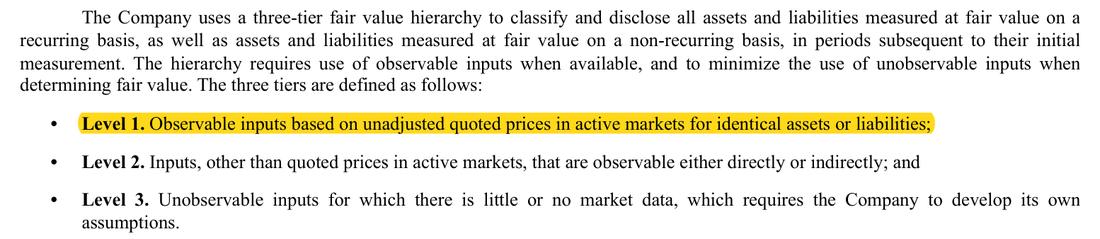
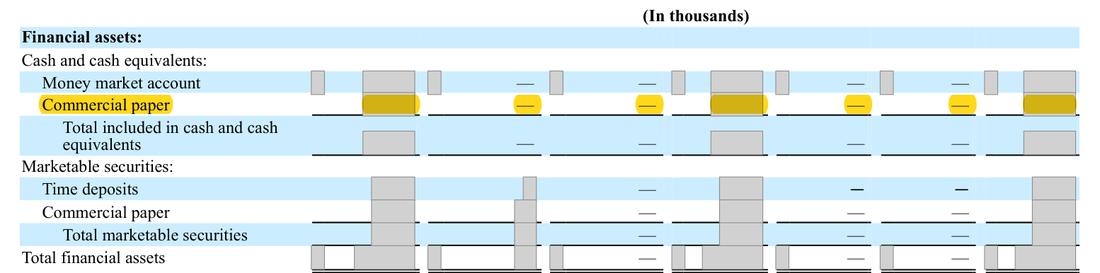
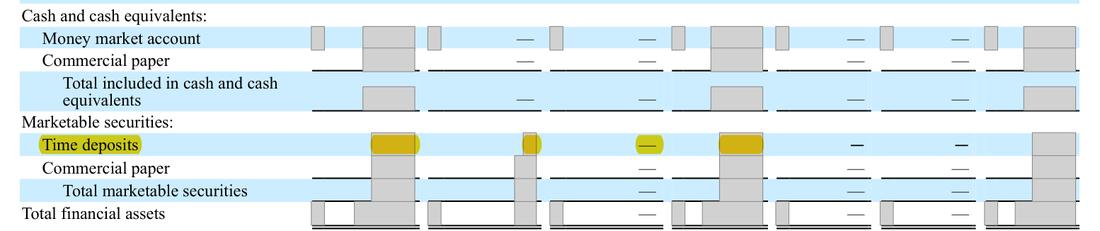
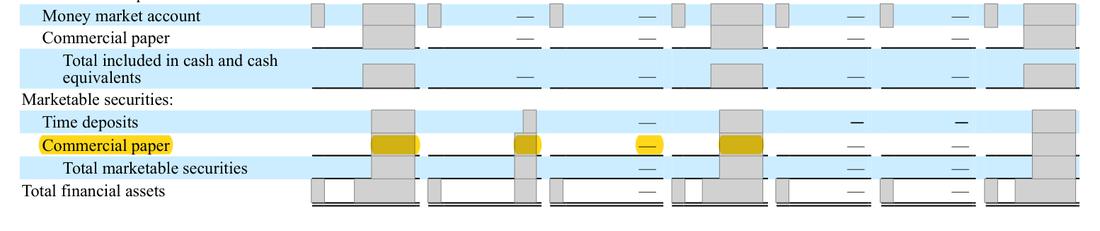
The Company's own policy defines Level 1 as observable inputs based on unadjusted quoted prices in active markets for identical assets. The fair value table places commercial paper ([n] in cash equivalents and [n] in marketable securities) and time deposits ([n]) in the Level 1 column, with nothing in Level 2. Note 2 itself records an unrealized gain of 5 on the time deposits and [n] on the commercial paper.
the instruments in question total [n] + [n] + [n] = [n] in 2025 and [n] + [n] = [n] in 2024.
| Instrument (Level 1 as presented) | 2025 | 2024 |
|---|---|---|
| Commercial paper in cash equivalents | [n] | [n] |
| Commercial paper in marketable securities | [n] | [n] |
| Time deposits | [n] | 0 |
| Total questioned | [n] + [n] + [n] = [n] | [n] + [n] = [n] |
| Share of Level 1 total | [n] / [n] = 36.6% | [n] / [n] = 26.2% |
Management’s best defense, and our reply
Management could argue that its custodian prices the commercial paper from dealer quotes that are in practice executable, and that the instruments are so short and high-grade that fair value equals amortized cost, so the level makes no difference to any amount. Time deposits at a bank are cash-like and some preparers present them alongside money market funds. However, the hierarchy turns on the input used, not on how close fair value is to cost; a dealer quote for similar paper is a Level 2 input, and a non-tradable time deposit has no quoted price at all. Because only management knows the pricing source, the point is put as a question rather than a finding.
The fix
- Move commercial paper and time deposits to the Level 2 column unless quoted prices for the identical instruments were used, and add: 'Commercial paper and time deposits are valued using observable market inputs such as yields on instruments of similar maturity and credit quality (Level 2).'
Question for the company
Were the commercial paper and time deposits held at [date] and 2024 valued from unadjusted quoted prices in an active market for the identical instruments? If not, would management reclassify them to Level 2 in the fair value table, and describe the valuation technique and inputs used?
Evidence relied on
| # | What it shows | Type | Where |
|---|---|---|---|
| 1 | The Company's own definition of Level 1 | Document | Form 10-K 2025, page 99 |
| 2 | Commercial paper in cash equivalents shown in the Level 1 column (2025) | Document | Form 10-K 2025, page 102 |
| 3 | Time deposits shown in the Level 1 column, with an unrealized gain of 5 (2025) | Document | Form 10-K 2025, page 102 |
| 4 | Commercial paper in marketable securities shown in Level 1 (2025) | Document | Form 10-K 2025, page 102 |
| 5 | All [n] of financial assets at fair value sit in Level 1 (2025) | Document | Form 10-K 2025, page 102 |
| 6 | Commercial paper in cash equivalents shown in Level 1 (2024) | Document | Form 10-K 2025, page 102 |
| 7 | Commercial paper in marketable securities shown in Level 1 (2024) | Document | Form 10-K 2025, page 102 |
| 8 | All [n] of financial assets at fair value sit in Level 1 (2024) | Document | Form 10-K 2025, page 102 |
Prepared by Pramanex from the company’s public SEC filings, without the company’s involvement, to show how a 10-K Pre-filing Check reads. The company is not named, and nothing on this page is a statement about any identifiable company. Observations are not an audit, review or other attestation or assurance engagement, and not legal advice. An SEC-style question is a question, not a conclusion.
Want this on your own 10-K, before you file?
Start with three free findings on your latest 10-K, or book a fixed-price 10-K Pre-filing Check.
Your next 10-K will be in draft before the audit is done.
Have it read before you file.
Start with three free findings on your latest 10-K, or book a fixed-price 10-K check. Drafts only under NDA, inside your insider trading policy.