1.14 The anti-dilutive restricted stock units in the loss-per-share note exceed the restricted stock units outstanding by about [n] in 2025 and [n] in 2024
Company D · a US-listed cloud communications software company · SEC-style question
In brief
Note 15 excludes [n] 'restricted stock units issued and outstanding' from diluted loss per share for 2025 as anti-dilutive. Note 9 and the award roll-forward show [n] nonvested restricted stock units issued and outstanding at the same date. The excess of [n] ([n] in 2024) is not explained, and the note does not say whether its count is a year-end or a weighted-average figure.
The evidence, as filed

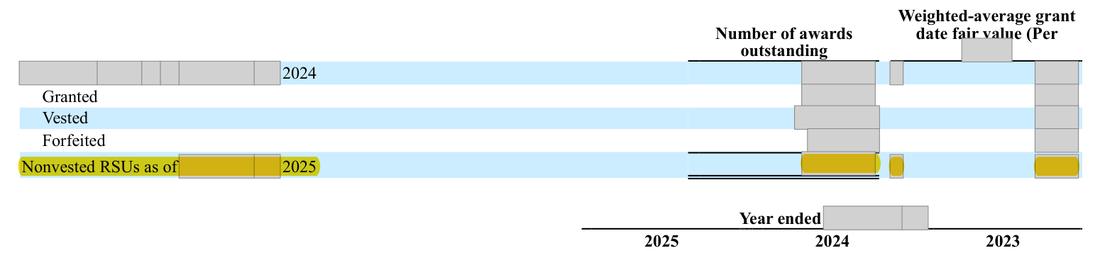


1 further page extract: screenshot withheld to protect the company’s identity. The rows below say what each shows.
What the filing shows, and what the rule requires
| What the filing shows | What the rule requires |
|---|---|
Anti-dilutive RSUs [n] (2025) and [n] (2024); nonvested RSUs outstanding [n] (2025) and [n] (2024), both labelled 'issued and outstanding'. | The anti-dilutive securities disclosure counting the same population as the award notes, or a description of what else it includes (for example, shares issuable under liability-classified performance awards or vested units not yet settled). |
The rule
FASB ASC 260-10-50-1(c)
Summary; FASB/IFRS text is copyrighted Present basic and diluted EPS on the income statement, apply the two-class method to participating securities, and reconcile numerators and denominators including antidilutive securities.
Version: Text in force at the date of this review · Source: FASB Accounting Standards Codification, ASC 260-10 (as amended to 2025), paraphrased
Why it applies here. the earnings-per-share standard asks for the securities that could dilute basic loss per share in future but were excluded as anti-dilutive. The count may legitimately be a weighted average for the year (units granted early in the year and vesting later lift the average above the year-end balance) or include instruments other than the nonvested units in Note 9, such as shares to be issued under the liability-classified performance awards; nothing in the notes says so, and the identical labels suggest the same population. Only management can say what the excess is.
Why it matters
If the excess reflects a weighted-average count or shares issuable under liability-classified awards, the dilution disclosure is right but its basis is not stated; otherwise the count of potentially dilutive securities would be overstated by about [n] shares (2.9% of weighted shares).
Exposure
A question for management; any correction would be a label or count change in future filings.
Our workings
Note 15 lists [n] restricted stock units issued and outstanding excluded from diluted loss per share for 2025 and [n] for 2024. Note 9 lists [n] and [n] nonvested restricted stock units issued and outstanding at the two year ends, and the roll-forward in Note 10 ends at [n].
[n] - [n] = [n]; [n] - [n] = [n].
| Item | 2025 | 2024 |
|---|---|---|
| Anti-dilutive RSUs (Note 15) | [n] | [n] |
| Nonvested RSUs outstanding (Note 9) | [n] | [n] |
| Excess | [n] - [n] = [n] | [n] - [n] = [n] |
| RSU roll-forward check (Note 10) | [n] + [n] - [n] - [n] = [n] |
Management’s best defense, and our reply
Management may say the anti-dilutive count includes shares expected to be issued to settle liability-classified performance bonuses and units vested but not yet released, which are potentially dilutive but are not nonvested units, so the two tables properly differ. The roll-forward in Note 10 covers only the time-based units, so a larger dilution count is what one would expect if performance awards are settled in shares. That is a tenable explanation consistent with Note 10, which is why this is a question. The answer would still need a label change, since both lines are called 'issued and outstanding'.
The fix
- Label the line by what it counts, e.g. 'Restricted stock units and shares issuable under performance-based awards', or align the count with Note 9.
Question for the company
Is the anti-dilutive count of [n] restricted stock units ([n] for 2024) a weighted average for the year rather than a year-end count and, if not, what does it include beyond the [n] ([n]) nonvested units outstanding, for example shares issuable under liability-classified performance awards, and will the note describe it?
Evidence relied on
| # | What it shows | Type | Where |
|---|---|---|---|
| 1 | Anti-dilutive RSUs excluded from diluted loss per share | Document | Form 10-K 2025, page 123 |
| 2 | Nonvested RSUs outstanding at the same dates | Document | Form 10-K 2025, page 114 |
| 3 | The award roll-forward ends at the same [n] | Document | Form 10-K 2025, page 115 |
| 4 | Opening balance of the roll-forward | Document | Form 10-K 2025, page 115 |
| 5 | Roll-forward: granted | Document | Form 10-K 2025, page 115 |
| 6 | Roll-forward: vested | Document | Form 10-K 2025, page 115 |
| 7 | Roll-forward: forfeited | Document | Form 10-K 2025, page 115 |
Prepared by Pramanex from the company’s public SEC filings, without the company’s involvement, to show how a 10-K Pre-filing Check reads. The company is not named, and nothing on this page is a statement about any identifiable company. Observations are not an audit, review or other attestation or assurance engagement, and not legal advice. An SEC-style question is a question, not a conclusion.
Want this on your own 10-K, before you file?
Start with three free findings on your latest 10-K, or book a fixed-price 10-K Pre-filing Check.
Your next 10-K will be in draft before the audit is done.
Have it read before you file.
Start with three free findings on your latest 10-K, or book a fixed-price 10-K check. Drafts only under NDA, inside your insider trading policy.