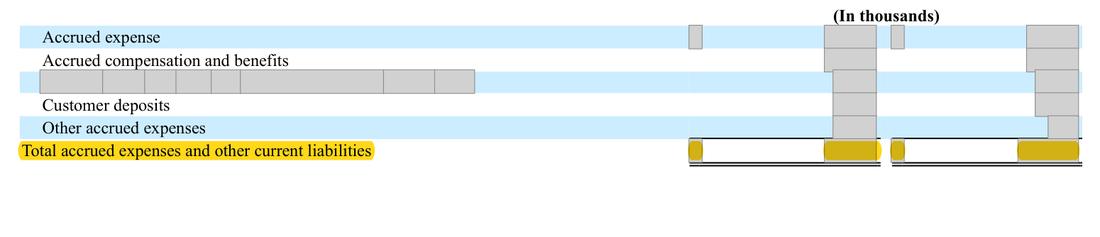
1.11 What does the single 'Accrued expense' line of [amount], [n]% of current liabilities, contain?
Company D · a US-listed cloud communications software company · SEC-style question
In brief
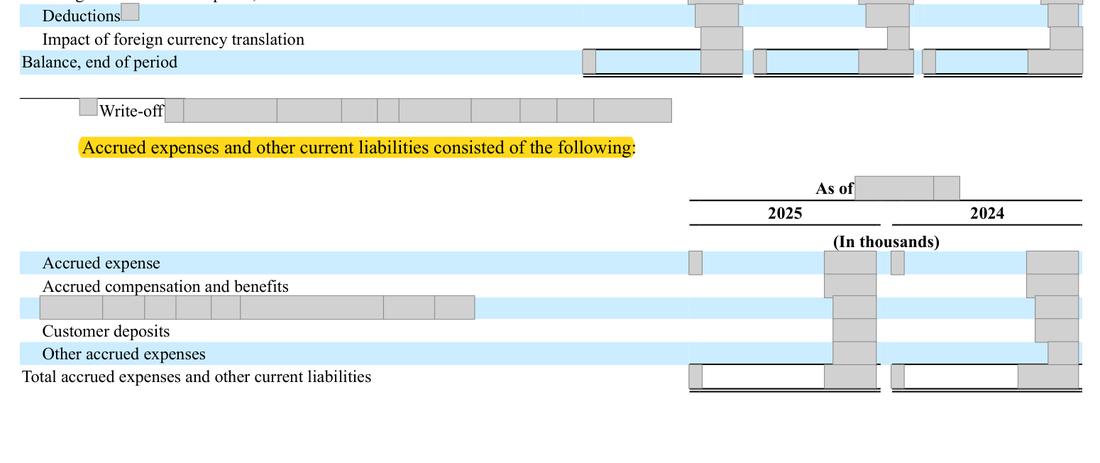
Note 3 splits accrued expenses and other current liabilities of [amount] into five lines, but the largest, 'Accrued expense' of [amount], carries no description of what it holds. Regulation S-X requires any item of other current liabilities above 5% of total current liabilities ([amount] this year) to be stated separately. The company can argue the line is one item already stated separately; the question is what it contains and whether any obligation of a distinct nature within it exceeds that threshold. The same line was [amount] in 2024 and [amount] in 2023.
The evidence, as filed


What the filing shows, and what the rule requires
| What the filing shows | What the rule requires |
|---|---|
'Accrued expense' [n] (2024: [n]) shown as one line in Note 3 with no description; it is 39.5% of total current liabilities of [n] and 66.7% of the note's total of [n]. The 2024 10-K showed the same line ([n] and [n]). | A description of what the [n] comprises and, if it holds obligations of different natures, each one above [n] (5% of total current liabilities) stated on its own line, with the remainder in one amount. |
The rule
Regulation S-X Rule 5-02, caption [n] (Other current liabilities)
Other current liabilities. State separately, in the balance sheet or in a note thereto, any item in excess of 5 percent of total current liabilities. Such items may include, but are not limited to, accrued payrolls, accrued interest, taxes, indicating the current portion of deferred income taxes, and the current portion of long-term debt. Remaining items may be shown in one amount.
Version: Text in force at the date of this review · Source: Regulation S-X, 17 CFR 210.5-02 (eCFR, as amended)
Why it applies here. Rule 5-02 caption [n] asks for each item over that threshold to be stated separately, and its illustrations (accrued payrolls, accrued interest, taxes) are items of a single nature. Whether a line labelled only 'Accrued expense' is one item or several is not answered by the filing, so the point is put as a question. It is one of presentation: no amount is said to be misstated.
Why it matters
Readers cannot tell what obligations make up the largest single current liability, larger than accounts payable, or why it moved; the staff has asked registrants to disaggregate such lines under caption [n].
Exposure
A question for management; if the staff reviews the filing, a comment letter and a future-filings undertaking to describe or split the line are the realistic outcome.
Our workings
the balance sheet shows accrued expenses and other current liabilities of [n] within total current liabilities of [n]. Note 3 gives accrued compensation and benefits, [wording masked], customer deposits and other accrued expenses separately, and leaves [n] as 'Accrued expense'. Nothing in the notes or MD&A says what that line contains. Note 10 says liability-classified performance awards are classified as accrued expenses on the balance sheet, without saying on which line of Note 3.
5% of total current liabilities is [n] (2024: [n]); the line is 39.5% of current liabilities (2024: 45.4%).
| Test | 2025 | 2024 |
|---|---|---|
| Total current liabilities (balance sheet) | [n] | [n] |
| 5% threshold | [n] x 5% = [n] | [n] x 5% = [n] |
| Undivided 'Accrued expense' line (Note 3) | [n] | [n] |
| Line as % of current liabilities | [n] / [n] = 39.5% | [n] / [n] = 45.4% |
| Line as % of the note's total | [n] / [n] = 66.7% | [n] / [n] = 62.5% |
| Times the threshold | [n] / [n] = [n] | [n] / [n] = [n] |
Management’s best defense, and our reply
Management would say 'Accrued expense' is itself an item: the accrual for goods and services received but not yet invoiced, already stated separately from payroll, taxes, customer deposits and other accrued expenses, and the rule's list of examples 'may include, but is not limited to' those named. They could add that the separate 'Other accrued expenses' line is the residual the rule allows in one amount. That reading is tenable, because the rule does not define an item and the filing does not show that the line mixes natures, so the point is put as a question rather than a finding. However, a line two-thirds of the note and eight times the threshold, with no description, does not let a reader see the nature of the obligation, which is what the caption [n] split is for.
The fix
- Describe the 'Accrued expense' line in Note 3 and, if it holds obligations of different natures, give each one above 5% of total current liabilities on its own line, for example accrued network service provider and carrier costs.
Question for the company
What does the [n] 'Accrued expense' balance at [date] ([n] at [date]) comprise by nature, does any obligation within it exceed [n] (5% of total current liabilities), and will Note 3 describe the line or split it in the next Form 10-K?
Evidence relied on
| # | What it shows | Type | Where |
|---|---|---|---|
| 1 | The largest component of the note is one undescribed line of [n] (2024: [n]) | Document | Form 10-K 2025, page 104 |
| 2 | The note's total, of which the undescribed line is two-thirds | Document | Form 10-K 2025, page 104 |
| 3 | Total current liabilities, the base for the 5% test | Document | Form 10-K 2025, page 84 |
| 4 | Liability-classified share awards are held in accrued expenses on the balance sheet; the note does not say on which line | Document | Form 10-K 2025, page 115 |
Absence check
- Document
- Form 10-K 2025
- Where it would appear
- Accrued expenses and other current liabilities consisted of the following
- What is missing
- a breakdown by nature of the [n] 'Accrued expense' line (each item over 5% of total current liabilities)
- Pages looked at
- p.84 and [n] (images); notes p.90-124 and MD&A p.61-77 (text)
- Result
- 'accrued network', 'accrued cost', 'accrued carrier' and 'surcharges payable' do not occur. 'accrued expense' hits p.69 (MD&A cash-flow narrative on the decrease in accrued expenses), [n] and [n] (balance-sheet and cash-flow captions), [n] (estimates list: 'certain accrued expenses'), [n] (finance leases sit in accrued expenses), [n] (carrying amounts approximate fair value), [n] (the table itself) and [n] (liability-classified awards sit in accrued expenses); none of them states what the [n] comprises.
Prepared by Pramanex from the company’s public SEC filings, without the company’s involvement, to show how a 10-K Pre-filing Check reads. The company is not named, and nothing on this page is a statement about any identifiable company. Observations are not an audit, review or other attestation or assurance engagement, and not legal advice. An SEC-style question is a question, not a conclusion.
Want this on your own 10-K, before you file?
Start with three free findings on your latest 10-K, or book a fixed-price 10-K Pre-filing Check.
Your next 10-K will be in draft before the audit is done.
Have it read before you file.
Start with three free findings on your latest 10-K, or book a fixed-price 10-K check. Drafts only under NDA, inside your insider trading policy.