1.10 The revenue note splits revenue only into cloud communications and surcharges, while the annual report explains revenue by three market offerings growing at very different rates
Company D · a US-listed cloud communications software company · SEC-style question
In brief
The revenue note disaggregates revenue into two categories, cloud communications and messaging surcharges (and Note 8 adds a United States / international split). Management's discussion and analysis, however, explains the year by three market offerings: [product line 1] grew by [n]%, [product line 2] fell by [n]% and [product line 3] grew by 21%, and Item 1 says about 60% of revenue came from voice and about 40% from messaging. The Codification asks the disaggregation to reflect the categories management uses outside the financial statements, so the company should explain why no amounts are given by offering.
The evidence, as filed
5 further page extracts: screenshot withheld to protect the company’s identity. The rows below say what each shows.
What the filing shows, and what the rule requires
| What the filing shows | What the rule requires |
|---|---|
Note 1 gives revenue by two categories (cloud communications, messaging surcharges) for three years; Note 8 gives revenue by United States and international. The offering-level picture appears only as growth rates in Management's discussion and analysis ([n]%, a [n]% fall, 21%) and approximate shares in Item 1 (about 60% voice, about 40% messaging), with no amounts. | Revenue by market offering or by product (voice, messaging) in the revenue note, or an explanation of why the categories used to discuss results outside the financial statements do not depict different economic factors. |
| What we checked. Revenue note (Note 1), geographic note (Note 8), the revenue discussion in Management's discussion and analysis, Item 1 product descriptions, the prior-year report, the 2024 staff correspondence and the two later quarterly reports | |
The rule
FASB ASC 606-10-50-5 to 50-6 and 606-10-55-89 to 55-91 (paraphrase; the Codification text is copyrighted)
Summary; FASB/IFRS text is copyrighted Disaggregate revenue into categories showing how economic factors affect the nature, amount, timing and uncertainty of revenue and cash flows; relate them to segment revenue.
Version: Text in force at the date of this review · Source: FASB Accounting Standards Codification, ASC 606-10-50-5 to 50-6 and 606-10-55-89 to 55-91 (as issued by ASU 2014-09)
Regulation S-X Rule 4-01(a)
The information required with respect to any statement shall be furnished as a minimum requirement to which shall be added such further material information as is necessary to make the required statements, in the light of the circumstances under which they are made, not misleading.
Version: Text in force at the date of this review · Source: Regulation S-X, 17 CFR 210.4-01(a)
Why it applies here. the Codification's disaggregation objective asks the company to consider the categories it uses in its annual report outside the financial statements, in earnings releases and in information reviewed by the chief operating decision maker. Offerings that move in opposite directions (from a [n]% fall to 21% growth) are affected differently by economic factors, which is the test for a separate category. The company may have reasons for keeping the note at two categories, so the point is put as a question.
Why it matters
Readers see the growth and decline of individual offerings only as percentages outside the audited statements, and cannot size them. The realistic result is a staff comment asking the company to explain its consideration of further disaggregation; no reported amount changes.
Exposure
A question for management; the realistic consequence is a staff comment and possibly a future-filings undertaking, with no change to any reported amount.
Our workings
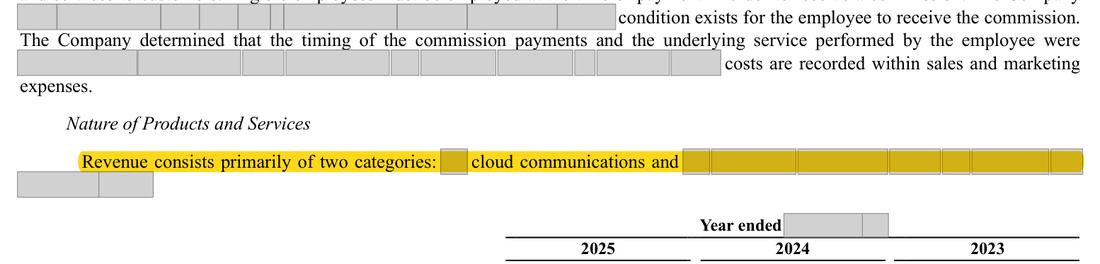
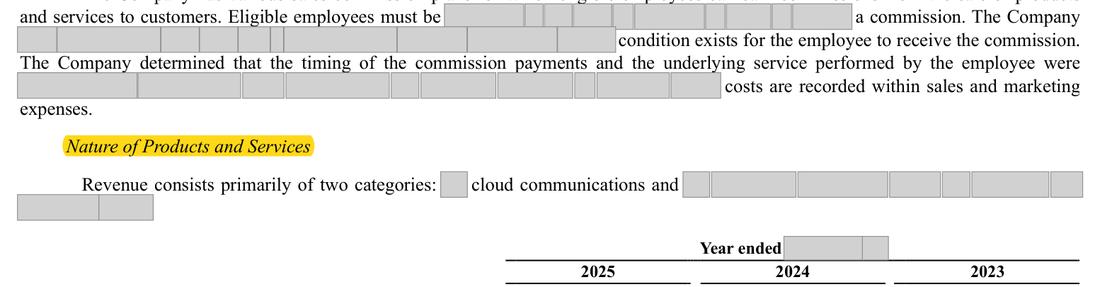
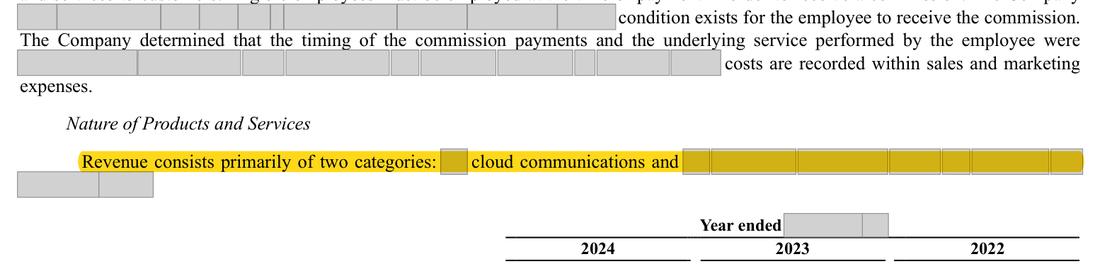
the revenue note says revenue consists primarily of two categories, cloud communications and messaging surcharges, and Note 8 adds revenue by United States and international. Management's discussion and analysis explains 2025 cloud communications revenue by three market offerings and their growth rates: [product line 1] up [n]%, [product line 2] down [n]% and [product line 3] up 21%. Item 1 says about 60% of consolidated revenue was earned from the voice domain and about 40% from the [product line 2] category. In its [date] reply to the staff, which asked about these offerings in the results discussion, the company undertook to align its disclosure of customer categories with its four principal product solutions.
| Category used to explain revenue | 2025 change or share as printed | Where |
|---|---|---|
| [product line 1] | grew by [n]% | Management's discussion and analysis |
| [product line 2] | decreased by [n]% | Management's discussion and analysis |
| [product line 3] | grew by 21% | Management's discussion and analysis |
| Voice domain | approximately 60% of consolidated revenue | Item 1 |
| [product line 2] category | approximately 40% of consolidated revenue | Item 1 |
Management’s best defense, and our reply
The finance team will say the note already disaggregates revenue in two ways, by type (cloud communications and pass-through surcharges) and by geography, and that every offering shares the same usage-based nature, the same performance obligation and the same timing of recognition, so a further split would add no information about nature, timing or uncertainty. They will add that the company described its offerings to the staff as customer categories used for descriptive purposes, and that Item 1 already gives the approximate voice and messaging shares. That is a credible position, which is why this is a question. However, the Codification points the company to the categories it uses outside the financial statements, and the company itself explains its results by these offerings with growth rates ranging from a [n]% fall to a 21% rise, which suggests different economic factors.
The fix
- Add to the revenue table a split of cloud communications revenue by market offering ([product line 1], [product line 3], [product line 2]), or a sentence explaining why those categories share the same nature, timing and uncertainty and are therefore not disaggregated.
Question for the company
Why does the revenue note not disaggregate cloud communications revenue by the market offerings ([product line 1], [product line 3], [product line 2]) that the company uses to explain its results, and would the company consider adding that split?
Evidence relied on
| # | What it shows | Type | Where |
|---|---|---|---|
| 1 | The revenue note disaggregates by two categories only | Document | Form 10-K 2025, page 91 |
| 2 | Management's discussion and analysis explains revenue by market offering: [product line 1] up [n]% | Document | Form 10-K 2025, page 66 |
| 3 | [product line 2] down [n]% | Document | Form 10-K 2025, page 66 |
| 4 | [product line 3] up 21% | Document | Form 10-K 2025, page 66 |
| 5 | Item 1 gives an approximate voice share, without amounts | Document | Form 10-K 2025, page 9 |
| 6 | Item 1 gives an approximate messaging share, without amounts | Document | Form 10-K 2025, page 10 |
| 7 | The company's 2024 undertaking to the staff on the offering and product categories | Document |
Absence check
- Document
- Form 10-K 2025
- Where it would appear
- Nature of Products and Services
- What is missing
- revenue amounts by market offering ([product line 1], [product line 3], [product line 2]) or by product (voice, messaging)
- Pages looked at
- p.7-10, 62-66, 90-92, [n] (Item 1 offerings, revenue discussion, revenue note, geographic note)
- Result
- '[product line 1] revenue', '[product line 3] revenue' and '[product line 2] revenue' each hit once, on p.66, the revenue discussion in Management's discussion and analysis, which gives growth rates only and no amounts. 'by market offering' has no hits.
Prepared by Pramanex from the company’s public SEC filings, without the company’s involvement, to show how a 10-K Pre-filing Check reads. The company is not named, and nothing on this page is a statement about any identifiable company. Observations are not an audit, review or other attestation or assurance engagement, and not legal advice. An SEC-style question is a question, not a conclusion.
Want this on your own 10-K, before you file?
Start with three free findings on your latest 10-K, or book a fixed-price 10-K Pre-filing Check.
Your next 10-K will be in draft before the audit is done.
Have it read before you file.
Start with three free findings on your latest 10-K, or book a fixed-price 10-K check. Drafts only under NDA, inside your insider trading policy.