1.10 First-year rate reconciliation: an aggregated foreign line above the 5% threshold, a tax-credit line that increases tax, and a valuation-allowance gap
Company C · a US-listed specialty healthcare products company · SEC-style question
In brief
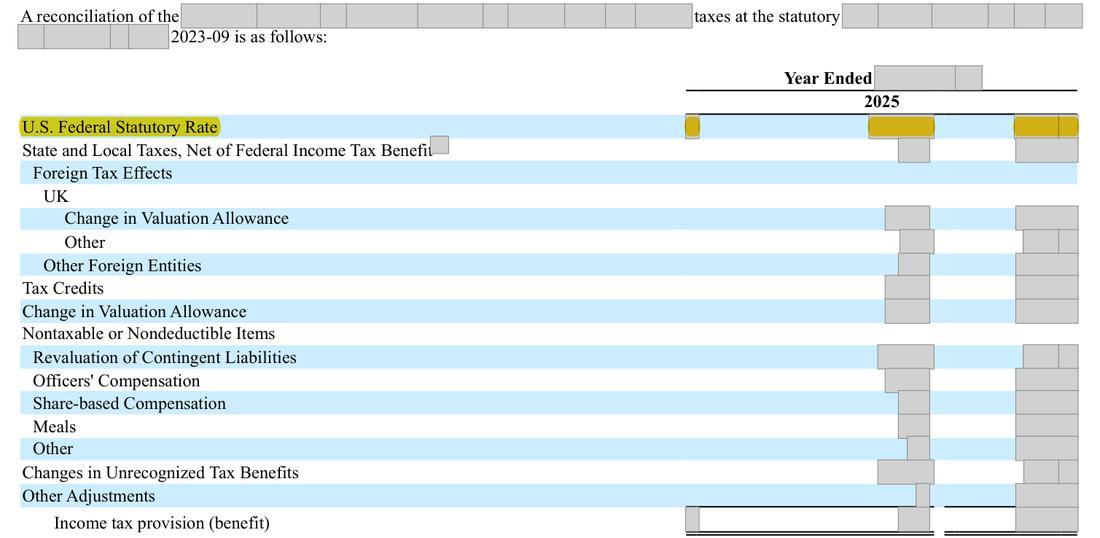
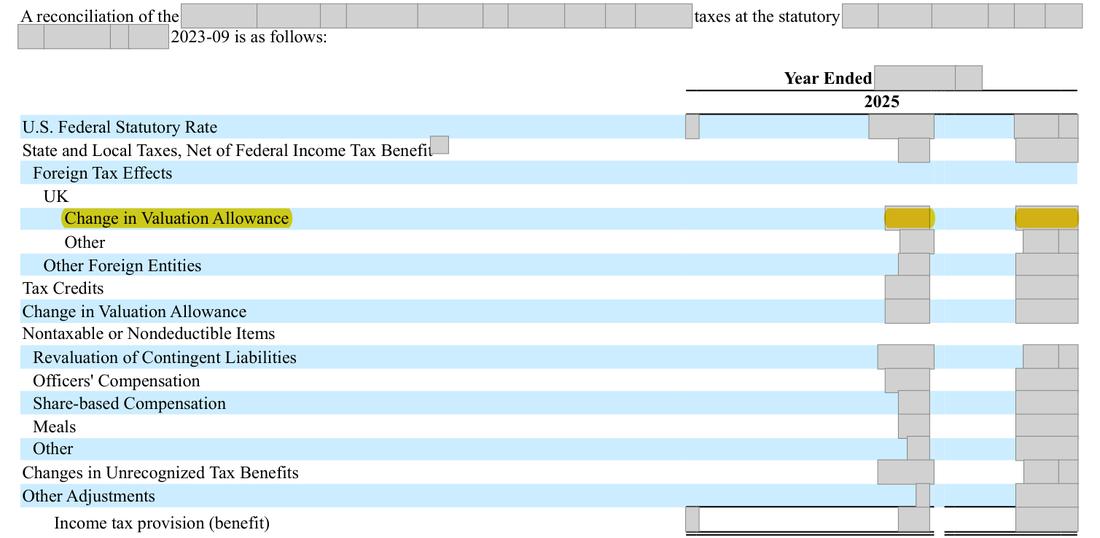
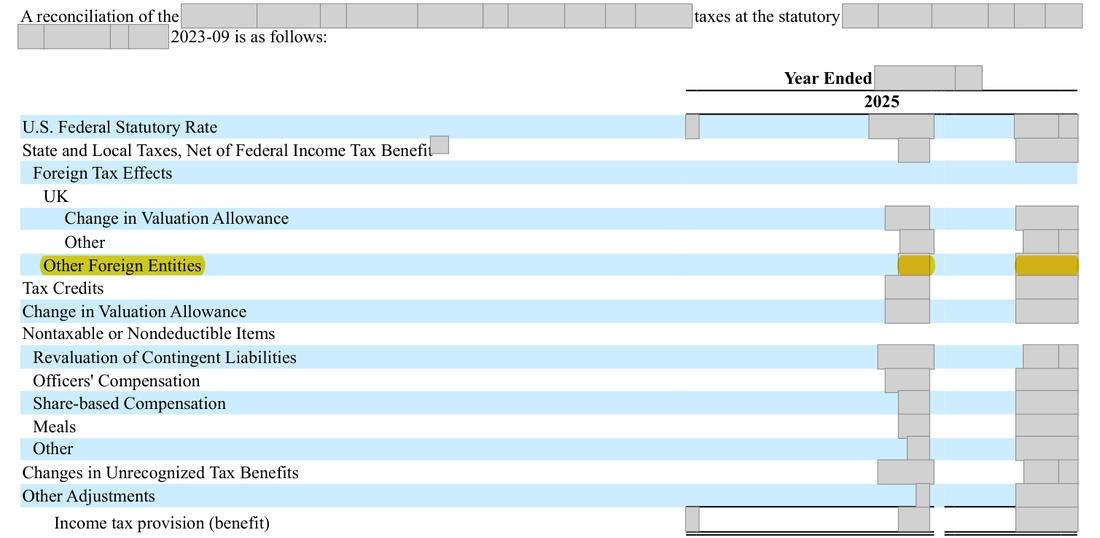
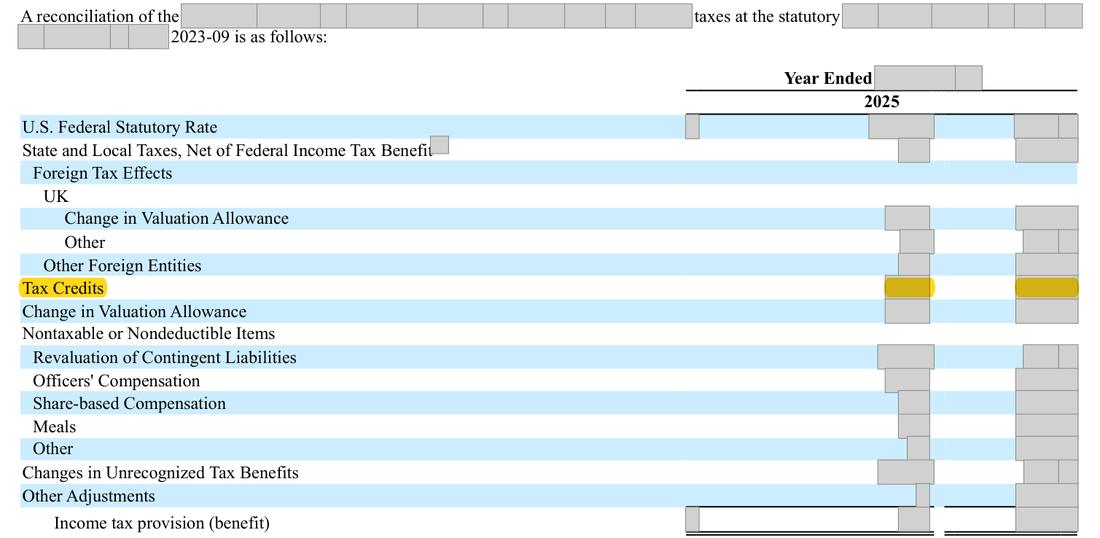
2025 is the first year of the expanded rate reconciliation. Three lines need explaining: 'Other Foreign Entities' of [amount] is above the 5% threshold of [amount] but is one aggregated line; 'Tax Credits' adds [amount] to tax although credits normally reduce it, beside a [amount] release of unrecognized tax benefits that equals the fall in the research credit asset; and the valuation-allowance lines total [amount] against a [amount] increase in the allowance in the deferred tax table.
The evidence, as filed
What the filing shows, and what the rule requires
| What the filing shows | What the rule requires |
|---|---|
Rate reconciliation 2025 with Other Foreign Entities [n] as one line; Tax Credits [n] increasing tax; Changes in Unrecognized Tax Benefits ([n]); valuation allowance lines [n] (UK) and [n], total [n], against an allowance increase of [n] | Each foreign jurisdiction whose effect reaches 5% of the tax at the statutory rate shown separately (by nature); an explanation of why the tax-credit category increases tax and how it relates to the release of unrecognized tax benefits; the valuation-allowance movement reconciled or the [n] difference explained |
| What we checked. Note 13: pre-tax income split, provision components, both rate reconciliations, deferred tax table, unrecognized tax benefit roll-forward and income taxes paid | |
The rule
FASB ASC 740-10-50-12A to 50-12C (rate reconciliation categories and 5% threshold, ASU 2023-09; paraphrase, Codification text not reproduced)
Summary; FASB/IFRS text is copyrighted PBEs disclose annually a tabular rate reconciliation in percentages and amounts with specified categories, separately itemising qualifying reconciling items, and explaining state and local effects.
Version: Text in force at the date of this review · Source: FASB Accounting Standards Codification, ASC 740-10-50-12A to 50-12C (as amended by ASU 2023-09)
Regulation S-X Rule 4-08(h)(2)
Reconciling items that are individually less than five percent of the computed amount may be aggregated in the reconciliation.
Version: Text in force at the date of this review · Source: Regulation S-X, 17 CFR 210.4-08(h) (eCFR as in force for fiscal 2025)
Why it applies here. the reconciliation may comply, but three lines need management's explanation; Regulation S-X Rule 4-08(h)(2) allows only items individually below 5% to be aggregated, and the new categories are meant to show the nature of each effect.
Why it matters
Readers cannot tell which foreign jurisdictions drive the foreign effect, why credits increase tax, or how the valuation-allowance movement fits the reconciliation, in the first year of the new format.
Exposure
A question for management; income-tax disclosure under the new standard is a frequent subject of staff comments in its first year.
Our workings
the 2025 reconciliation starts from tax at 21% of the pre-tax loss, ([n]), and lists the categories introduced by Accounting Standards Update (ASU) 2023-09, which the company says it adopted prospectively.
the 5% threshold is [n] ([n] x 5%). The line 'Other Foreign Entities' is [n], which exceeds the threshold by [n] ([n] - [n]), yet it is presented as one amount for several jurisdictions; the income taxes paid table shows payments in [country], the [country] ([n]) and [country], so it is not apparent whether one jurisdiction alone reaches [n]. 'Tax Credits' is a positive [n], an increase in tax, while 'Changes in Unrecognized Tax Benefits' is a reduction of [n], the same amount by which the research and development credit asset fell ([n] - [n] = [n]); the unrecognized tax benefit roll-forward shows a decrease of [n] for prior-year positions. The two valuation-allowance lines total [n] ([n] + [n]), while the allowance in the deferred tax table rose by [n] ([n] - [n]), leaving [n] ([n] - [n]) not shown in the reconciliation, which may be currency translation or allowance placed in another line.
| Test | Computation | Result |
|---|---|---|
| 5% threshold | [n] x 5% = [n] | [n] |
| Other Foreign Entities vs threshold | [n] - [n] = [n] | above threshold by [n] |
| Fall in research credit asset | [n] - [n] = [n] | equals the unrecognized tax benefit line ([n]) |
| Valuation allowance in reconciliation | [n] + [n] = [n] | [n] |
| Valuation allowance increase in deferred tax table | [n] - [n] = [n] | [n] |
| Difference | [n] - [n] = [n] | not explained |
Management’s best defense, and our reply
Management can say that 'Other Foreign Entities' combines several small subsidiaries, none of which reaches the threshold on its own, that the tax-credit line reflects credits written off on completion of the credit study and is offset by the release of the related unrecognized benefits, and that the valuation-allowance difference is currency translation recorded outside the reconciliation. Each of those explanations is plausible and consistent with the figures. The answer: none of them is stated in the note, and in the first year of the new categories a reader needs them to understand the reconciliation, so the point is a question rather than a finding.
The fix
- Split 'Other Foreign Entities' by jurisdiction (and nature) where any one reaches 5% of the statutory-rate tax, explain the tax-credit and unrecognized-benefit lines in a sentence, and reconcile the valuation-allowance lines to the deferred tax table (for example, translation of the UK allowance).
Question for the company
Which jurisdictions make up 'Other Foreign Entities' ([n]) and does any of them alone reach the 5% threshold of [n]; why does the 'Tax Credits' category increase tax by [n] and how does it relate to the [n] release of unrecognized tax benefits and the fall in the research credit asset; and what explains the [n] difference between the valuation-allowance lines ([n]) and the increase in the allowance ([n])?
Evidence relied on
| # | What it shows | Type | Where |
|---|---|---|---|
| 1 | Tax at the statutory rate, the base for the 5% threshold | Document | Form 10-K 2025, page 91 |
| 2 | UK valuation allowance line | Document | Form 10-K 2025, page 91 |
| 3 | Aggregated foreign line above the 5% threshold | Document | Form 10-K 2025, page 91 |
| 4 | Tax-credit category increases tax | Document | Form 10-K 2025, page 91 |
| 5 | Domestic valuation allowance line | Document | Form 10-K 2025, page 91 |
| 6 | Release of unrecognized tax benefits | Document | Form 10-K 2025, page 91 |
| 7 | Research credit deferred tax asset fell by [n] | Document | Form 10-K 2025, page 92 |
| 8 | Valuation allowance balances: increase of [n] in 2025 | Document | Form 10-K 2025, page 92 |
| 9 | Unrecognized tax benefit roll-forward | Document | Form 10-K 2025, page 93 |
| 10 | Income taxes paid in the [country], one of the foreign jurisdictions | Document | Form 10-K 2025, page 93 |
Prepared by Pramanex from the company’s public SEC filings, without the company’s involvement, to show how a 10-K Pre-filing Check reads. The company is not named, and nothing on this page is a statement about any identifiable company. Observations are not an audit, review or other attestation or assurance engagement, and not legal advice. An SEC-style question is a question, not a conclusion.
Want this on your own 10-K, before you file?
Start with three free findings on your latest 10-K, or book a fixed-price 10-K Pre-filing Check.
Your next 10-K will be in draft before the audit is done.
Have it read before you file.
Start with three free findings on your latest 10-K, or book a fixed-price 10-K check. Drafts only under NDA, inside your insider trading policy.