1.09 Research and development credit carryforwards fell sharply; the amounts appear in the rate reconciliation but the reason is not given
Company C · a US-listed specialty healthcare products company · SEC-style question
In brief
Federal research and development credit carryforwards fell from [amount] to [amount] and [state] credits from [amount] to [amount] in 2025, and the first federal expiry year moved from 2034 to 2039. The new rate reconciliation shows a 'Tax Credits' item of [amount] and a [amount] change in unrecognized tax benefits, which match the fall in federal credits and in the deferred tax asset for credits, so the amounts are disclosed. What the note does not give is the reason the oldest credits were removed.
The evidence, as filed

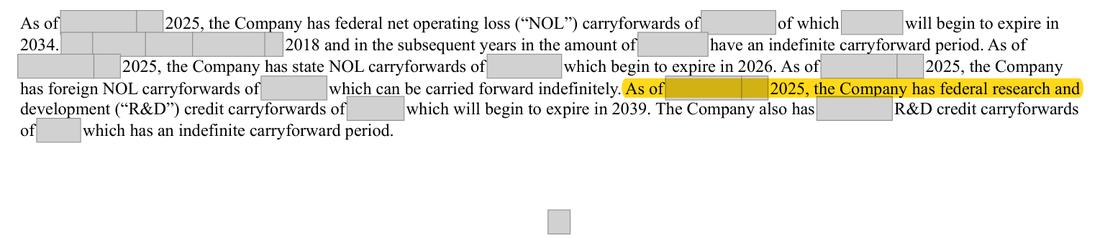
2 further page extracts: screenshot withheld to protect the company’s identity. The rows below say what each shows.
What the filing shows, and what the rule requires
| What the filing shows | What the rule requires |
|---|---|
Federal credits [n] (from [n]), [state] [n] (from [n]), first federal expiry 2039 (from 2034), deferred tax asset for credits [n] (from [n]); rate reconciliation 'Tax Credits' [n] and 'Changes in Unrecognized Tax Benefits' ([n]); no reason given. | A sentence explaining the reduction (for example a completed credit study or the re-measurement of prior-year positions) and why the earliest federal expiry year changed. |
Why it matters
Readers can size the reduction but cannot tell whether credits were lost, limited or re-measured, which matters for the value of the tax attributes if the valuation allowance is released.
Exposure
None until the company answers; income taxes are a frequent SEC staff comment theme.
Our workings
the 2024 Form 10-K reported federal credit carryforwards of [amount] beginning to expire in 2034 and [state] credits of [amount]; the 2025 note reports [amount] beginning to expire in 2039 and [amount]. The deferred tax asset for credits fell from [amount] to [amount]. The rate reconciliation adopted this year under the new income tax disclosure standard shows 'Tax Credits' of [amount] (a cost) and 'Changes in Unrecognized Tax Benefits' of [amount]. The unrecognized tax benefits roll-forward shows a [amount] decrease for prior-year positions and a [amount] increase for current-year positions, and the note says these benefits relate primarily to credits. The note also says a Section 382 study through 2024 found several ownership changes but that carryforwards are not expected to expire unused solely because of it.
federal credits fell by [amount], which the 'Tax Credits' item of [amount] matches within rounding; the deferred tax asset for credits fell by [amount], the same as the change in unrecognized tax benefits in the reconciliation; [state] credits fell by [amount] (workings).
the amounts are disclosed and tie, so the statements are not in question; the five-year shift in the first expiry year means the oldest federal credits were removed rather than used, and the note does not say why. Because a full valuation allowance is held, there is no effect on the balance sheet or results; the point is the clarity of the carryforward disclosure.
| Item | Working | Result |
|---|---|---|
| Fall in federal credit carryforwards | [n] - [n] | [n] |
| Rate reconciliation 'Tax Credits' item | [n] against [n] | ties within rounding |
| Fall in deferred tax asset for credits | [n] - [n] | [n] |
| Rate reconciliation change in unrecognized tax benefits | ([n]) against [n] | ties |
| Fall in [state] credit carryforwards | [n] - [n] | [n] |
| Unrecognized tax benefits roll-forward 2025 | [n] - [n] + [n] | [n] |
Management’s best defense, and our reply
The company can say that the reduction is a re-measurement of credits following its review, already quantified in the rate reconciliation ('Tax Credits' [n] and the change in unrecognized tax benefits) and in the roll-forward of unrecognized tax benefits. It would add that with a full valuation allowance there is no effect on the financial statements, and that the income tax standard asks for the amounts and expiry dates of carryforwards, which are given, not a narrative of why they changed. That is a reasonable position, which is why this is a question. The answer: the note gives the amounts but not the cause, and the move of the first federal expiry year from 2034 to 2039 shows the oldest credits were removed, so only the company can say why.
The fix
- Add a sentence to Note 13, e.g. 'The decrease in research and development credit carryforwards in 2025 reflects [the re-measurement of prior-year credits / a Section 383 limitation], which also reduced unrecognized tax benefits.'
Question for the company
What removed the federal research and development credits that were due to expire from 2034 (the first expiry year is now 2039), and what reduced the [state] credits from [n] to [n]? Is the reduction the re-measurement shown as the decrease in unrecognized tax benefits for prior-year positions, or a result of the Section 382 study?
Evidence relied on
| # | What it shows | Type | Where |
|---|---|---|---|
| 1 | 2025: federal credits and first expiry year | Document | Form 10-K 2025, page 92 |
| 2 | 2025: [state] credits ([n] on the next line) | Document | Form 10-K 2025, page 92 |
| 3 | Deferred tax asset for credits | Document | Form 10-K 2025, page 92 |
| 4 | 2025: [state] credits of [n] | Document | Form 10-K 2025, page 92 |
| 5 | Decrease in unrecognized tax benefits for prior-year positions | Document | Form 10-K 2025, page 93 |
| 6 | Increase for current-year positions | Document | Form 10-K 2025, page 93 |
| 7 | Opening unrecognized tax benefits | Document | Form 10-K 2025, page 93 |
| 8 | The unrecognized tax benefits relate primarily to credits | Document | Form 10-K 2025, page 93 |
| 9 | 2024 Form 10-K: federal [n] from 2034; [state] [n] | Document | Form 10-K 2024 (prior year), page 94 |
| 10 | Rate reconciliation: tax credits item of [n], matching the fall in federal credits | Document | Form 10-K 2025, page 91 |
| 11 | Rate reconciliation: change in unrecognized tax benefits of ([n]), matching the fall in the deferred tax asset for credits | Document | Form 10-K 2025, page 91 |
Absence check
- Document
- Form 10-K 2025
- Where it would appear
- As of [date], the Company has federal research and
- What is missing
- the reason the research and development credit carryforwards fell in 2025 and why the first federal expiry year moved from 2034 to 2039
- Pages looked at
- whole Form 10-K text; Note 13 income taxes p.90-93 read on the page images; Item 1A tax attribute risk factor p.27
- Result
- p.27 (risk factor) gives the 2025 amounts of [n] and [n] and an expiry from 2034 for NOLs and credits, with no reason for the fall; p.91 rate reconciliation gives the Tax Credits item and the change in unrecognized tax benefits (amounts only); p.92 gives the carryforward amounts and the 2039 expiry; p.93 gives the Section 382 study and the unrecognized tax benefits roll-forward, with no link to the credits' fall. No page gives the cause.
Prepared by Pramanex from the company’s public SEC filings, without the company’s involvement, to show how a 10-K Pre-filing Check reads. The company is not named, and nothing on this page is a statement about any identifiable company. Observations are not an audit, review or other attestation or assurance engagement, and not legal advice. An SEC-style question is a question, not a conclusion.
Want this on your own 10-K, before you file?
Start with three free findings on your latest 10-K, or book a fixed-price 10-K Pre-filing Check.
Your next 10-K will be in draft before the audit is done.
Have it read before you file.
Start with three free findings on your latest 10-K, or book a fixed-price 10-K check. Drafts only under NDA, inside your insider trading policy.