1.02 The Level 3 royalty obligation gives no figure for its key input, projected Product 1 net revenues
Company C · a US-listed specialty healthcare products company · Compliance or disclosure gap
In brief
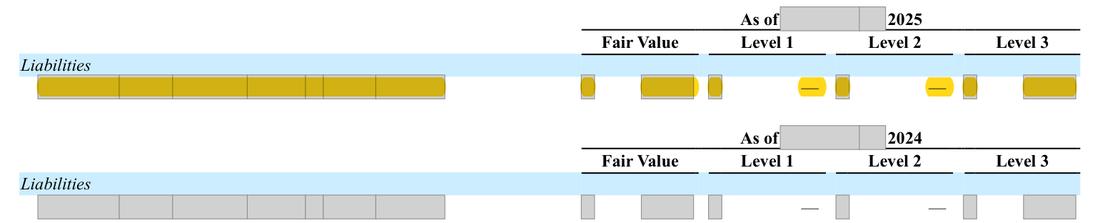
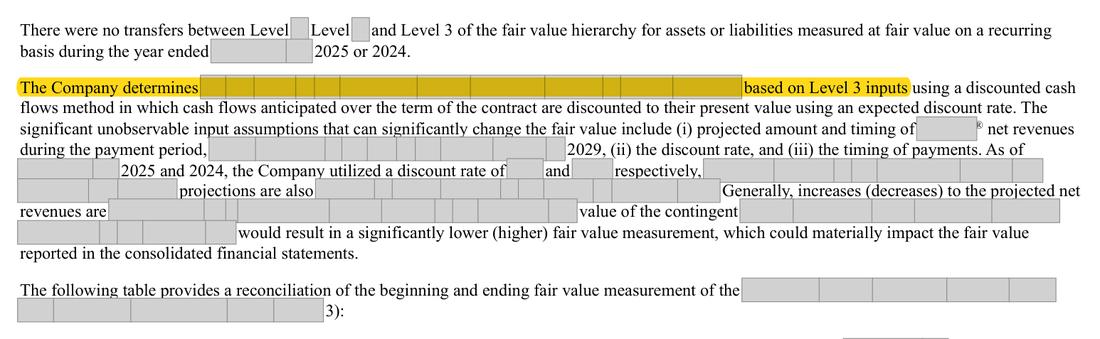
[wording masked], [amount], is the company's only recurring Level 3 measurement, and the auditor's critical audit matter (CAM) says its key input is the projected US net revenues of Product 1. The fair value note names that input but gives no figure for it (no amount, range or growth rate); it quantifies only the discount rate ([n]% and [n]%). The 2024 Form 10-K did the same.
The evidence, as filed


What the filing shows, and what the rule requires
| What the filing shows | What the rule requires |
|---|---|
Significant unobservable inputs listed as projected net revenues, discount rate and timing; only the discount rate is quantified ([n]% at 2025, [n]% at 2024) | Quantitative information about each significant unobservable input that the company develops, including projected net revenues (for example the aggregate or annual revenue assumed, or the growth-rate range and weighted average), alongside the discount rate |
| What we checked. Fair value note, critical accounting estimates, auditor's report and the Level 3 roll-forward in both years; whole-report search | |
The rule
FASB ASC 820-10-50-2(bbb) (quantitative information about significant unobservable inputs; paraphrase, Codification text not reproduced)
Summary; FASB/IFRS text is copyrighted Disclose fair values by hierarchy level, Level 3 techniques and significant unobservable inputs with ranges and weighted averages, Level 3 changes and measurement uncertainty.
Version: Text in force at the date of this review · Source: FASB Accounting Standards Codification, ASC 820-10-50-2 (as amended by ASU 2018-13)
Regulation S-X Rule 4-01(a)(1)
Financial statements filed with the Commission which are not prepared in accordance with generally accepted accounting principles will be presumed to be misleading or inaccurate, despite footnote or other disclosures
Version: Text in force at the date of this review · Source: Regulation S-X, 17 CFR 210.4-01 (eCFR as in force for fiscal 2025)
Why it applies here. paragraph 820-10-50-2(bbb) of the Accounting Standards Codification (ASC) requires quantitative information about the significant unobservable inputs used in a recurring Level 3 measurement; the exemption for inputs not developed by the entity does not apply because management itself prepares the revenue projection. Naming the input without any figure is a partial disclosure, repeated in both years.
Why it matters
Readers cannot judge the revenue path behind a [n] liability whose remeasurement swung operating expenses by a [n] gain in 2025, and cannot connect the measurement to the auditor's CAM.
Exposure
Level 3 input disclosure is a recurring subject of staff comments on fair value; the usual outcome is a comment letter and a future-filings undertaking.
Our workings
Note 3 measures [wording masked], [n] at [date], entirely on Level 3 inputs by discounted cash flows, and lists the significant unobservable inputs as (i) projected amount and timing of Product 1 net revenues, (ii) the discount rate and (iii) the timing of payments. Only the discount rate is given a figure ([n]% for 2025, [n]% for 2024; [n]% to 15% in the prior-year report). The auditor's report identifies the projected US net revenues as the input that made the estimate a CAM, and the remeasurement moved operating expenses by a gain of [n] in 2025 after losses of [n] in 2024.
| Element (Level 3, recurring) | Where | Status |
|---|---|---|
| Fair value by level | Note 3 table | Given ([n], Level 3) |
| Valuation technique | Note 3 | Given (discounted cash flows) |
| Discount rate | Note 3 | Given ([n]% and [n]%) |
| Projected net revenues | Note 3, critical accounting estimates | Absent: named, not quantified |
| Level 3 roll-forward | Note 3 | Given ([n] - [n] - [n] = [n]) |
| Narrative sensitivity | Note 3 | Given |
Management’s best defense, and our reply
Management can argue that the revenue projection is commercially sensitive and that publishing it would amount to multi-year revenue guidance, and that the narrative sensitivity, the discount rate and the full roll-forward already let readers understand the measurement. It can add that the auditor reviewed the disclosure in both years without objection. The answer: the standard has no exemption for commercially sensitive inputs that the entity develops itself, and a range or growth rate over the remaining payment period would meet it without annual guidance; the auditor's own CAM shows the projection is the input that matters, so leaving it unquantified is a partial disclosure, not a judgment call.
The fix
- Add to Note 3 a table of significant unobservable inputs: valuation technique, projected Product 1 net revenues over the remaining payment period (range or annual growth rate and weighted average), discount rate and expected payment timing, for both balance-sheet dates.
Evidence relied on
| # | What it shows | Type | Where |
|---|---|---|---|
| 1 | The obligation is wholly Level 3 at [date] | Document | Form 10-K 2025, page 79 |
| 2 | Projected net revenues named as a significant unobservable input | Document | Form 10-K 2025, page 79 |
| 3 | Only the discount rate is quantified | Document | Form 10-K 2025, page 79 |
| 4 | Level 3 roll-forward: payments | Document | Form 10-K 2025, page 79 |
| 5 | Level 3 roll-forward: remeasurement in operating expenses | Document | Form 10-K 2025, page 79 |
| 6 | Level 3 roll-forward: opening balances | Document | Form 10-K 2025, page 79 |
| 7 | The auditor's CAM identifies projected revenues as the key input | Document | Form 10-K 2025, page 61 |
| 8 | Prior year: again only the discount rate is quantified | Document | Form 10-K 2024 (prior year), page 80 |
Absence check
- Document
- Form 10-K 2025
- Where it would appear
- [wording masked] obligation payable to the Company [wording masked] 3 inputs
- What is missing
- a figure (amount, range or growth rate, with weighted average) for the projected Product 1 net revenues used in the measurement
- Pages looked at
- p.56-57 (critical accounting estimates), 63-64 (auditor's report), [n] (policy), 82-83 (fair value note)
- Result
- 'projected' hits p.57 and p.79 (the input is named without a figure), p.61 (the auditor's CAM naming the input) and p.77 (projected taxable income, unrelated); 'revenue projections' hits p.79 only, saying projections are updated, without a figure; 'growth rate' and 'compound annual' have no hits.
Prepared by Pramanex from the company’s public SEC filings, without the company’s involvement, to show how a 10-K Pre-filing Check reads. The company is not named, and nothing on this page is a statement about any identifiable company. Observations are not an audit, review or other attestation or assurance engagement, and not legal advice. An SEC-style question is a question, not a conclusion.
Want this on your own 10-K, before you file?
Start with three free findings on your latest 10-K, or book a fixed-price 10-K Pre-filing Check.
Your next 10-K will be in draft before the audit is done.
Have it read before you file.
Start with three free findings on your latest 10-K, or book a fixed-price 10-K check. Drafts only under NDA, inside your insider trading policy.