1.01 The segment note no longer gives revenue by country or the location of long-lived assets
Company C · a US-listed specialty healthcare products company · Compliance or disclosure gap
In brief
The 2025 segment note describes the single segment, its expenses and customer concentration, but gives no split of revenue between the United States and foreign countries and does not say where long-lived assets are held. The 2024 Form 10-K gave both: international revenue of [amount] for 2024 and a statement that all long-lived assets were in the United States. The company operates in [country], Europe and [country] and paid foreign income taxes in 2025, so foreign revenue exists; the income tax note (p.90) shows foreign operations made a loss before income taxes of [amount] in 2025 ([amount] in 2024), so the foreign business is not small. US GAAP requires these entity-wide figures from every public company, including one with a single segment.
The evidence, as filed

1 further page extract: screenshot withheld to protect the company’s identity. The rows below say what each shows.
What the filing shows, and what the rule requires
| What the filing shows | What the rule requires |
|---|---|
Note 14 gives revenue by product (Product 1, Product line 2) and by product versus service only; no revenue attributed to the United States and to foreign countries, and no statement of long-lived assets by location, for any year presented. | A table of revenue from external customers attributed to the United States and to all foreign countries in total (and any material individual country) for 2025, 2024 and 2023, and long-lived assets in the United States and abroad (or a statement that all are in the United States). |
The rule
FASB ASC 280-10-50-40 to 50-42 (entity-wide disclosures; 50-41 information about geographic areas)
Summary; FASB/IFRS text is copyrighted Disclose revenues by product or service group and by geography (domicile and material individual foreign countries), long-lived assets by geography, and reliance on 10%-plus customers.
Version: Text in force at the date of this review · Source: FASB Accounting Standards Codification, ASC 280-10-50-40 to 50-42 (as amended by ASU 2023-07), paraphrased (Codification text is copyrighted)
Why it applies here. international revenue continued in 2025, and the entity-wide disclosure that the segment reporting topic of the Accounting Standards Codification (ASC) requires of a single-segment public company is not given for any year. The requirement has no size threshold for the domicile-versus-foreign split; only an individual foreign country is shown separately when material, and the only escape is impracticability, which cannot apply to figures the company produced a year ago.
Why it matters
Readers lose the only audited measure of the growth of the international business (Europe, [country], [country]), which the company presents as a strategic priority; the audited notes fall short of a required US GAAP disclosure.
Exposure
Segment disclosures are among the most frequent SEC staff comment themes; the realistic consequence is a comment letter asking for the disclosure and a commitment to give it in future filings.
Our workings
Note 14 states the company has one operating and reportable segment, gives segment revenue by product and significant segment expenses, then a paragraph on segment assets and a sentence on customer concentration; Note 15 follows. Nothing in the note, the revenue policy (which refers the reader to Note 14 for disaggregation by revenue source) or the results discussion in Item 7 gives revenue by country or the location of long-lived assets. The 2024 Form 10-K gave a revenue-by-country table (United States and International) for three years and said all long-lived assets were in the United States. The 2025 report says the company operates in the United States, [country], Europe and [country] and conducts business in foreign countries, and the new income-taxes-paid table shows taxes paid in [country], the [country] and [country].
international revenue was 3.30% of total in 2023 and 4.93% in 2024 (workings); foreign income taxes paid in 2025 were [amount].
| Item | Working | Result |
|---|---|---|
| International share of revenue 2023 (prior-year report) | [n] / [n] | 3.30% |
| International share of revenue 2024 (prior-year report) | [n] / [n] | 4.93% |
| Foreign income taxes paid 2025 | [n] + [n] + [n] | [n] |
Management’s best defense, and our reply
Management could argue that international revenue is small, under 5% of the total in 2024, and that the materiality principle of the Codification lets an entity leave out an immaterial disclosure; it could add that the auditor raised no objection. However, the split between the country of domicile and all foreign countries is a standing requirement for every public entity with no size threshold, the company itself judged it worth giving last year, the international business is growing with [wording masked] the device products, and the 2025 report gives no impracticability statement. The defense does not explain why figures produced a year ago were dropped.
The fix
- Restore in Note 14 a table of revenue attributed to the United States and to foreign countries (and any material individual country) for each year presented, and state where long-lived assets are held, e.g. 'All long-lived assets are located in the United States' or amounts by area.
Evidence relied on
| # | What it shows | Type | Where |
|---|---|---|---|
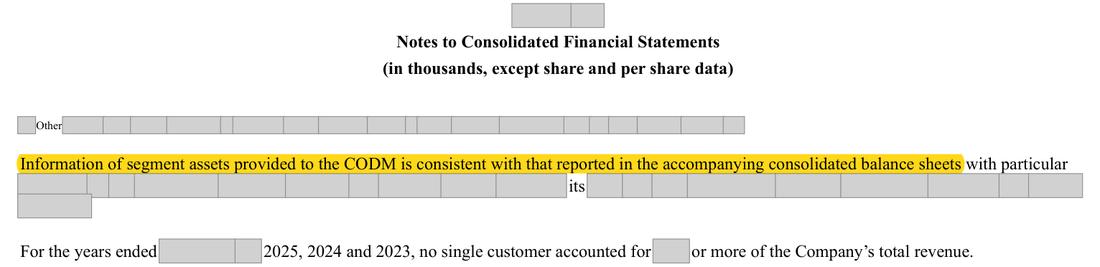
| 1 | Note 14 opens: one operating and reportable segment, so the entity-wide disclosures are the only geographic information the notes can carry | Document | Form 10-K 2025, page 94 |
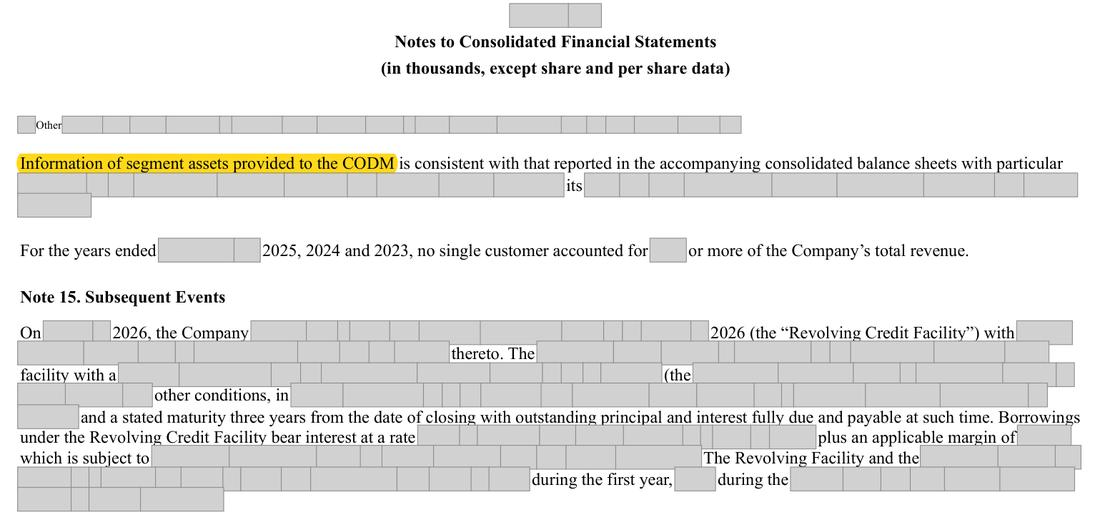
| 2 | The note continues with segment assets and customer concentration, then Note 15; no revenue by country or asset location | Document | Form 10-K 2025, page 95 |
| 3 | The company operates outside the United States | Document | Form 10-K 2025, page 25 |
| 4 | Item 7A confirms business is conducted in foreign countries | Document | Form 10-K 2025, page 58 |
| 5 | Income taxes paid in [country] in 2025 | Document | Form 10-K 2025, page 93 |
| 6 | Income taxes paid in the [country] in 2025 | Document | Form 10-K 2025, page 93 |
| 7 | Income taxes paid in [country] in 2025 | Document | Form 10-K 2025, page 93 |
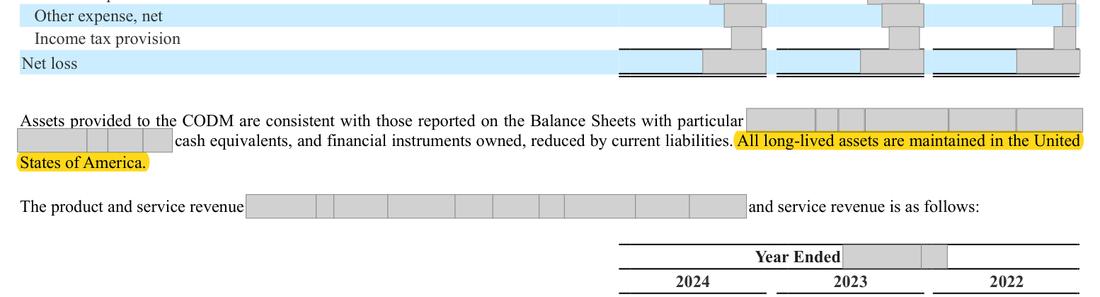
| 8 | Prior-year report: international revenue 2024, 2023, 2022 | Document | Form 10-K 2024 (prior year), page 96 |
| 9 | Prior-year report: total revenue by country (denominator of the shares) | Document | Form 10-K 2024 (prior year), page 96 |
| 10 | The tax note shows a foreign pre-tax loss of [n] for 2025 ([n] for 2024), confirming foreign operations of a size that the geographic disclosure would describe | Document | Form 10-K 2025, page 90 |
| 11 | Income taxes paid in the [country], [country] and [country] show revenue-earning foreign subsidiaries | Document | Form 10-K 2025, page 93 |
Absence check
- Document
- Form 10-K 2025
- Where it would appear
- Information of segment assets provided to the CODM
- What is missing
- Revenue from external customers attributed to the United States and to all foreign countries, and long-lived assets by location
- Pages looked at
- p.94-95 (Note 14), p.74 (revenue policy, disaggregation), p.49 (results of operations table)
- Result
- 'attributed to', 'revenue by country', 'maintained in the United States' and 'country of domicile' have no hits. 'foreign countries' hits p.13, [n] (regulation and intellectual-property risk factors) and p.58 (currency risk): no revenue by country. 'geographic' hits p.25 and [n] (risk factors) and p.50 (gross margin outlook mentions geographic mix, no amounts). 'long-lived assets' hits p.72 (impairment policy only). 'International' hits p.17, [n] (risk factors), p.50 (expense outlook) and p.77 (tax legislation): none gives international revenue or asset location.
Prepared by Pramanex from the company’s public SEC filings, without the company’s involvement, to show how a 10-K Pre-filing Check reads. The company is not named, and nothing on this page is a statement about any identifiable company. Observations are not an audit, review or other attestation or assurance engagement, and not legal advice. An SEC-style question is a question, not a conclusion.
Want this on your own 10-K, before you file?
Start with three free findings on your latest 10-K, or book a fixed-price 10-K Pre-filing Check.
Your next 10-K will be in draft before the audit is done.
Have it read before you file.
Start with three free findings on your latest 10-K, or book a fixed-price 10-K check. Drafts only under NDA, inside your insider trading policy.