1.03 The financial statements do not describe the dividend restriction in the term loan, which Item 5 says exists
Company C · a US-listed specialty healthcare products company · Compliance or disclosure gap
In brief
Item 5 and the risk factors say the payment of dividends is restricted under the company's credit facility, and the same sentence appeared in the 2024 Form 10-K when the [former lender] term loan was the only facility. The term-loan note lists the restrictive covenants (indebtedness, change of control, liens) but not the dividend restriction, and no note states the restriction or that no retained earnings are free of it. The notes mention dividends only for the revolving facility signed after year-end.
The evidence, as filed
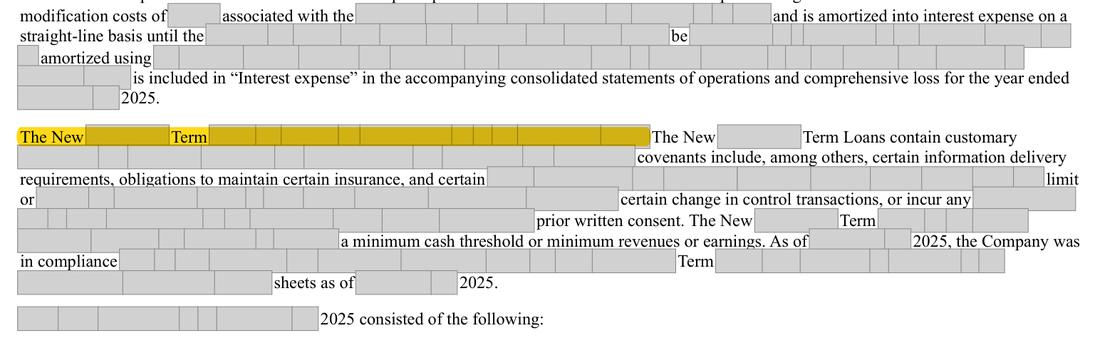
3 further page extracts: screenshot withheld to protect the company’s identity. The rows below say what each shows.
What the filing shows, and what the rule requires
| What the filing shows | What the rule requires |
|---|---|
Note 7 describes the term loan's restrictive covenants without the dividend restriction; no note gives the source, provisions or amount of retained earnings restricted or free, in either year | A description in the notes of the most significant restrictions on paying dividends (the term loan covenant, and from [date] the revolving facility), their pertinent provisions, and the amount of retained earnings restricted or free of restriction (none free, given the accumulated deficit of [n]) |
| What we checked. Note 7 (term loans), Note 15 (subsequent events), Note 1, Item 5 and risk factors, both years; whole-report search | |
The rule
Regulation S-X Rule 4-08(e)(1)
Describe the most significant restrictions on the payment of dividends by the registrant, indicating their sources, their pertinent provisions, and the amount of retained earnings or net income restricted or free of restrictions.
Version: Text in force at the date of this review · Source: Regulation S-X, 17 CFR 210.4-08(e) (eCFR as in force for fiscal 2025)
Why it applies here. Regulation S-X Rule 4-08(e)(1) requires the financial statements to describe the most significant restrictions on the payment of dividends, with their source, pertinent provisions and the amount of retained earnings restricted or free; that disclosure is absent for the facility in force at both balance-sheet dates. The practical effect is small, because no retained earnings exist, but the item is required and the fix is one sentence.
Why it matters
The financial statements alone do not tell readers that dividends are contractually restricted; the information sits only in Item 5 and the risk factors.
Exposure
A staff comment would normally be resolved by adding the sentence in future filings; no fixed penalty.
Our workings
Item 5 of both the 2025 and the 2024 Form 10-K states that the payment of dividends is restricted under the company's credit facility; in the 2024 report the only facility was the [former lender] term loan. Note 7 of the 2025 report lists the restrictive covenants of the amended term loan as limits on additional indebtedness, change-of-control transactions and liens; it does not mention dividends or restricted payments. The notes mention dividends and restricted payments only in describing the revolving credit facility entered into on [date], a subsequent event. The balance sheet shows an accumulated deficit of [n].
| Requirement of Rule 4-08(e)(1) | Where looked | Status |
|---|---|---|
| Most significant dividend restriction | Note 7 covenants | Absent (given only in Item 5, outside the financial statements) |
| Source and pertinent provisions | Note 7 | Absent |
| Retained earnings restricted or free | Notes, balance sheet | Absent (accumulated deficit [n], so none free) |
| Post-year-end revolving facility | Note 15 | Given (dividends listed among covenants) |
Management’s best defense, and our reply
Management can argue that with an accumulated deficit of [n] there are no retained earnings to restrict, that the company has never paid dividends, and that Item 5 and the risk factors in the same Form 10-K already tell investors about the restriction. It can add that the revolving facility note lists dividends among the covenants. The answer: Rule 4-08(e)(1) places the description in the financial statements themselves, which are audited and read separately, and the revolving facility note covers a facility signed after year-end, not the term loan in force at both balance-sheet dates; the omission is small but it is an omission of a required item.
The fix
- Add to Note 7: "The A&R Loan Agreement (and, from [date], the Revolving Credit Facility) prohibits the payment of cash dividends without the lenders' consent; because of the accumulated deficit, no retained earnings are free of this restriction."
Evidence relied on
| # | What it shows | Type | Where |
|---|---|---|---|
| 1 | Item 5 (2025): dividends are restricted under the credit facility | Document | Form 10-K 2025, page 45 |
| 2 | Item 5 (2024): the same restriction when the term loan was the only facility | Document | Form 10-K 2024 (prior year), page 46 |
| 3 | Note 7 lists restrictive covenants without the dividend restriction | Document | Form 10-K 2025, page 82 |
| 4 | Dividends are mentioned only for the revolving facility signed after year-end | Document | Form 10-K 2025, page 95 |
| 5 | No retained earnings are free of restriction | Document | Form 10-K 2025, page 62 |
Absence check
- Document
- Form 10-K 2025
- Where it would appear
- The New [former lender] Term Loans are secured by substantially all of the Company’s assets.
- What is missing
- the term loan's restriction on dividends, its pertinent provisions and the amount of retained earnings restricted or free
- Pages looked at
- p.67-68 (Note 1), 84-86 (Note 7), 99 (Note 15), 48 (Item 5)
- Result
- 'dividend' hits p.41 (risk factor) and [n] (Item 5), both outside the financial statements; p.46 (performance graph reinvestment); p.52, [n] and [n] (the revolving facility signed on [date]); p.76 and [n] (expected dividend assumption for award valuations). 'restricted payments' hits p.52, [n] and [n], all the revolving facility. 'retained earnings' and 'free of restriction' have no hits.
Prepared by Pramanex from the company’s public SEC filings, without the company’s involvement, to show how a 10-K Pre-filing Check reads. The company is not named, and nothing on this page is a statement about any identifiable company. Observations are not an audit, review or other attestation or assurance engagement, and not legal advice. An SEC-style question is a question, not a conclusion.
Want this on your own 10-K, before you file?
Start with three free findings on your latest 10-K, or book a fixed-price 10-K Pre-filing Check.
Your next 10-K will be in draft before the audit is done.
Have it read before you file.
Start with three free findings on your latest 10-K, or book a fixed-price 10-K check. Drafts only under NDA, inside your insider trading policy.