2.01 MD&A gives no reason for the [n]-point fall in gross profit margin and does not quantify how much of Product 1's growth came from price and how much from volume
Company C · a US-listed specialty healthcare products company · Compliance or disclosure gap
In brief
Gross profit margin fell from [n]% to [n]% in 2025, and management's discussion and analysis (MD&A) gives no reason for the fall: the cost of goods sold increase is put down to higher volume, which cannot by itself explain why costs grew [n]% against revenue growth of [n]%. Had the 2024 margin held, gross profit would have been [n] (thousand dollars) higher, 12.47% of the pre-tax loss. MD&A also names higher Product 1 sales as a revenue driver without quantifying how much of the growth came from price and how much from volume; the new-product share itself can be computed from the segment note.
The evidence, as filed
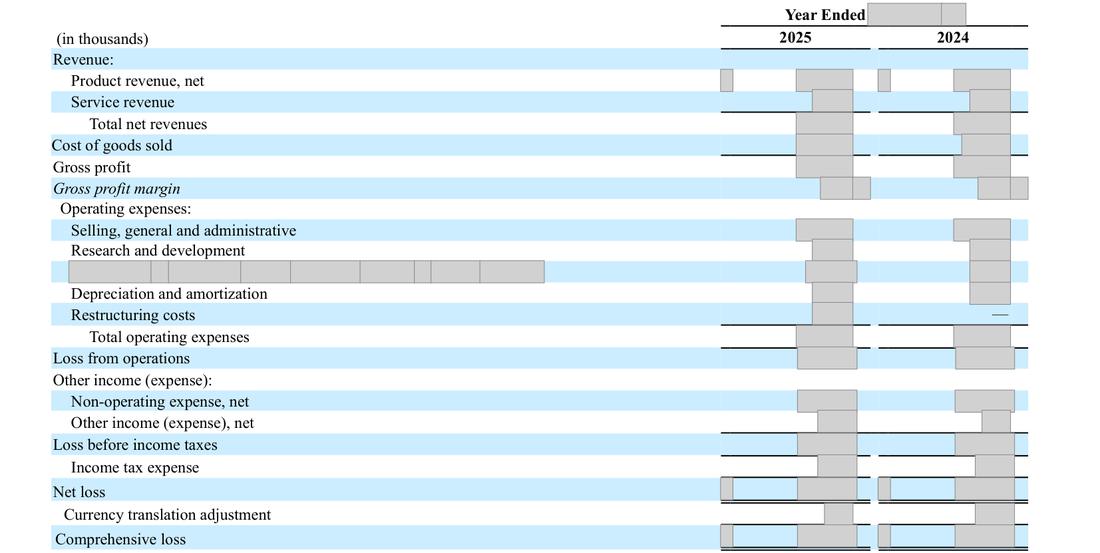
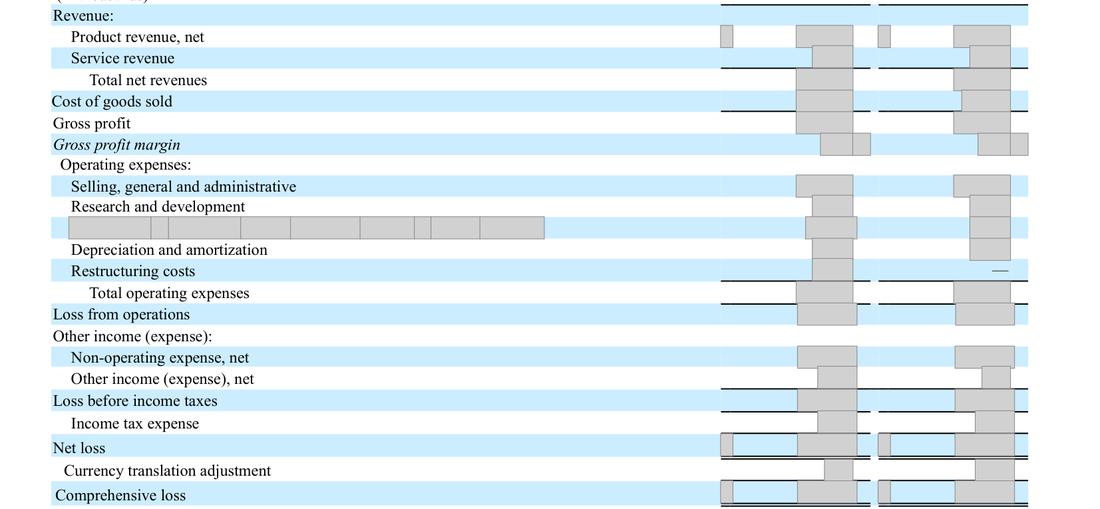
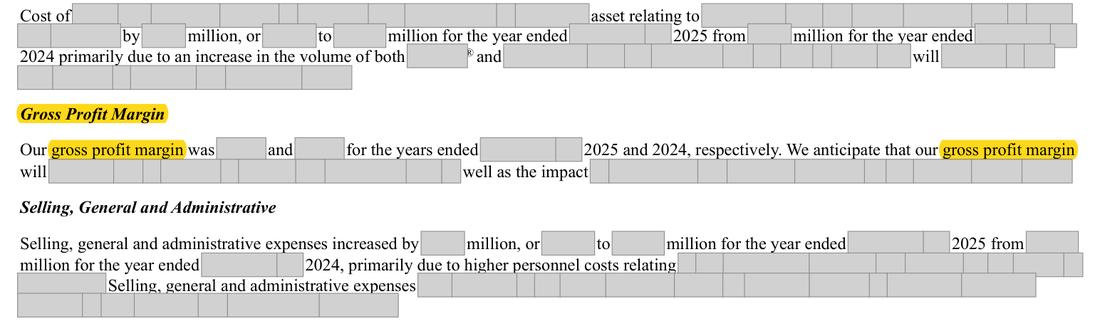
2 further page extracts: screenshot withheld to protect the company’s identity. The rows below say what each shows.
What the filing shows, and what the rule requires
| What the filing shows | What the rule requires |
|---|---|
Gross profit margin [n]% against [n]%, followed only by a sentence on how the margin will fluctuate in future; cost of goods sold up [n]% 'primarily due to an increase in the volume' sold; revenue increase of [n] attributed 'primarily' to the Product line 2 launch and higher Product 1 sales, with no price or volume split for Product 1. | The reasons for the [n]-point fall in gross profit margin stated in quantitative and qualitative terms (for example product mix, amortization of the Product line 2 distribution right, tariff and inventory costs, promotional pricing), and the Product 1 revenue change ([n]) described as price or volume. |
The rule
Regulation S-K Item 303(b) (full fiscal years), 17 CFR 229.303(b)
Where the financial statements reflect material changes from period-to-period in one or more line items, including where material changes within a line item offset one another, describe the underlying reasons for these material changes in quantitative and qualitative terms.
Version: In force from [date] · Source: Regulation S-K Item 303, 17 CFR [n], as amended by Release No. 33-10890
Regulation S-K Item 303(b)(2)(iii), 17 CFR [n](b)(2)(iii)
describe the extent to which such changes are attributable to changes in prices or to changes in the volume or amount of goods or services being sold or to the introduction of new products or services.
Version: In force from [date] · Source: Regulation S-K Item 303, 17 CFR [n], as amended by Release No. 33-10890
Regulation S-K Item 303, Instruction 2 to paragraph (b), 17 CFR 229.303(b)
Registrants need not recite the amounts of changes from period to period if they are readily computable from the financial statements. The discussion must not merely repeat numerical data contained in the financial statements.
Version: In force from [date] · Source: Regulation S-K Item 303, 17 CFR [n], as amended by Release No. 33-10890
Why it applies here. the margin change, worth about a fifth of the revenue increase, is a material change in the cost-revenue relationship left without a stated reason anywhere in the Form 10-K (whole-text search below). The prior-year Form 10-K explained the 2023 margin change against 2022, so the company has given such reasons before; MD&A results and gross-margin drivers are the most frequent theme of staff comment letters.
Why it matters
A reader cannot tell why each dollar of revenue now earns about two points less gross profit, or whether the established product grew by price or by volume. These are the points the staff most often raise on MD&A.
Exposure
No fine; the realistic consequence is a staff comment letter asking for the quantification and an undertaking to give it in future filings.
Our workings
the results table on p.49 shows gross profit of [n] on total net revenues of [n] in 2025 and [n] on [n] in 2024, a gross profit margin of [n]% against [n]%. MD&A on p.50 says cost of goods sold rose [amount], or [n]%, 'primarily due to an increase in the volume of both Product 1 and Product line 2 sold'; the Gross Profit Margin paragraph states the two margins and then only says the margin will fluctuate in future with product and geographic mix and promotional pricing. Revenue rose [amount], or [n]%, 'primarily due to the launch of Product line 2 in the United States and an increase in revenues from sales of Product 1'. Note 14 (p.94) shows Product 1 revenue of [n] against [n] and Product line 2 revenue of [n] against nil. The earnings release furnished the same day, [date], gave a 2025 adjusted gross profit margin of [n]% excluding amortization of intangible assets, so the company measured that effect.
had the 2024 margin of 68.46% held, 2025 gross profit would have been [n]; the margin fall therefore cost [n], equal to 12.47% of the pre-tax loss of [n]. Architecture: Item 303(b) requires, where a line item changes materially, the underlying reasons 'in quantitative and qualitative terms'; Item 303(b)(2)(iii) requires the extent to which a material revenue change is due to price, volume or new products. Instruction 2 to paragraph (b) excuses reciting amounts that are readily computable from the financial statements, so the new-product share of the revenue increase ([n] of [n], 73.24%) is not itself a gap: it can be read from Note 14. What cannot be computed from the statements is why each dollar of revenue earned [n] points less gross profit, and whether Product 1's 3.03% growth came from price or volume; the volume explanation given for cost of goods sold does not account for costs growing faster than revenue.
| Item (USD thousand) | 2025 | 2024 | Computation | Result |
|---|---|---|---|---|
| Total net revenues | [n] | [n] | [n] - [n] | [n] |
| Product 1 revenue (Note 14) | [n] | [n] | [n] - [n]; [n] / [n] | [n]; 3.03% |
| Product line 2 share of the increase (Note 14) | [n] | 0 | [n] / [n] | 73.24% |
| Gross profit margin | [n] / [n] = 66.33% | [n] / [n] = 68.46% | ([n] / [n] - [n] / [n]) x [n], unrounded | [n] points |
| Gross profit at the 2024 margin | [n] x [n] / [n] | [n] | ||
| Gross profit lost to the margin fall | [n] - [n] | [n] | ||
| Share of pre-tax loss | [n] / [n] | 12.47% |
Management’s best defense, and our reply
Management would say MD&A names the drivers (the Product line 2 launch, higher Product 1 sales, higher volume of both products), that Instruction 2 to Item 303(b) excuses reciting amounts readily computable from the statements, and that Note 14 gives the product split. It would add that the gross margin paragraph names product mix and promotional pricing as the factors that move the margin. The answer: the defense holds for the new-product share of revenue, which Note 14 makes computable, and that limb has been dropped. It does not hold for the margin: no page of the Form 10-K says why the margin fell [n] points (the risk factors mention tariffs on the cost of goods, without any amount), the mix sentence is forward-looking, and a volume explanation cannot account for costs growing faster than revenue; nor can the Product 1 price / volume split be computed from the statements.
The fix
- In the next Form 10-K and Forms 10-Q, add for example: 'Gross profit margin fell [n] points, of which [x] points from amortization of the Product line 2 distribution right, [y] from product mix and [z] from tariff and inventory costs. Product 1 revenue grew [amount], reflecting [higher volume / a change in average selling price of x%].'
Evidence relied on
| # | What it shows | Type | Where |
|---|---|---|---|
| 1 | Results table: total net revenues for both years | Document | Form 10-K 2025, page 49 |
| 2 | Results table: gross profit for both years, the base of the margin computation | Document | Form 10-K 2025, page 49 |
| 3 | MD&A states the revenue change | Document | Form 10-K 2025, page 50 |
| 4 | The two drivers are named without amounts and without a price or volume split | Document | Form 10-K 2025, page 50 |
| 5 | Cost of goods sold grew faster than revenue; attributed to volume only | Document | Form 10-K 2025, page 50 |
| 6 | The margin fall is stated; the paragraph gives only a forward-looking statement, no reason for the 2025 change | Document | Form 10-K 2025, page 50 |
| 7 | Note 14: Product 1 revenue by year | Document | Form 10-K 2025, page 94 |
| 8 | Note 14: revenue from the new product in its first year | Document | Form 10-K 2025, page 94 |
| 9 | Earnings release of [date] quantified the product split that MD&A gives only in words | Document | |
| 10 | Earnings release isolates the intangible amortization effect on margin, which MD&A does not discuss | Document | |
| 11 | Item 1A says tariffs have already raised the cost of goods | Document | Form 10-K 2025, page 18 |
| 12 | MD&A cost of goods increase | Document | Form 10-K 2025, page 50 |
| 13 | MD&A gives volume as the only reason, with tariffs only as a future factor | Document | Form 10-K 2025, page 50 |
| 14 | Year-end earnings release, same day as the Form 10-K | Document | |
| 15 | Later filing: tariffs previously paid had been charged to cost of goods sold | Document |
Absence check
- Document
- Form 10-K 2025
- Where it would appear
- Gross Profit Margin
- What is missing
- The reasons for the fall in gross profit margin in 2025, and the price and volume split of the Product 1 revenue change
- Pages looked at
- p.48-57 (Item 7, page images) and the whole the machine-readable text
- Result
- 'gross margin' hits only p.19 (a risk factor on guidance assumptions). 'product and geographic mix' hits only p.50, the forward-looking sentence on how margin will fluctuate. 'average selling price' hits p.50 (the same forward-looking sentence), p.57 and p.74 (loyalty-reward measurement policy). None gives a reason for the 2025 margin change or a price / volume split. 'gross profit margin decreased', 'decrease in gross', 'margin decreased' and 'price increase' do not hit.
Prepared by Pramanex from the company’s public SEC filings, without the company’s involvement, to show how a 10-K Pre-filing Check reads. The company is not named, and nothing on this page is a statement about any identifiable company. Observations are not an audit, review or other attestation or assurance engagement, and not legal advice. An SEC-style question is a question, not a conclusion.
Want this on your own 10-K, before you file?
Start with three free findings on your latest 10-K, or book a fixed-price 10-K Pre-filing Check.
Your next 10-K will be in draft before the audit is done.
Have it read before you file.
Start with three free findings on your latest 10-K, or book a fixed-price 10-K check. Drafts only under NDA, inside your insider trading policy.