4.04 The self-insurance critical accounting estimate repeats the accounting policy and gives no change history or sensitivity
Company B · a US-listed transportation and logistics company · Compliance or disclosure gap
In brief
Item 303(b)(3) of Regulation S-K asks, for each critical accounting estimate, why it is uncertain and, where material and reasonably available, how much it changed and how sensitive the reported amount is. The self-insurance estimate in the management's discussion and analysis (MD&A) is a paragraph of policy text, near word for word the policy in Note 1, with no figures. The insurance and claims accrual was [amount] at the year end; after the insured claims carried with a matching receivable, the self-insured accrual is about [amount], 844.6% of pre-tax income, and the auditor names the auto liability reserve as its critical audit matter, so the quantitative information is both material and available. The 2024 10-K had the same paragraph.
The evidence, as filed
2 further page extracts: screenshot withheld to protect the company’s identity. The rows below say what each shows.
What the filing shows, and what the rule requires
| What the filing shows | What the rule requires |
|---|---|
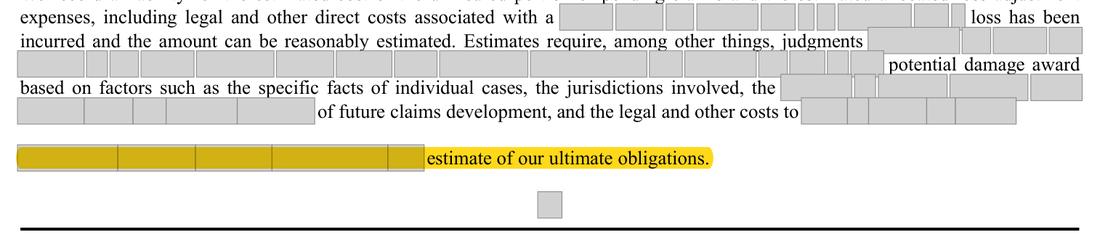
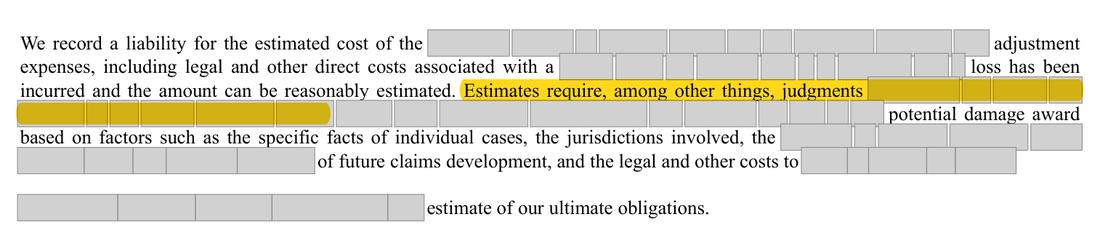
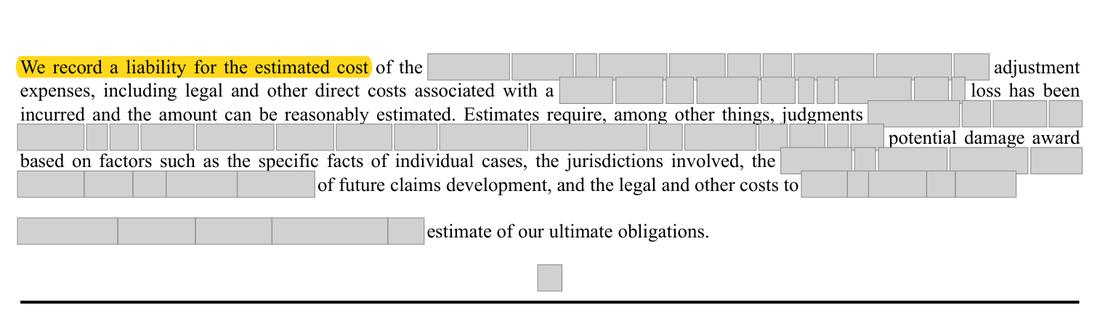
Self-Insurance Accruals paragraph lists the judgments involved and ends 'Self-insured liabilities represent management's best estimate of our ultimate obligations'; no balance, no change, no sensitivity; the same wording is in the Note 1 policy | Estimate-specific analysis: the accrual and how it moved (development on prior-year claims, large-claim settlements), the key assumptions (loss development, severity trends), and the effect on pre-tax income of a reasonably possible change, e.g. a 10% change in estimated ultimate losses |
The rule
Regulation S-K Item 303(b)(3)
This information should include why each critical accounting estimate is subject to uncertainty and, to the extent the information is material and reasonably available, how much each estimate and/or assumption has changed over a relevant period, and the sensitivity of the reported amount to the methods, assumptions and estimates underlying its calculation.
Version: In force from [date] · Source: Regulation S-K, 17 CFR 229.303(b)(3), as amended by Release 33-10890; text in force throughout fiscal 2024 and 2025
Regulation S-K Item 303(b), Instruction 3
For critical accounting estimates, this disclosure must supplement, but not duplicate, the description of accounting policies or other disclosures in the notes to the financial statements.
Version: In force from [date] · Source: Regulation S-K, 17 CFR 229.303, Instructions to paragraph (b), as amended by Release 33-10890
Why it applies here. Excluding [amount] of insured claims matched by a receivable, the self-insured accrual is about [amount], 844.6% of pre-tax income; no change history or sensitivity is given. The fiscal 2024 Form 10-K was the same.
Why it matters
- Investors cannot judge how far results could move on the estimate the auditor found most judgmental; an [n]% change would equal 2025 pre-tax income.
- Critical estimates are a standing SEC comment theme; a request for quantified disclosure in future filings is the realistic outcome.
How often the SEC staff raises this. In 1,100 SEC staff comment letters on fiscal 2023 and 2024 Forms 10-K, released January 2025 to October 2026, critical accounting estimates drew 23 of the 1,774 numbered comments (1.3%): topic 16 of 25 by frequency.
The SEC staff has raised this with other companies
The SEC staff asked Oil-Dri and Autoliv for quantitative information on the estimation uncertainty in their critical accounting estimates.
Exposure
Critical accounting estimates are a standing staff comment theme; the realistic consequence is a comment letter asking for quantified change and sensitivity disclosure in future filings. No fixed penalty.
Our workings
the Critical Accounting Estimates section lists Revenue Equipment, Business Combination Estimates, Goodwill and Other Intangible Assets, and Self-Insurance Accruals. The self-insurance paragraph (p.41) gives the recognition policy and the factors judged; it contains no amounts. Note 1 carries substantially the same sentences. The balance sheet shows the current and long-term insurance and claims accrual; MD&A attributes the rise in insurance and claims expense partly to '[wording masked] during 2025'. The auditor's report identifies the auto liability self-insurance reserve as a critical audit matter because of 'the high level of estimation uncertainty' in claim severity and records that claims data were reconciled to actuarial software.
the gross accrual rose by [n], but [n] of that rise is insured claims above the retention, recorded gross with a matching receivable (Note 1 gives [amount] against [amount]), so the movement in the gross balance overstates the change in the estimate. On the self-insured (net) basis the accrual rose by [n] (14.5%) to [n], which is 844.6% of 2025 pre-tax income; a 10% change in it equals 84.5% of pre-tax income, and a change of [n]% would equal the whole of it.
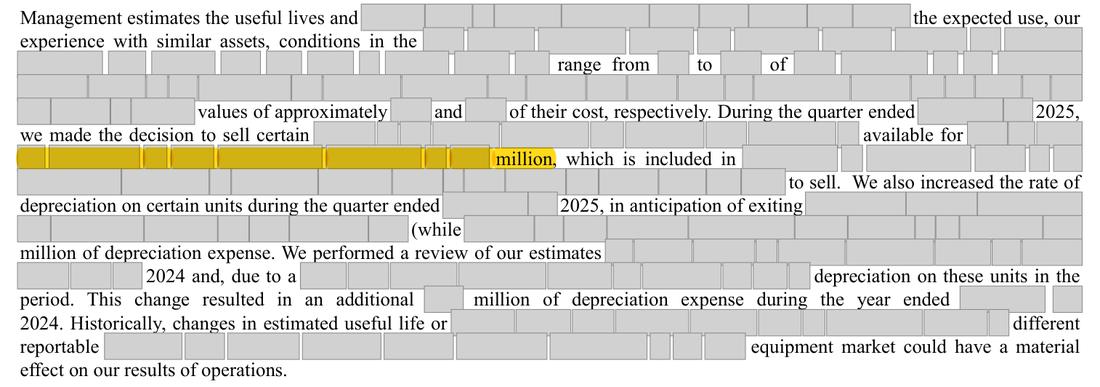
the information Item 303(b)(3) asks for is material on these figures and reasonably available from the actuarial process the auditor tested; repeating the policy note is what Instruction 3 to Item 303(b) rules out. The revenue equipment estimate, by contrast, does quantify its changes ([amount] write-down, [amount] extra depreciation), which shows the format is workable.
| Item | 2025 | 2024 | Working |
|---|---|---|---|
| Total accrual (gross) | [n] | [n] | [n] + [n] = [n]; [n] + [n] = [n] |
| Insured claims above the retention, matched by a receivable | [n] | [n] | [n] x [n] = [n]; [n] x [n] = [n]; [n] - [n] = [n] |
| Self-insured accrual (net) | [n] | [n] | [n] - [n] = [n]; [n] - [n] = [n] |
| Increase in the year | [n] | gross [n] - [n] = [n]; net [n] - [n] = [n]; [n] / [n] = 14.5% | |
| Net accrual against 2025 pre-tax income | [n] / [n] = 844.6% | ||
| Illustrative 10% change in the net accrual | [n] | [n] x 10% = [n]; [n] / [n] = 84.5%; [n] / [n] = [n]% | |
| In millions (for the text) | [n] / [n] | [n] | [n] / [n] = [n]; [n] / [n] = [n]; [n] / [n] = [n]; [n] / [n] = [n] |
| Estimate | Why uncertain | How much it changed | Sensitivity | Page |
|---|---|---|---|---|
| Revenue equipment | Given | Given ([amount] write-down; [amount] extra depreciation) | Absent | p.40 |
| Business combinations | Given | Absent | Absent | unnumbered page |
| Goodwill | Given | Partial ([amount] interim impairment) | Absent (no headroom or key assumptions for the partly impaired unit) | unnumbered page |
| Self-insurance accruals | Generic (policy text) | Absent | Absent | p.41 |
Management’s best defense, and our reply
Management could argue that claims are estimated case by case with third-party administrators, so no single assumption drives the reserve and a sensitivity would be arbitrary; and that Item 303(b)(3) asks for quantitative information only to the extent it is material and reasonably available. It could add that Note 1 already gives the retention levels and the insured-claim amounts, that the results discussion explains the rise in claims expense, and that much of the rise in the accrual is insured claims matched by a receivable. However, the auditor's report records that the reserve is projected using actuarial software, so development and severity data exist; even after the insured claims the self-insured accrual is more than eight times pre-tax income and a change of [n]% in it would equal the year's pre-tax income, which settles materiality; retention levels and expense explanations are not a change history or a sensitivity of the estimate; and Instruction 3 to Item 303(b) expressly forbids using the critical accounting estimate to duplicate the policy note, which is what the paragraph does.
The fix
- Replace the paragraph with estimate-specific analysis, e.g.: 'Our insurance and claims accrual was [amount] at [date] ([amount] at [date]), of which [amount] relates to claims above our retention for which we record a corresponding receivable. The change reflects [development on prior-year claims of $x million and [wording masked]]. A 10% change in our estimated ultimate self-insured losses would change pre-tax income by approximately [amount].'
Critical accounting estimates, page 41: after the last sentence of the self-insurance estimate
Evidence relied on
| # | What it shows | Type | Where |
|---|---|---|---|
| 1 | The critical accounting estimate ends with this sentence; no figures anywhere in it | Document | Form 10-K 2025, page 41 |
| 2 | Wording of the estimate | Document | Form 10-K 2025, page 41 |
| 3 | The revenue equipment estimate quantifies its changes | Document | Form 10-K 2025, page 40 |
| 4 | Revenue equipment: change in depreciation quantified | Document | Form 10-K 2025, page 40 |
| 5 | Goodwill estimate: interim impairment given, no headroom or sensitivity | Document | Form 10-K 2025, unnumbered page |
| 6 | Same wording in the Note 1 accounting policy | Document | Form 10-K 2025, page 62 |
| 7 | Current accrual | Document | Form 10-K 2025, unnumbered page |
| 8 | Long-term accrual | Document | Form 10-K 2025, unnumbered page |
| 9 | A large claim settled in the year: the estimate moved | Document | Form 10-K 2025, unnumbered page |
| 10 | The auditor's critical audit matter on the auto liability reserve | Document | Form 10-K 2025, page 51 |
| 11 | An actuarial process exists: the data are reasonably available | Document | Form 10-K 2025, page 51 |
| 12 | Prior-year 10-K: same paragraph, no figures | Document | Form 10-K 2024 (prior year), page 41 |
| 13 | Part of the long-term accrual is insured claims above the retention, matched by a receivable; removed to reach the self-insured accrual | Document | Form 10-K 2025, page 62 |
Absence check
- Document
- Form 10-K 2025
- Where it would appear
- We record a liability for the estimated cost
- What is missing
- the change in the accrual over the period and the sensitivity of the reported amount to its key assumptions
- Pages looked at
- p.40-41, 87-51, [n], 134-76
- Result
- 'sensitivity' hits only unnumbered page (the fuel-price sensitivity in market risk); 'actuar' hits only p.51 (the auditor's procedures); 'would increase' hits only unnumbered page (interest-rate sensitivity); 'reasonably possible' and 'change in estimate' have no hits. None gives a sensitivity or change history for the claims accrual.
Prepared by Pramanex from the company’s public SEC filings, without the company’s involvement, to show how a 10-K Pre-filing Check reads. The company is not named, and nothing on this page is a statement about any identifiable company. Observations are not an audit, review or other attestation or assurance engagement, and not legal advice. An SEC-style question is a question, not a conclusion.
Want this on your own 10-K, before you file?
Start with three free findings on your latest 10-K, or book a fixed-price 10-K Pre-filing Check.
Your next 10-K will be in draft before the audit is done.
Have it read before you file.
Start with three free findings on your latest 10-K, or book a fixed-price 10-K check. Drafts only under NDA, inside your insider trading policy.