4.03 Three non-GAAP measures in the MD&A overview have no reconciliation or statement of usefulness
Company B · a US-listed transportation and logistics company · Compliance or disclosure gap
In brief
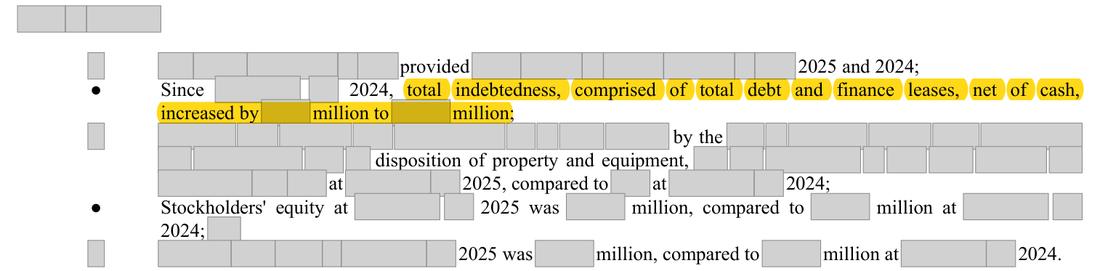
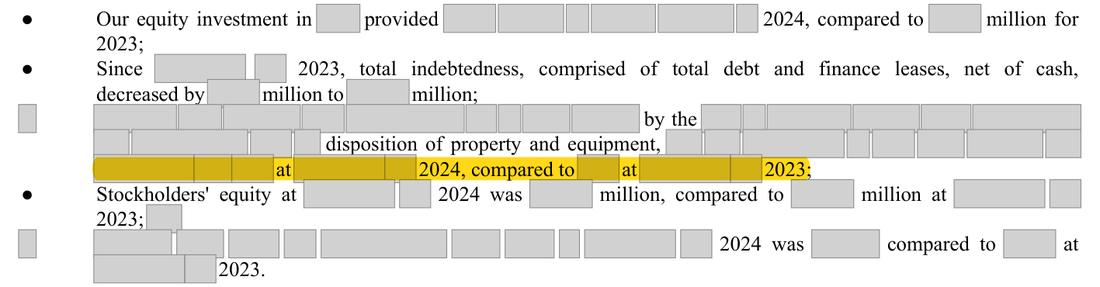
The management's discussion and analysis (MD&A) overview highlights total indebtedness net of cash, a leverage ratio and tangible book value. Each excludes or adjusts amounts in a measure prepared under generally accepted accounting principles (GAAP), so each is a non-GAAP financial measure under Item 10(e) of Regulation S-K. The only non-GAAP reconciliation in the 10-K covers freight revenue and adjusted operating ratio; these three measures have no reconciliation to the most directly comparable GAAP measure and no statement of why they are useful (stockholders' equity is printed in the bullet before tangible book value, but the two are not reconciled). The prior-year 10-K did the same.
The evidence, as filed
What the filing shows, and what the rule requires
| What the filing shows | What the rule requires |
|---|---|
Overview bullets give total indebtedness net of cash ([amount]), a leverage ratio ([n] against [n]) and tangible book value ([amount] against [amount]); the non-GAAP section reconciles only freight revenue and adjusted operating ratio | For each measure: the most directly comparable GAAP measure with equal or greater prominence, a quantitative reconciliation to it, and a statement of why management believes it is useful to investors (or remove the measures from the filing) |
The rule
Regulation S-K Item 10(e)(1)(i)(A)
A presentation, with equal or greater prominence, of the most directly comparable financial measure or measures calculated and presented in accordance with Generally Accepted Accounting Principles (GAAP);
Version: Text in force at the date of this review · Source: Regulation S-K, 17 CFR 229.10(e), as amended by Release 33-8176 (2003); text in force throughout fiscal 2024 and 2025
Regulation S-K Item 10(e)(1)(i)(B)
A reconciliation (by schedule or other clearly understandable method), which shall be quantitative for historical non-GAAP measures presented
Version: Text in force at the date of this review · Source: Regulation S-K, 17 CFR 229.10(e), as amended by Release 33-8176 (2003); text in force throughout fiscal 2024 and 2025
Regulation S-K Item 10(e)(1)(i)(C)
A statement disclosing the reasons why the registrant's management believes that presentation of the non-GAAP financial measure provides useful information to investors
Version: Text in force at the date of this review · Source: Regulation S-K, 17 CFR 229.10(e), as amended by Release 33-8176 (2003); text in force throughout fiscal 2024 and 2025
Regulation S-K Item 10(e)(2)(i) (definition)
Excludes amounts, or is subject to adjustments that have the effect of excluding amounts, that are included in the most directly comparable measure calculated and presented in accordance with GAAP
Version: Text in force at the date of this review · Source: Regulation S-K, 17 CFR 229.10(e), as amended by Release 33-8176 (2003); text in force throughout fiscal 2024 and 2025
Regulation S-K Item 10(e)(4)(ii) (exclusion from the definition)
Ratios or statistical measures calculated using exclusively one or both of:
Version: Text in force at the date of this review · Source: Regulation S-K, 17 CFR 229.10(e), as amended by Release 33-8176 (2003); text in force throughout fiscal 2024 and 2025
Why it applies here. None of the three meets these conditions. Tangible book value can be rebuilt (equity of [amount] less goodwill and intangibles); the leverage ratio cannot be reproduced on its stated basis.
Why it matters
- Investors are given headline credit and balance-sheet metrics they cannot tie to the audited figures.
- Non-GAAP presentation is among the most frequent SEC comment themes; a comment and future-filings undertaking are the realistic outcome.
How often the SEC staff raises this. In 1,100 SEC staff comment letters on fiscal 2023 and 2024 Forms 10-K, released January 2025 to October 2026, non-GAAP measures drew 317 of the 1,774 numbered comments (17.9%): the most frequent topic.
The SEC staff has raised this with other companies
The SEC staff asked LGI Homes and Viasat to reconcile net debt, and the earnings measure used in their leverage calculations, to the most comparable GAAP figure.
Exposure
Non-GAAP presentation is among the most frequent staff comment themes; the realistic consequence is a comment letter and an undertaking to revise future filings. No fixed penalty.
Our workings
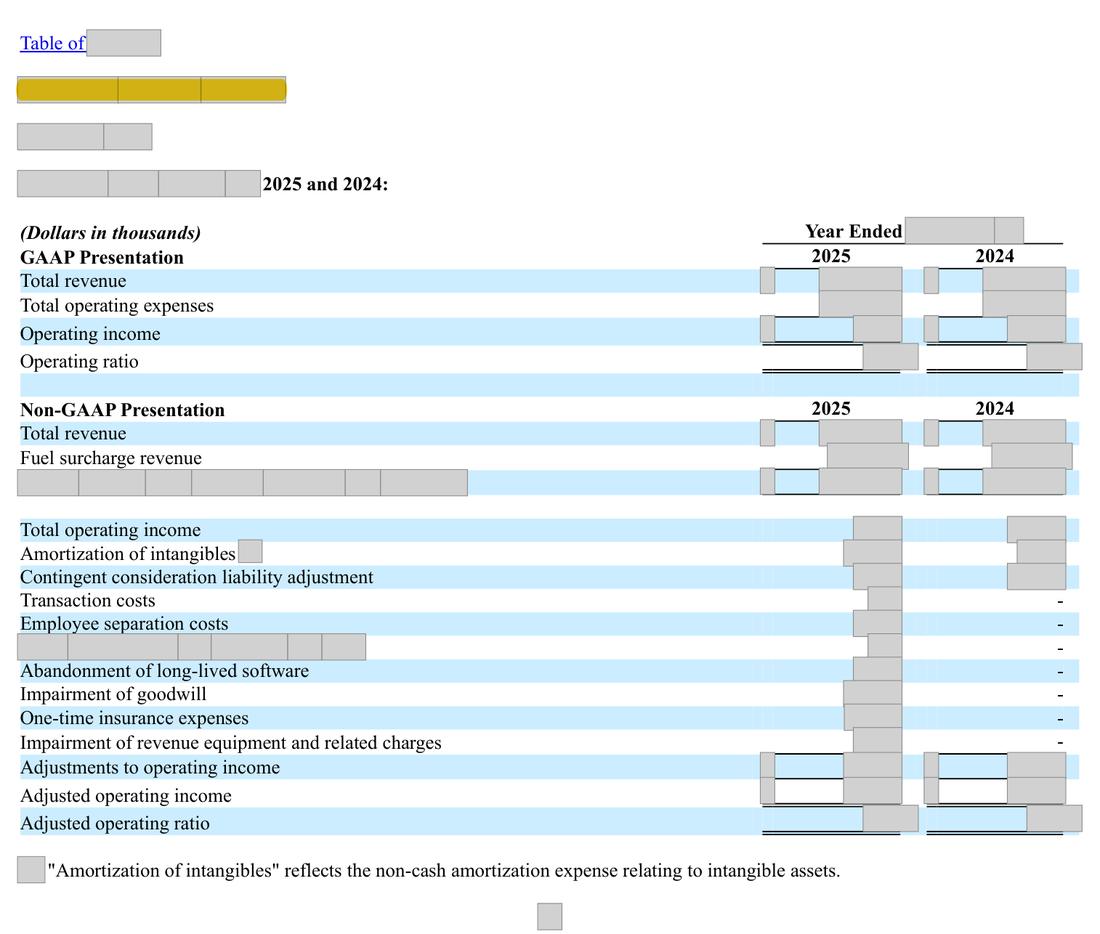
the executive overview on p.29 presents total indebtedness 'comprised of total debt and finance leases, net of cash', a 'Leverage ratio' whose denominator is operating income adjusted for depreciation and amortization, disposal results and impairment, and 'Tangible book value'. The section headed Non-GAAP Financial Measures (printed pages 39-40) reconciles only freight revenue and operating income to adjusted operating ratio, and its usefulness statement speaks only of adjusted operating ratio. The 2024 10-K carried the same leverage ratio and a per-share tangible book value with no reconciliation.
tangible book value can be rebuilt as stockholders' equity less goodwill and other intangibles (workings), which confirms it excludes balance-sheet amounts and is therefore non-GAAP under Item 10(e)(2)(i); the leverage ratio cannot be rebuilt on the 'average' indebtedness basis the overview states, because neither that average nor the adjusted earnings denominator is given as such in the filing (the printed ratios reproduce only on year-end net debt, the subject of a separate observation). Law: Item 10(e)(4)(ii) takes out of the definition only ratios or statistical measures calculated exclusively from GAAP measures and operating measures. Net indebtedness and tangible book value are not ratios but adjusted balance-sheet amounts that exclude cash, goodwill and intangibles from total debt and stockholders' equity, and the leverage ratio's denominator is itself an adjusted earnings figure, so the exclusion reaches none of the three; for net indebtedness and tangible book value this is a matter of reading the definition, which is why the point is graded on interpretation rather than as pure fact.
Item 10(e)(1)(i) applies to every non-GAAP measure in a filing, not only to the one management labels as such; the three overview measures meet none of its three conditions.
| Measure (2025) | Shown in overview | Basis / rebuild | Reconciliation in 10-K | Usefulness statement |
|---|---|---|---|---|
| Total indebtedness, net of cash | [amount] | Debt and finance leases less cash (components listed in Liquidity; no schedule) | Absent | Absent |
| Leverage ratio | [n] | Average net indebtedness / adjusted operating income: inputs not given | Absent | Absent |
| Tangible book value | [amount] | [n] / [n] = [n]; [n] / [n] = [n]; [n] - [n] - [n] = [n] ($ million) | Absent | Absent |
| Adjusted operating ratio (for contrast) | [n]% | Reconciled from operating income | Given | Given |
Management’s best defense, and our reply
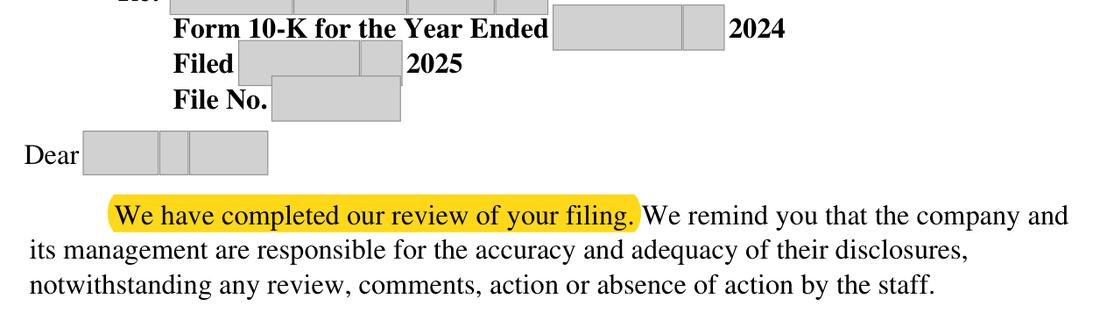
The company could argue that tangible book value and net indebtedness are simple arithmetic on balance-sheet captions that a reader can rebuild, and that the leverage ratio is a credit metric shown as a highlight rather than a performance measure. It could add that the staff reviewed the 2024 Form 10-K, which carried the same leverage ratio and a per-share tangible book value in the same overview, commented only on segment and revenue disclosures, and completed its review on [date] without raising these measures. However, the staff's closing letter itself reminds the company that it remains responsible for the adequacy of its disclosures 'notwithstanding any review, comments, action or absence of action by the staff', so silence in a review is not clearance. Item 10(e) applies to any non-GAAP measure in the filing wherever it appears, and requires the reconciliation and the usefulness statement to be presented, not assembled by the reader; the leverage ratio's stated 'average' indebtedness and its adjusted denominator are not given as such in the 10-K, so a reader must assemble them, and the Credit Facility test described is a fixed-charge covenant, so the accommodation for covenant ratios does not reach it.
The fix
- Add each measure to the Non-GAAP Financial Measures section: e.g. 'Tangible book value = total stockholders' equity less goodwill and other intangibles' with a schedule; reconcile net indebtedness to total debt and finance lease obligations; define and reconcile the leverage ratio's numerator and denominator; add a measure-specific usefulness statement for each, or delete the bullets.
Executive overview, page 29: tangible book value bullet
Also: the same treatment for total indebtedness net of cash and the leverage ratio
Evidence relied on
| # | What it shows | Type | Where |
|---|---|---|---|
| 1 | Net indebtedness, a non-GAAP measure, highlighted in the overview | Document | Form 10-K 2025, page 29 |
| 2 | Leverage ratio on an adjusted-earnings denominator | Document | Form 10-K 2025, page 29 |
| 3 | Tangible book value, a non-GAAP measure | Document | Form 10-K 2025, page 29 |
| 4 | GAAP equity used to rebuild tangible book value | Document | Form 10-K 2025, page 29 |
| 5 | Goodwill deducted in tangible book value | Document | Form 10-K 2025, unnumbered page |
| 6 | Other intangibles deducted in tangible book value | Document | Form 10-K 2025, unnumbered page |
| 7 | The Credit Facility test described is a fixed-charge covenant, not the leverage ratio | Document | Form 10-K 2025, page 28 |
| 8 | The only usefulness statement covers adjusted operating ratio | Document | Form 10-K 2025, unnumbered page |
| 9 | Prior-year 10-K: same leverage ratio, no reconciliation | Document | Form 10-K 2024 (prior year), page 29 |
| 10 | Prior-year 10-K: per-share tangible book value, no reconciliation | Document | Form 10-K 2024 (prior year), page 29 |
| 11 | The staff closed its review of the 2024 Form 10-K (which carried the same overview measures) without commenting on them | Document | |
| 12 | The closing letter states that the staff's silence does not relieve the company of responsibility for its disclosures | Document | |
| 13 | goodwill removed from equity to reach tangible book value | Document | Form 10-K 2025, unnumbered page |
| 14 | other intangibles removed from equity to reach tangible book value | Document | Form 10-K 2025, unnumbered page |
| 15 | stockholders' equity, the comparable GAAP measure for tangible book value | Document | Form 10-K 2025, page 54 |
| 16 | operating income, the starting point of the leverage-ratio denominator | Document | Form 10-K 2025, page 55 |
| 17 | added back in the leverage-ratio denominator | Document | Form 10-K 2025, page 55 |
| 18 | added back in the leverage-ratio denominator | Document | Form 10-K 2025, page 55 |
| 19 | added back in the leverage-ratio denominator | Document | Form 10-K 2025, page 55 |
Absence check
- Document
- Form 10-K 2025
- Where it would appear
- Non-GAAP Financial Measures
- What is missing
- a reconciliation, the comparable GAAP measure and a usefulness statement for net indebtedness, the leverage ratio and tangible book value
- Pages looked at
- p.28-29, 64-40, 93-58
- Result
- 'tangible book' hits only p.29 (the bullet itself); 'leverage ratio' hits unnumbered page (strategy narrative saying the ratio rose, no figure or reconciliation) and p.29; 'net of cash' hits p.29 (the bullets) and unnumbered page (cash-flow caption 'Acquisitions, net of cash acquired'); 'non-GAAP' hits p.39-40, which reconcile only freight revenue and adjusted operating ratio; 'reconcil' hits p.51 (an audit procedure), unnumbered page (cash-flow caption) and unnumbered page (income-tax rate reconciliation). None reconciles the three overview measures.
Prepared by Pramanex from the company’s public SEC filings, without the company’s involvement, to show how a 10-K Pre-filing Check reads. The company is not named, and nothing on this page is a statement about any identifiable company. Observations are not an audit, review or other attestation or assurance engagement, and not legal advice. An SEC-style question is a question, not a conclusion.
Want this on your own 10-K, before you file?
Start with three free findings on your latest 10-K, or book a fixed-price 10-K Pre-filing Check.
Your next 10-K will be in draft before the audit is done.
Have it read before you file.
Start with three free findings on your latest 10-K, or book a fixed-price 10-K check. Drafts only under NDA, inside your insider trading policy.