1.23 Restricted share roll-forward: the 2023 vested weighted-average grant-date fair value of [amount] does not reconcile with the table's own opening and closing values
Company B · a US-listed transportation and logistics company · SEC-style question
In brief
The restricted share award table, printed in the fiscal 2024 10-K and again in the fiscal 2025 10-K, shows [n] shares vested in 2023 at a weighted-average grant-date fair value of [amount]. With the table's own opening balance ([n] at [amount]), grants ([n] at [amount]) and closing balance ([n] at [amount]), the vested shares work out at [amount], and [n] shares at [amount] give the [amount] the note reports as the fair value of awards vested in 2023; at [amount] they would give [amount]. The 2024 rows of the same table reconcile.
The evidence, as filed
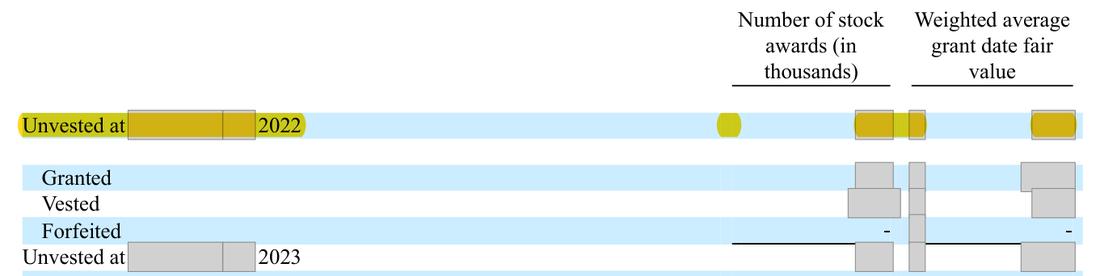
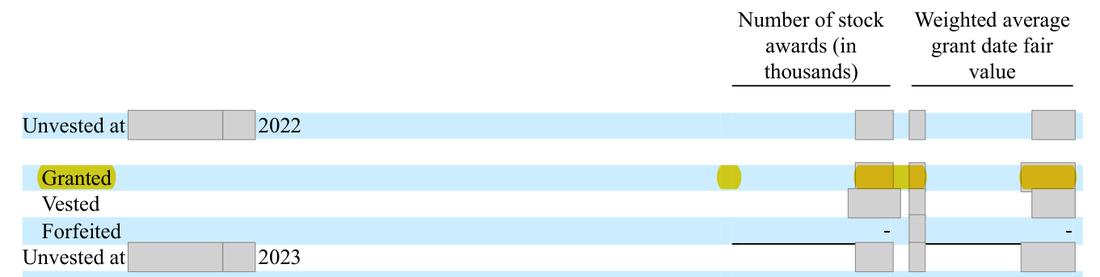
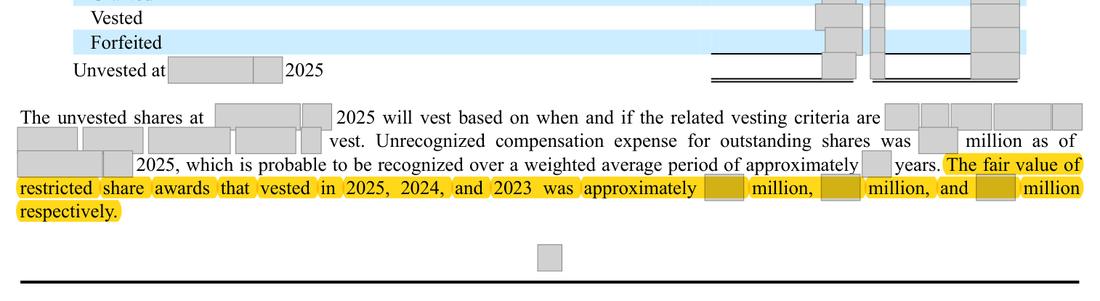

4 further page extracts: screenshot withheld to protect the company’s identity. The rows below say what each shows.
What the filing shows, and what the rule requires
| What the filing shows | What the rule requires |
|---|---|
2023 rows: Unvested at [date] [n] at [amount]; Granted [n] at [amount]; Vested ([n]) at [amount]; Forfeited nil; Unvested at [date] [n] at [amount]. Fair value of awards vested in 2023: [amount]. The roll-forward gives [amount] for the vested shares (or [amount] for the closing balance if [amount] is right). | A roll-forward whose weighted-average grant-date fair values reconcile: the 2023 vested figure at about [amount] (consistent with the [amount] vested fair value), or a corrected [date] closing value, with any performance-share or modification adjustment shown as its own line. |
The rule
FASB ASC 718-10-50-2
Summary; FASB/IFRS text is copyrighted Disclose share-based arrangement terms, fair-value methods and assumptions, award activity, compensation cost and tax effects, and unrecognised cost with weighted-average recognition period.
Version: Text in force at the date of this review · Source: FASB Accounting Standards Codification, ASC 718-10-50-2 (as amended by ASU 2016-09)
Why it applies here. the [amount] printed for 2023 vestings appears inconsistent with both the closing balance and the company's own vested fair value; rounding of share counts to the nearest thousand moves the averages by about a cent, not by [amount]. A performance-share adjustment or modification not shown as a separate line could explain the gap, which only management can confirm.
Why it matters
An award-activity figure in the audited notes cannot be reproduced from its own table in two consecutive [n]-Ks, and the [date] average that opens the next table may be wrong. No reported compensation expense is affected.
Exposure
A disclosure-table inconsistency with no effect on reported expense; at most a correction in the next table that presents the [date] balance.
Our workings
the restricted share award table in Note 4 shows, for 2023, an opening balance of [n] unvested shares at a weighted-average grant-date fair value of [amount], grants of [n] at [amount], vestings of [n] at [amount], no forfeitures, and a closing balance of [n] at [amount]. The same note says the fair value of restricted share awards that vested in 2023 was approximately [amount]. Both [n]-Ks print the identical 2023 rows.
opening value [n] x [n] = [n] and grants [n] x [n] = [n] (thousand dollars). If the vested shares left at [amount] ([n] x [n] = [n]), the closing average would be [amount], not [amount]. If the closing [amount] is right, the vested shares left at [amount], and [n] x [n] = [n], which is the [amount] the note reports. The 2024 rows reconcile to [amount] against [amount] printed, so the method works for the following year.
| Step | Computation | Result |
|---|---|---|
| 2023 vested at the printed price | [n] x [n] = [n] | [n] USD thousand ([amount]) |
| Closing average implied by the printed vested price | ([n] x [n] + [n] x [n] - [n]) / [n] = ([n] + [n] - [n]) / [n] = [n] | [amount] against [amount] printed |
| Vested price implied by the printed closing | ([n] + [n] - [n] x [n]) / [n] = ([n] - [n]) / [n] = [n] | [amount] against [amount] printed |
| 2023 vested fair value at the implied price | [n] x [n] = [n] | [amount], as the note reports |
| Control: 2024 closing average | ([n] + [n] x [n] - [n] x [n] - [n] x [n]) / [n] = ([n] + [n] - [n] - [n]) / [n] = [n] | [amount] printed, agrees |
| Difference on the vested row | [n] - [n] = [n]; [n] x [n] = [n] | [n] USD thousand |
| Materiality | [n] / [n] = 0.46% of 2024 pre-tax income; [n] / [n] = [n]% of the line | below [n]% of pre-tax income, above 1% of the line |
Management’s best defense, and our reply
Management could argue that weighted-average columns in an award roll-forward need not foot exactly: share counts are rounded to thousands, and performance awards that vest above or below target, or awards modified in the year, change the averages without a separate line. They could add that the table was audited in two years without comment. However, rounding share counts to the nearest thousand moves the averages by about a cent, not [amount] on the vested row, and the company's own [amount] vested fair value for 2023 agrees with [amount] rather than [amount]. Because a performance-share adjustment could still explain the gap and only management can confirm it, the point is put as a question.
The fix
- Re-perform the 2023 restricted share roll-forward from the award records; correct the vested weighted-average grant-date fair value (for example to about [amount]) or the [date] closing value, and show any performance-share or modification adjustment as a separate line.
Question for the company
In the 2023 restricted share roll-forward, which figure is correct: the [amount] weighted-average grant-date fair value of shares vested, or the [amount] closing balance? Did 2023 include performance-share adjustments or modifications that are not shown as a separate line?
Evidence relied on
| # | What it shows | Type | Where |
|---|---|---|---|
| 1 | Opening balance for 2023 in the fiscal 2025 10-K table | Document | Form 10-K 2025, unnumbered page |
| 2 | 2023 grants | Document | Form 10-K 2025, unnumbered page |
| 3 | 2023 vestings at the [amount] that does not reconcile | Document | Form 10-K 2025, unnumbered page |
| 4 | Closing balance for 2023, the opening line for 2024 | Document | Form 10-K 2025, unnumbered page |
| 5 | The company's own vested fair value for 2023 ([amount]) matches [n] shares at [amount], not at [amount] | Document | Form 10-K 2025, page 67 |
| 6 | The fiscal 2024 10-K printed the same 2023 vested row | Document | Form 10-K 2024 (prior year), unnumbered page |
| 7 | The fiscal 2024 10-K printed the same 2023 closing balance | Document | Form 10-K 2024 (prior year), unnumbered page |
| 8 | 2024 grants used in the control computation | Document | Form 10-K 2024 (prior year), page 67 |
| 9 | 2024 vestings used in the control computation | Document | Form 10-K 2024 (prior year), page 67 |
| 10 | 2024 forfeitures used in the control computation | Document | Form 10-K 2024 (prior year), page 67 |
| 11 | 2024 closing balance, which the roll-forward reproduces | Document | Form 10-K 2024 (prior year), page 67 |
| 12 | The fiscal 2024 10-K gave the same [amount] for 2023 vestings | Document | Form 10-K 2024 (prior year), page 67 |
Prepared by Pramanex from the company’s public SEC filings, without the company’s involvement, to show how a 10-K Pre-filing Check reads. The company is not named, and nothing on this page is a statement about any identifiable company. Observations are not an audit, review or other attestation or assurance engagement, and not legal advice. An SEC-style question is a question, not a conclusion.
Want this on your own 10-K, before you file?
Start with three free findings on your latest 10-K, or book a fixed-price 10-K Pre-filing Check.
Your next 10-K will be in draft before the audit is done.
Have it read before you file.
Start with three free findings on your latest 10-K, or book a fixed-price 10-K check. Drafts only under NDA, inside your insider trading policy.