1.24 The depreciation-rate changes are given only as pre-tax expense, with no net-income or per-share effect, although the 2025 change is about 40% of continuing earnings per share
Company B · a US-listed transportation and logistics company · SEC-style question
In brief
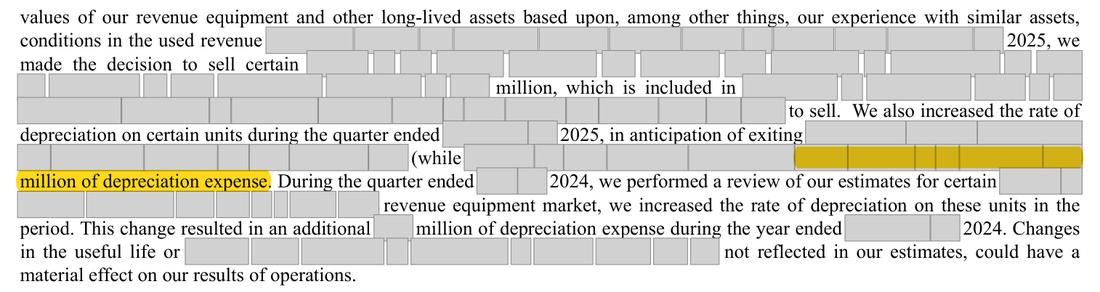
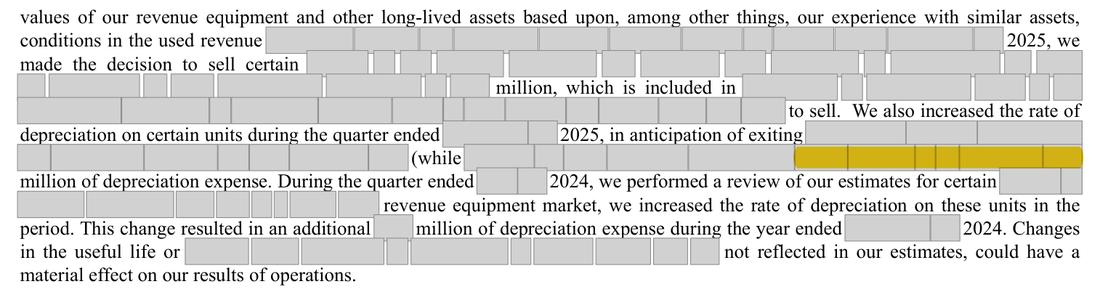
In the fourth quarter of 2025 the company raised depreciation rates on certain units, adding [amount] of depreciation; in 2024 a similar change added [amount]. Note 1 gives only the extra expense. The US accounting rule for a change in estimate that affects future periods, such as a change in service lives, asks for the effect on income from continuing operations, net income and the per-share amounts. On the 2025 figures the after-tax effect is about [amount] per diluted share, 40.3% of reported diluted earnings from continuing operations of [amount].
The evidence, as filed


What the filing shows, and what the rule requires
| What the filing shows | What the rule requires |
|---|---|
Note 1: 'an additional [amount] of depreciation expense' (2025) and 'an additional [amount] of depreciation expense' (2024); no after-tax or per-share effect in the note or in the MD&A. | For each change: the effect on income from continuing operations, on net income and on basic and diluted earnings per share for the year of change (and, where material, the expected effect on future years). |
The rule
Exchange Act Rule 12b-20 (further material information so that required statements are not misleading)
there shall be added such further material information, if any, as may be necessary to make the required statements, in the light of the circumstances under which they are made not misleading.
Version: Text in force at the date of this review · Source: Exchange Act Rule 12b-20, 17 CFR 240.12b-20, eCFR text as amended
Why it applies here. the change is not an ordinary-course estimate (it was a targeted change in rates), and it is large relative to the year's earnings, so the per-share disclosure appears to be required; the pre-tax figure alone leaves the reader to compute it. Management may hold that the pre-tax expense is the effect on income from continuing operations, which is why this is put as a question.
Why it matters
Readers cannot see from the statements how much of the fall in continuing earnings per share came from the depreciation-rate change; the SEC staff commonly asks registrants to give the per-share effect of material changes in estimate.
Exposure
No penalty attaches to a question. The realistic outcome is a staff comment and a future-filings undertaking to give the net-income and per-share effect.
Our workings
Note 1 says the fourth-quarter 2025 increase in depreciation rates, made [wording masked], 'resulted in an additional [amount] of depreciation expense', and that the second-quarter 2024 review 'resulted in an additional [amount] of depreciation expense'. The MD&A repeats the [amount]. Neither gives the after-tax or per-share effect. Law: the Codification's disclosure rule for changes in accounting estimate (Topic 'Accounting Changes and Error Corrections') requires, for a change that affects several future periods such as a change in service lives of depreciable assets, the effect on income from continuing operations, net income and any related per-share amounts of the current period; estimates made each period in the ordinary course (for example uncollectible accounts) are excluded unless material.
at the 2025 effective tax rate of [n] / [n] = [n]%, the after-tax effect is [n] x (1 - [n]) = [n], or [n] / [n] = [amount] per diluted share ([n] / [n] = [amount] per basic share), which is [n] / [n] = 40.3% of reported diluted earnings from continuing operations of [amount]; the pre-tax figure ([n] / [n] = [amount] per diluted share) is not compared with after-tax earnings per share because the bases differ.
| Item | Computation | Result |
|---|---|---|
| Pre-tax effect per diluted share (2025) | [n] / [n] = [n] | [amount] |
| 2025 effective tax rate | [n] / [n] = [n]% | [n]% |
| After-tax effect (2025) | [n] x (1 - [n]) = [n] | [n] |
| After-tax effect per diluted share (2025) | [n] / [n] = [n] | [amount] |
| After-tax effect per basic share (2025) | [n] / [n] = [n] | [amount] |
| After-tax effect as % of diluted continuing EPS | [n] / [n] = 40.3% | 40.3% |
| Pre-tax effect as % of pre-tax income | [n] / [n] = 39.3% | 39.3% |
Management’s best defense, and our reply
Management would say the [amount] of additional depreciation is itself the effect on income from continuing operations, stated before tax as is common practice, and that readers can derive the after-tax and per-share amounts from the tax rate and share count given elsewhere in the 10-K. They would add that the 2025 change applied only to the last quarter and to a subset of units, and that the critical accounting estimates section already warns that useful-life and salvage changes can be material.
The fix
- Add to the note: 'This change in estimate increased depreciation expense by [amount], reduced income from continuing operations and net income by approximately [amount], and reduced basic and diluted earnings per share by approximately [amounts].' (adjusted to the company's own tax computation), with the same for the 2024 change in the comparative discussion.
Question for the company
Does management consider the 2025 and 2024 depreciation-rate changes to be changes in estimate affecting several future periods and, if so, will the next Form 10-K give their effect on income from continuing operations, net income and per-share amounts?
Evidence relied on
| # | What it shows | Type | Where |
|---|---|---|---|
| 1 | The 2025 change is given only as extra pre-tax expense. | Document | Form 10-K 2025, page 61 |
| 2 | The 2024 change, given the same way. | Document | Form 10-K 2025, page 61 |
| 3 | Diluted weighted-average shares used in the per-share computation. | Document | Form 10-K 2025, unnumbered page |
| 4 | Basic weighted-average shares used in the per-share computation. | Document | Form 10-K 2025, unnumbered page |
| 5 | Reported diluted earnings per share from continuing operations, 2025. | Document | Form 10-K 2025, unnumbered page |
| 6 | 2025 income tax expense used for the effective rate. | Document | Form 10-K 2025, page 55 |
| 7 | 2025 pre-tax income. | Document | Form 10-K 2025, page 55 |
| 8 | The fiscal 2024 10-K (Note 1) gives the 2024 depreciation-rate change only as additional pre-tax expense. | Document | Form 10-K 2024 (prior year), page 61 |
| 9 | The fiscal 2024 critical accounting estimates repeat the same pre-tax amount, again with no effect on net income or per share. | Document | Form 10-K 2024 (prior year), unnumbered page |
Absence check
- Document
- Form 10-K 2025
- Where it would appear
- which resulted in an additional [amount]
- What is missing
- the effect of the change in depreciation estimate on income from continuing operations, net income and earnings per share
- Pages looked at
- p.33-35 (MD&A depreciation), p.40 (critical accounting estimates), p.103-61 (Note 1 property and equipment)
- Result
- 'per diluted share' hits p.28, [n] and [n] (total and continuing EPS, not the effect of the change); 'net of tax' hits p.55, [n] and [n] (discontinued operations and hedge reclassifications); 'after tax' hits p.74 (driver per diem pay); 'per share' hits dividends, share prices, EPS lines and acquisition pro formas (p.2, 3, 6, [n]), none about the depreciation change; 'change in estimate' does not hit.
Absence check
- Document
- Form 10-K 2024 (prior year)
- Where it would appear
- This change resulted in an additional
- What is missing
- the effect of the 2024 change in estimate on income from continuing operations, net income and the related per-share amounts
- Pages looked at
- Form 10-K 2024 (prior year) p.101-61 (Note 1 property and equipment), p.39 (critical accounting estimates), p.27 (MD&A overview), p.93 and [n] (earnings per share)
- Result
- 'per diluted share' hits only p.27, [n] and [n], which give reported earnings per share, not the effect of the depreciation change; 'net of tax' hits only p.93, [n] (discontinued operations and cash-flow hedge captions); 'after tax' hits only unnumbered page ([wording masked] program); 'change in estimate' has no hit.
Prepared by Pramanex from the company’s public SEC filings, without the company’s involvement, to show how a 10-K Pre-filing Check reads. The company is not named, and nothing on this page is a statement about any identifiable company. Observations are not an audit, review or other attestation or assurance engagement, and not legal advice. An SEC-style question is a question, not a conclusion.
Want this on your own 10-K, before you file?
Start with three free findings on your latest 10-K, or book a fixed-price 10-K Pre-filing Check.
Your next 10-K will be in draft before the audit is done.
Have it read before you file.
Start with three free findings on your latest 10-K, or book a fixed-price 10-K check. Drafts only under NDA, inside your insider trading policy.