1.22 The stock split row moves the whole [n] treasury stock balance into retained earnings, and the equity note does not say why
Company B · a US-listed transportation and logistics company · SEC-style question
In brief
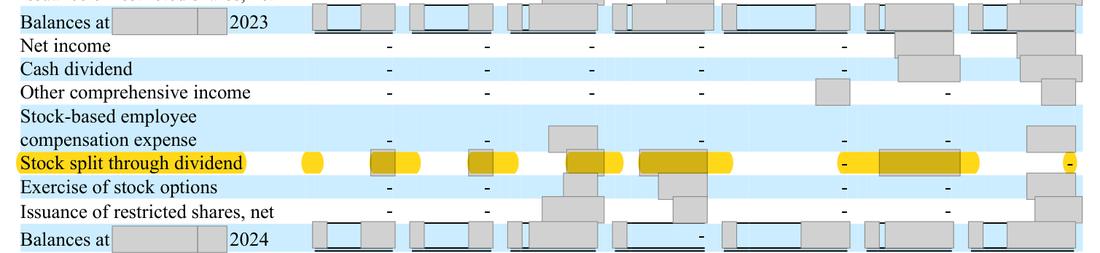
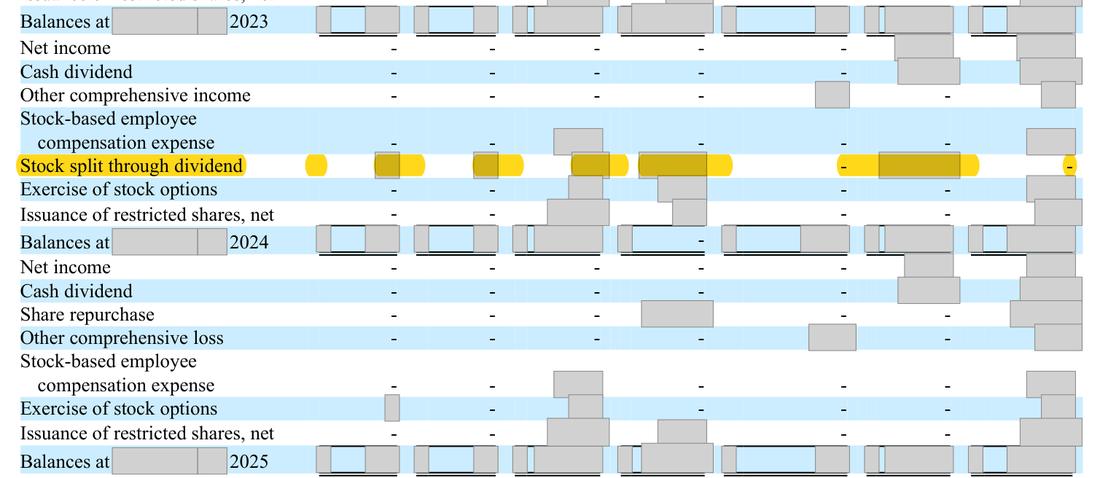
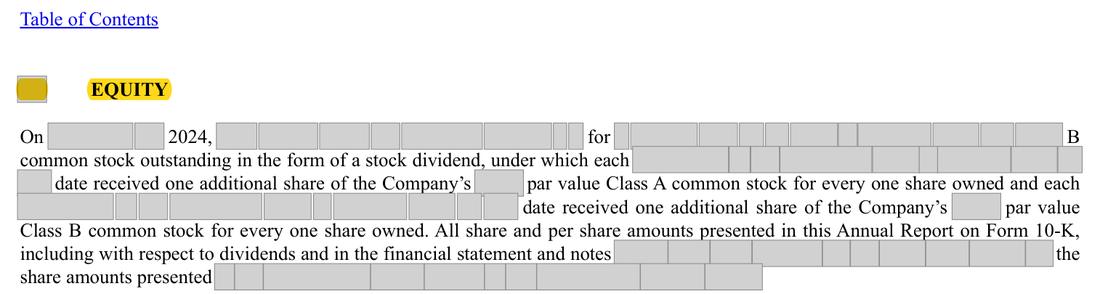
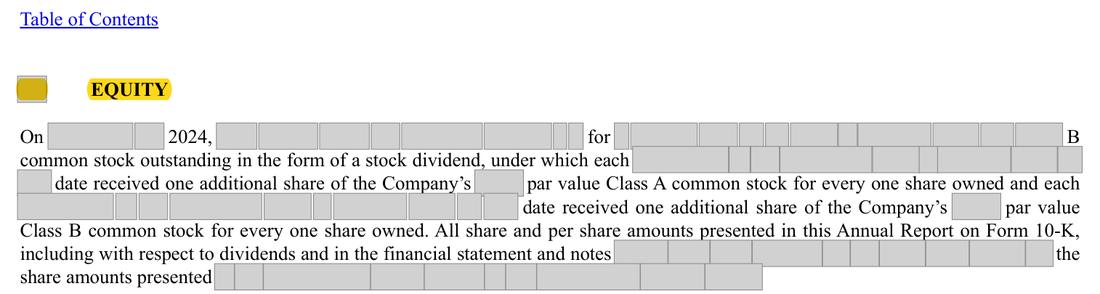
The [date] two-for-one split was effected as a stock dividend. In the statement of stockholders' equity the row 'Stock split through dividend' adds [n] and [n] to Class A and Class B par value, takes [n] from paid-in capital, eliminates [n] of treasury stock and charges the same [n] to retained earnings. The [n] treasury shares held at the end of 2023 are gone at the end of 2024, but Note 18 describes the split only as one new share for every share owned and says nothing about treasury shares or the charge to retained earnings. The same row and note appear in both [n]-Ks.
The evidence, as filed
1 further page extract: screenshot withheld to protect the company’s identity. The rows below say what each shows.
What the filing shows, and what the rule requires
| What the filing shows | What the rule requires |
|---|---|
Split row: Class A [n], Class B [n], APIC ([n]), treasury stock [n], retained earnings ([n]); Note 18 silent on treasury shares | A sentence in the equity note saying whether the treasury shares were distributed (or retired) in the split and on what basis their cost was charged to retained earnings |
The rule
Regulation S-X Rule 3-04
This analysis shall be presented in the form of a reconciliation of the beginning balance to the ending balance for each period for which a statement of comprehensive income is required to be filed with all significant reconciling items described by appropriate captions
Version: In force from [date] · Source: 17 CFR 210.3-04, Changes in stockholders' equity and noncontrolling interests
Why it applies here. the split was partly satisfied by distributing treasury shares, whose cost was charged to retained earnings. That treatment can be acceptable, but neither 10-K says it happened or why retained earnings rather than paid-in capital bore the cost, and the label 'stock split' does not tell a reader that [n] treasury shares and [n] of equity moved.
Why it matters
Readers cannot tell from the notes that [n] treasury shares were used in the split or why [n] of retained earnings was consumed, which also bears on the retained-earnings figure used in dividend-capacity discussions.
Exposure
A disclosure clarification; no figure is shown to be wrong.
Our workings
at [date] the company held [n] Class A treasury shares at a cost of [n]; at [date] it held none. The equity statement attributes [n] of the reduction to 'Stock split through dividend', with an equal charge to retained earnings, and the rest to option exercises ([n]) and restricted share issuance ([n]). Class A par value rose by only [n], and the balance sheet shows issued Class A shares rising from [n] to [n] while outstanding shares roughly doubled from [n].
the treasury movements reconcile (workings), and [n] of par value at [amount] a share is about [n] new shares, so the rest of the split shares appear to have come from treasury.
| Item | Figure | Source |
|---|---|---|
| Treasury stock at [date] | ([n]) | Equity statement |
| Option exercises 2024 | [n] | Equity statement |
| Restricted share issuance 2024 | [n] | Equity statement |
| Stock split row | [n] | Equity statement |
| Treasury stock at [date] | -[n] + [n] + [n] + [n] = 0 | computed |
| New Class A shares implied by par value increase | [n] / [n] = [n] shares | computed (par [amount], figures in thousands) |
Management’s best defense, and our reply
Management would say the split was a stock dividend, that distributing treasury shares and charging their cost to retained earnings is an accepted treatment, and that the equity statement already shows the movement on its own captioned line, which is what Rule 3-04 asks. That defense is tenable on the accounting. The open point is only whether a [n] movement labelled 'stock split' is described clearly enough when the note does not mention treasury shares at all.
The fix
- Add to Note 18: 'The stock split was effected in part by distributing the [n] shares then held in treasury; their cost of [amount] was charged to retained earnings.' (or the correct description).
Question for the company
Were the [n] treasury shares distributed to shareholders as part of the [date] stock split, and why was their cost of [n] charged to retained earnings rather than paid-in capital? Would the company add a sentence to the equity note explaining this?
Evidence relied on
| # | What it shows | Type | Where |
|---|---|---|---|
| 1 | The split row eliminates [n] of treasury stock against retained earnings (fiscal 2024 10-K) | Document | Form 10-K 2024 (prior year), page 57 |
| 2 | Treasury stock balance before the split | Document | Form 10-K 2024 (prior year), page 57 |
| 3 | Treasury shares used for option exercises in 2024 | Document | Form 10-K 2024 (prior year), page 57 |
| 4 | Treasury shares used for restricted share issuance in 2024 | Document | Form 10-K 2024 (prior year), page 57 |
| 5 | [n] treasury shares at the end of 2023, none at the end of 2024 | Document | Form 10-K 2024 (prior year), unnumbered page |
| 6 | Class A shares issued and outstanding before the split | Document | Form 10-K 2024 (prior year), unnumbered page |
| 7 | Class A shares after the split | Document | Form 10-K 2024 (prior year), unnumbered page |
| 8 | The same row is repeated in the fiscal 2025 10-K | Document | Form 10-K 2025, page 57 |
Absence check
- Document
- Form 10-K 2025
- Where it would appear
- [n]. EQUITY
- What is missing
- any statement that treasury shares were used in (or retired with) the stock split and why their [n] cost was charged to retained earnings
- Pages looked at
- p.93-57 (balance sheet and equity statement), unnumbered page (stock compensation note), p.78 (Note 18 Equity)
- Result
- 'treasury' hits unnumbered page (balance-sheet caption for 2025 repurchases), p.57 (column heading) and unnumbered page twice (treasury shares used for share-based awards), none of which mentions the split; '[n]' hits only the equity statement row on p.57; 'retire', 'reissu' and '[n]' have no hits.
Absence check
- Document
- Form 10-K 2024 (prior year)
- Where it would appear
- [n]. EQUITY
- What is missing
- the same explanation in the fiscal 2024 10-K, the year of the split
- Pages looked at
- Form 10-K 2024 (prior year) p.91-57, unnumbered page, unnumbered page
- Result
- 'treasury' hits unnumbered page (balance-sheet caption), p.55 (column heading) and unnumbered page twice (share-based awards); '[n]' hits only the equity statement row on p.55; 'retire' hits p.39 (executive retirement costs) and p.48 (a retirement agreement exhibit), unrelated; 'reissu' has no hits.
Prepared by Pramanex from the company’s public SEC filings, without the company’s involvement, to show how a 10-K Pre-filing Check reads. The company is not named, and nothing on this page is a statement about any identifiable company. Observations are not an audit, review or other attestation or assurance engagement, and not legal advice. An SEC-style question is a question, not a conclusion.
Want this on your own 10-K, before you file?
Start with three free findings on your latest 10-K, or book a fixed-price 10-K Pre-filing Check.
Your next 10-K will be in draft before the audit is done.
Have it read before you file.
Start with three free findings on your latest 10-K, or book a fixed-price 10-K check. Drafts only under NDA, inside your insider trading policy.