1.08 The revenue note gives no remaining performance obligations and does not say which practical expedient removes them, although Segment 2 contracts aim at three to five years of committed capacity
Company B · a US-listed transportation and logistics company · Compliance or disclosure gap
In brief
The revenue standard requires either the amount of revenue still to be recognized on contracts already in force (remaining performance obligations) with its expected timing, or a statement of the practical expedient the company relies on not to give it. Neither appears in this 10-K or the prior-year 10-K. The omission matters most for Segment 2, which reported revenue of [amount] (34.6% of total revenue) and which the company describes as committed capacity over contracts aimed at three to five years. The same note says no contract assets or liabilities are recorded, while it reports [amount] of in-process revenue for 2025 without naming the balance-sheet line that carries it (by that statement, accounts receivable).
The evidence, as filed
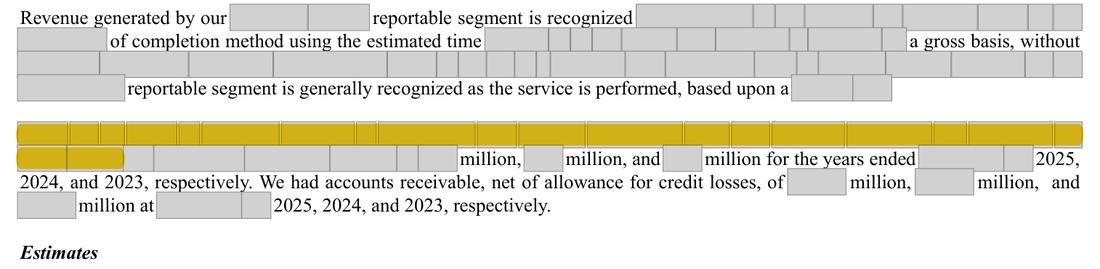
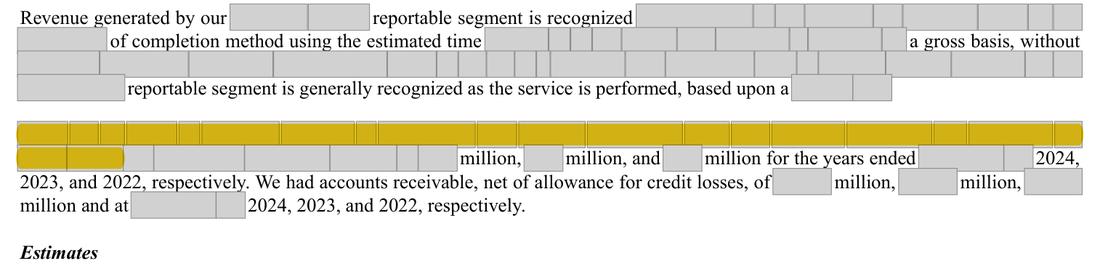
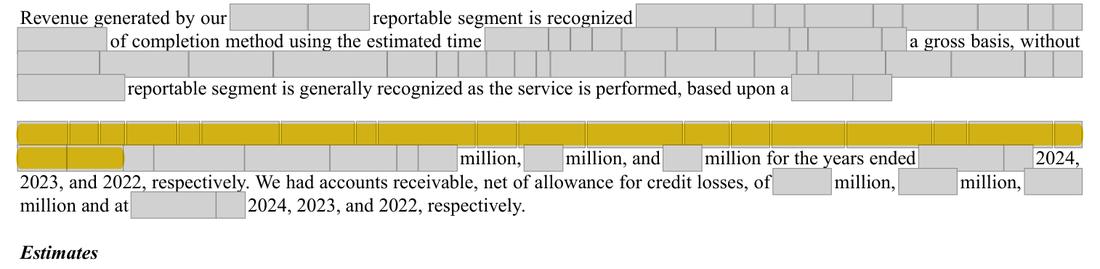
4 further page extracts: screenshot withheld to protect the company’s identity. The rows below say what each shows.
What the filing shows, and what the rule requires
| What the filing shows | What the rule requires |
|---|---|
No amount of remaining performance obligations, no timing, and no statement that the one-year or right-to-invoice practical expedient is applied, in either year; in-process revenue is given as an amount with no balance-sheet line. | The revenue note either gives the transaction price allocated to unsatisfied performance obligations at year end with the expected timing, or states which practical expedient is applied and the nature of the obligations excluded (including the Segment 2 contracts), and says where the in-process revenue is carried. |
The rule
FASB ASC 606-10-50-13 to 50-15
Summary; FASB/IFRS text is copyrighted Disclose transaction price allocated to unsatisfied performance obligations and expected timing of recognition, or state use of the permitted practical expedients and what is excluded.
Version: Text in force at the date of this review · Source: FASB Accounting Standards Codification, ASC 606-10-50-13 to 50-15 (as amended by ASU 2016-10 and ASU 2016-20)
Exchange Act Rule 12b-20
In addition to the information expressly required to be included in a statement or report, there shall be added such further material information, if any, as may be necessary to make the required statements, in the light of the circumstances under which they are made not misleading.
Version: Text in force at the date of this review · Source: 17 CFR 240.12b-20, as in force for fiscal 2024 and 2025
Why it applies here. No remaining performance obligations, timing or expedient statement is given in either year, and the line carrying in-process revenue is not named.
Why it matters
- Readers cannot see how much contracted revenue the multi-year Segment 2 business carries, or whether an expedient is relied on.
- Revenue is a leading SEC comment area; a future-filings undertaking is the realistic outcome, with no change to revenue recognized.
How often the SEC staff raises this. In 1,100 SEC staff comment letters on fiscal 2023 and 2024 Forms 10-K, released January 2025 to October 2026, revenue recognition and disclosure drew 68 of the 1,774 numbered comments (3.8%): topic 7 of 25 by frequency.
Exposure
A staff comment and a future-filings undertaking are the realistic consequences (revenue is a top comment area); no change to recognized revenue.
Our workings
Note 1 describes the Segment 2 segment as providing customers with committed truckload capacity over contracted periods aimed at three to five years, and reports Segment 2 revenue of [n] out of total revenue of [n] (USD thousand). The revenue policy explains when revenue is recognized for each segment, states that no assets or liabilities are recorded in conjunction with revenue other than accounts receivable and the credit-loss allowance, and reports in-process revenue of [amount] for 2025. A search of the whole filing finds no remaining performance obligations, no unsatisfied obligations and no revenue practical expedient; the prior-year 10-K has the same policy text.
[n] / [n] = 34.6% of revenue comes from the segment whose contracts are described as multi-year commitments.
if each shipment is a separate short contract, the company may use the one-year practical expedient, and if Segment 2 fixed charges match value delivered it may use the right-to-invoice expedient; either way the standard makes the expedient's use, and the nature of what it excludes, a required disclosure. In-process revenue for loads not yet delivered is ordinarily a right conditional on completing delivery, so the statement that no contract assets exist needs the balance-sheet line to be credible.
| Step | Computation | Result |
|---|---|---|
| Segment 2 share of 2025 revenue | [n] / [n] = 34.6% | 34.6% |
| Segment 2 share of 2024 revenue | [n] / [n] = 32.2% | 32.2% |
| In-process revenue at year end as share of receivables | [n] / [n] = [n]% | [n]% |
| Requirement | Where | Status |
|---|---|---|
| Disaggregation of revenue, linked to segments (606-10-50-5, 50-6) | Note 1, unnumbered page; Note 17, unnumbered page (freight and fuel surcharge by segment) | Given |
| Timing of satisfaction and measure of progress (606-10-50-12, 50-18) | Note 1, p.60 (miles completed; time elapsed; weekly rate) | Given |
| Payment terms (606-10-50-12(b)) | Note 1, unnumbered page (30-45 days, up to [n]) | Given |
| Contract balances: opening and closing receivables, contract assets and liabilities (606-10-50-8) | Note 1, p.60: receivables given; 'no assets or liabilities' other than receivables | Partial (in-process revenue [n] with no line) |
| Remaining performance obligations: amount and timing (606-10-50-13) | Searched whole filing | Absent |
| Practical expedient applied and nature of obligations excluded (606-10-50-14, 50-15) | Searched whole filing | Absent |
| Principal versus agent judgment (606-10-50-12(c), 55-36 to 55-40) | Note 1, p.60 | Carried by 1.25 |
Management’s best defense, and our reply
Management could say each load or service order is a separate contract completed within days, so there are no material unsatisfied obligations at year end, and Segment 2 fixed charges are billed weekly in step with service, so nothing would be disclosed even under the full requirement. They could add that the staff reviewed the revenue policy in 2019 and did not raise this point. However, both of those positions are practical expedients, and the standard makes disclosure of the expedient used, and the nature of what it excludes, a condition of relying on it; the company's own description of Segment 2 as committed capacity over three-to-five-year contracts makes the point relevant to a third of revenue. A past review that did not raise a point is not a clearance of it.
The fix
- Add to the revenue policy: the remaining performance obligations at year end with expected timing, or 'We apply the practical expedients in ASC 606-10-50-14 and do not disclose remaining performance obligations for contracts with an original expected duration of one year or less [and for Segment 2 contracts where we recognize revenue in the amount we have the right to invoice]; these obligations relate to ...'; and state where the in-process revenue is carried.
Evidence relied on
| # | What it shows | Type | Where |
|---|---|---|---|
| 1 | Segment 2 contracts described as committed capacity over three-to-five-year terms | Document | Form 10-K 2025, unnumbered page |
| 2 | Segment 2 revenue [n] (2025) and [n] (2024) | Document | Form 10-K 2025, unnumbered page |
| 3 | Total revenue for the Segment 2 share | Document | Form 10-K 2025, unnumbered page |
| 4 | Policy says no contract assets or liabilities | Document | Form 10-K 2025, page 60 |
| 5 | In-process revenue [n] at the end of 2025, no balance-sheet line given | Document | Form 10-K 2025, page 60 |
| 6 | Receivables [n] for the in-process ratio | Document | Form 10-K 2025, page 60 |
| 7 | Prior-year 10-K: same policy text, no remaining performance obligation disclosure | Document | Form 10-K 2024 (prior year), page 60 |
Absence check
- Document
- Form 10-K 2025
- Where it would appear
- Revenue Recognition
- What is missing
- the transaction price allocated to remaining performance obligations with expected timing, or a statement of the practical expedient applied and the nature of the obligations excluded
- Pages looked at
- p.100-103, 76-77
- Result
- 'remaining performance', 'unsatisfied' and 'backlog' do not hit. 'performance obligation' hits only unnumbered page, the report on the equity-method investee's statements (its equipment sales), not the company's revenue note. 'practical expedient' hits only unnumbered page, describing a credit-loss expedient in a new accounting standard, not a revenue expedient.
Prepared by Pramanex from the company’s public SEC filings, without the company’s involvement, to show how a 10-K Pre-filing Check reads. The company is not named, and nothing on this page is a statement about any identifiable company. Observations are not an audit, review or other attestation or assurance engagement, and not legal advice. An SEC-style question is a question, not a conclusion.
Want this on your own 10-K, before you file?
Start with three free findings on your latest 10-K, or book a fixed-price 10-K Pre-filing Check.
Your next 10-K will be in draft before the audit is done.
Have it read before you file.
Start with three free findings on your latest 10-K, or book a fixed-price 10-K check. Drafts only under NDA, inside your insider trading policy.