1.07 The notes say one customer exceeded 10% of revenue but never give the amount of revenue from that customer
Company B · a US-listed transportation and logistics company · Compliance or disclosure gap
In brief
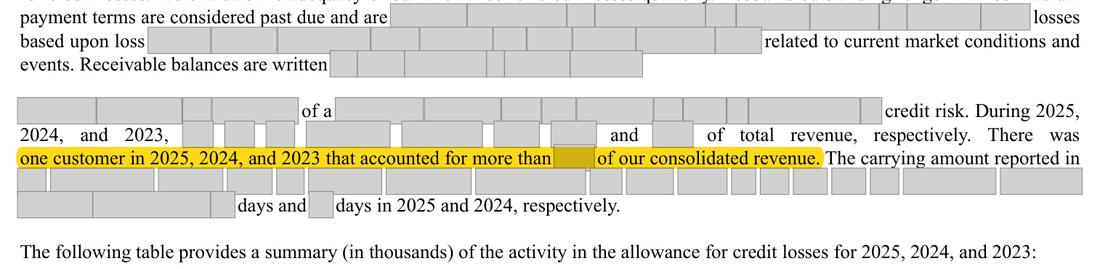
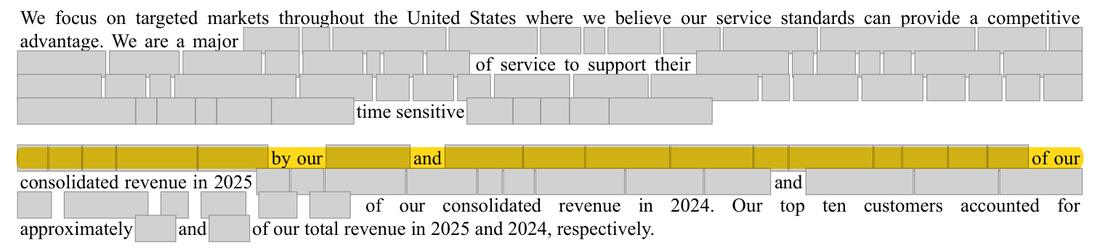
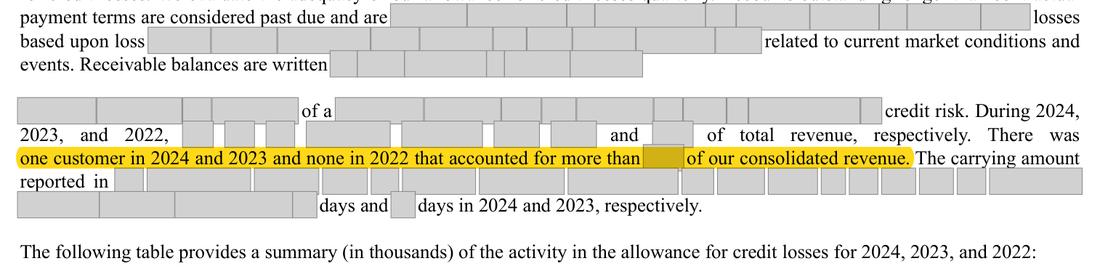
Note 1 says one customer accounted for more than 10% of consolidated revenue in each of 2025, 2024 and 2023, and Item 1 repeats this for 2025 and 2024 and names the segments that served it. Neither the segment note nor any other part of the filing gives the amount of revenue from that customer. US GAAP requires that amount. On total revenue of [amount] the undisclosed figure is at least [amount].
The evidence, as filed
1 further page extract: screenshot withheld to protect the company’s identity. The rows below say what each shows.
What the filing shows, and what the rule requires
| What the filing shows | What the rule requires |
|---|---|
The fact of a customer above 10% and the segments serving it are given; the revenue amount from that customer is given in neither year. | The segment note states the total revenue from each customer at or above 10% of consolidated revenue, for each year presented, with the segments that report it. |
The rule
FASB ASC 280-10-50-40 to 50-42
Summary; FASB/IFRS text is copyrighted Disclose revenues by product or service group and by geography (domicile and material individual foreign countries), long-lived assets by geography, and reliance on 10%-plus customers.
Version: Text in force at the date of this review · Source: FASB Accounting Standards Codification, ASC 280-10-50-40 to 50-42 (as amended by ASU 2023-07)
Exchange Act Rule 12b-20
In addition to the information expressly required to be included in a statement or report, there shall be added such further material information, if any, as may be necessary to make the required statements, in the light of the circumstances under which they are made not misleading.
Version: Text in force at the date of this review · Source: 17 CFR 240.12b-20, as in force for fiscal 2024 and 2025
Why it applies here. The fact and the segments are given; the amount is absent in this and the prior-year Form 10-K. The top-ten customer figure of [n]% does not substitute for it.
Why it matters
- Readers cannot size dependence on the largest customer, which the risk factors call material.
- A staff request to add the amount in future filings is the realistic outcome; no figures change.
Exposure
A staff comment asking for the amount in future filings is the realistic consequence; no restatement of figures.
Our workings
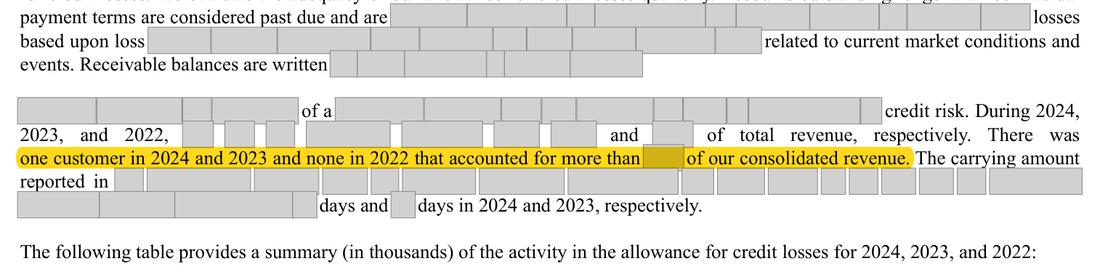
Note 1 (Accounts Receivable and Concentration of Credit Risk) says there was one customer in 2025, 2024 and 2023 above 10% of consolidated revenue; Item 1 says that customer was served by the Segment 1 and Segment 3 segments in 2025. Note 17 (segment information) has no entity-wide major-customer disclosure, and a search of the whole filing finds no revenue amount for the customer. The prior-year 10-K gives the same words without an amount.
10% of total revenue of [amount] is [amount], so the omitted 2025 amount is at least that.
the entity-wide disclosure on major customers is two-thirds given (the fact and the segments) and one-third absent (the amount). The amount is the element investors use to size concentration risk; the top-ten figure of [n]% does not substitute for it.
| Element of the major-customer disclosure (accounting standard on segments, entity-wide) | Where | Status |
|---|---|---|
| Fact that a customer is at or above 10% of revenue | Note 1, unnumbered page; Item 1, unnumbered page | Given |
| Segment(s) reporting the revenue | Item 1, unnumbered page | Given (outside the notes) |
| Total revenue from that customer, each year | Searched whole filing | Absent |
| Minimum omitted amount 2025 | [n] x 10% = [n] | USD thousand |
Management’s best defense, and our reply
Management could say the fact of the concentration, the segments involved and the top-ten share are all disclosed, so investors already understand the dependence, and that naming the revenue could harm the customer relationship in a competitive bid market. They could add that the omission has been in place for years without comment. However, the standard requires the total revenue from each such customer in terms, and competitive sensitivity is answered by the rule itself, which does not require the customer to be named. A long-standing omission is not an exemption.
The fix
- Add to Note 17: 'Revenue from one customer, reported in the Segment 1 and Segment 3 segments, was $[x] million, $[y] million and $[z] million in 2025, 2024 and 2023.'
Evidence relied on
| # | What it shows | Type | Where |
|---|---|---|---|
| 1 | Note 1 states the fact of a 10% customer for all three years, with no amount | Document | Form 10-K 2025, unnumbered page |
| 2 | Item 1 names the segments serving the 10% customer, again with no amount | Document | Form 10-K 2025, unnumbered page |
| 3 | Total revenue used to compute the minimum omitted amount | Document | Form 10-K 2025, page 55 |
| 4 | The prior-year 10-K gives the fact without the amount | Document | Form 10-K 2024 (prior year), unnumbered page |
Absence check
- Document
- Form 10-K 2025
- Where it would appear
- SEGMENT INFORMATION
- What is missing
- the total revenue from the customer above 10% of consolidated revenue, by year, with the segments reporting it
- Pages looked at
- p.10, [n], 76-78
- Result
- '10% of our consolidated revenue' hits unnumbered page and unnumbered page, which state the fact only; 'major customer' hits the risk factor on p.15, which gives no amount; 'concentration' hits unnumbered page (credit-risk concentration and the top-ten share) and p.15; 'largest customer' and 'single customer' do not hit.
Prepared by Pramanex from the company’s public SEC filings, without the company’s involvement, to show how a 10-K Pre-filing Check reads. The company is not named, and nothing on this page is a statement about any identifiable company. Observations are not an audit, review or other attestation or assurance engagement, and not legal advice. An SEC-style question is a question, not a conclusion.
Want this on your own 10-K, before you file?
Start with three free findings on your latest 10-K, or book a fixed-price 10-K Pre-filing Check.
Your next 10-K will be in draft before the audit is done.
Have it read before you file.
Start with three free findings on your latest 10-K, or book a fixed-price 10-K check. Drafts only under NDA, inside your insider trading policy.