1.04 Balance-sheet common stock captions still show the pre-2025 authorized share counts and do not say the Class B stock is convertible
Company B · a US-listed transportation and logistics company · Compliance or disclosure gap
In brief
Stockholders approved a proportional increase in the authorized Class A and Class B common stock in [date], and the company filed its Fourth Amended and Restated Articles of Incorporation, which authorize [n] Class A and [n] Class B shares, with its [date] quarterly report. This 10-K lists those Articles as Exhibit 3.1 and describes them in its risk factors as the company's Articles, yet the [date] balance sheet still states [n] Class A and [n] Class B shares authorized. The same captions also do not indicate that the Class B common stock is convertible, which the notes describe.
The evidence, as filed
What the filing shows, and what the rule requires
| What the filing shows | What the rule requires |
|---|---|
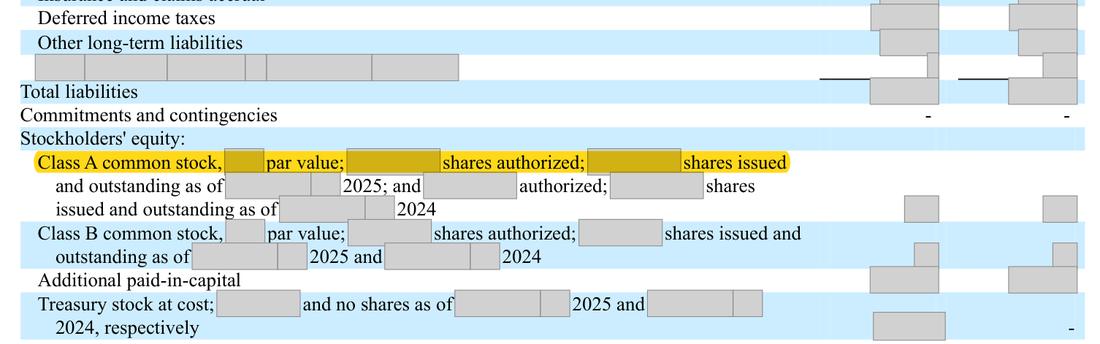
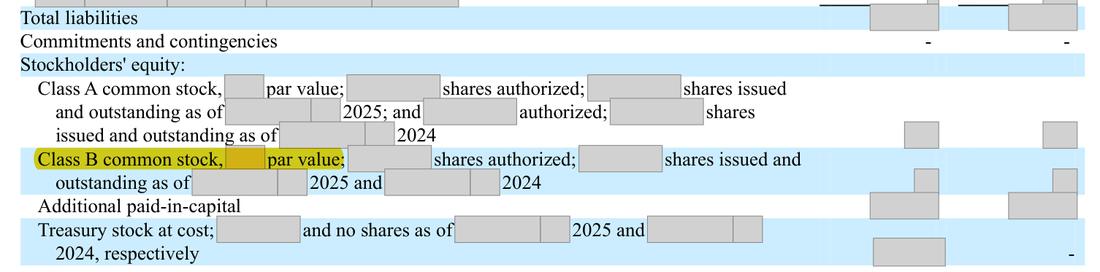
Balance sheet at [date]: 'Class A common stock, $.01 par value; [n] shares authorized' and 'Class B common stock, $.01 par value; [n] shares authorized'; no statement on the face that Class B is convertible. | The authorized counts under the Articles in force at [date] ([n] Class A; [n] Class B), and the Class B caption marked as convertible into Class A share for share, with the basis of conversion on the face or in a note. |
The rule
Regulation S-X Rule 5-02.29 (common stocks)
For each class of common shares state, on the face of the balance sheet or in a note, the title of the issue, the number of shares authorized, and, if convertible, the basis of conversion
Version: Text in force at the date of this review · Source: Regulation S-X, 17 CFR 210.5-02, as amended to 2025
Regulation S-X Rule 5-02.29 (convertibility on the face)
If convertible, this fact should be indicated on the face of the balance sheet.
Version: Text in force at the date of this review · Source: Regulation S-X, 17 CFR 210.5-02, as amended to 2025
Why it applies here. The authorized counts are half those in the Articles in force at year end, and Class B convertibility (share for share into Class A, per Note 1 and the risk factors) is not indicated. No dollar amount changes.
Why it matters
- Readers of the balance sheet and its XBRL data see half the authorized capital, understating headroom for issuance or dilution.
- A staff comment and a correction in the next periodic report are the realistic outcome; no dollar amount is restated.
How often the SEC staff raises this. In 1,100 SEC staff comment letters on fiscal 2023 and 2024 Forms 10-K, released January 2025 to October 2026, financial statement presentation drew 254 of the 1,774 numbered comments (14.3%): the second most frequent topic.
Exposure
A staff comment and a correction in the next periodic report; no restatement of any dollar amount.
Our workings
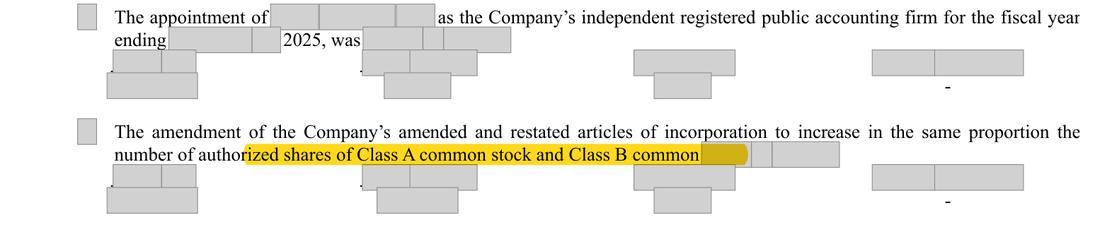
the [date] Form 8-K reports that stockholders approved the amendment of the articles 'to increase in the same proportion the number of authorized shares of Class A common stock and Class B common stock'. Article IV of the Fourth Amended and Restated Articles, filed as Exhibit 3.1 to the Form 10-Q filed [date], authorizes [n] Class A and [n] Class B common shares; the Third Amended and Restated Articles authorized [n] and [n], and a clause-by-clause comparison of the two shows that Article IV is the only change. This 10-K incorporates the Fourth Amended and Restated Articles as Exhibit 3.1 and names them in the risk factors as the company's Articles of Incorporation. The balance sheet at [date], and its Inline XBRL tags, carry [n] and [n]. A week after the 10-K, the company's Form S-3 stated that under the Fourth Amended and Restated Articles its authorized capital is [n] Class A and [n] Class B shares. Separately, the Class B caption on the face does not say the shares are convertible; Note 1 (capital structure) says Class B shares convert to Class A shares, and the risk factors say they are convertible share for share.
see the workings.
the balance-sheet captions were rolled forward from 2024 without the charter amendment; Rule 5-02.29 requires the number of shares authorized for each class and requires the convertibility of a class to be indicated on the face. No dollar amount changes, so the point is a disclosure-accuracy point, not a measurement error in equity.
| Caption | Balance sheet, [date] | Fourth A&R Articles, Article IV | Difference (shares) |
|---|---|---|---|
| Class A common stock authorized | [n] | [n] | [n] - [n] = [n] |
| Class B common stock authorized | [n] | [n] | [n] - [n] = [n] |
| Class B convertible indicated on the face | No | Convertible share for share (Note 1; risk factors) | statement missing |
Management’s best defense, and our reply
The company could argue that the amended Articles became effective only when filed with the [state] Secretary of State, so the balance sheet may reflect the authorized capital legally in force at year end; it could add that authorized shares carry no dollar amount and that the conversion feature is fully described in Note 1 and the risk factors, so no reader is misled. The answer: the company filed the Fourth Amended and Restated Articles as its current charter in [date], lists them in this 10-K as Exhibit 3.1, calls them its Articles of Incorporation in the risk factors, and stated [n] and [n] in its Form S-3 one week after the 10-K, so on the company's own filings the amendment was in force at [date]; and Rule 5-02.29 requires the authorized count and the convertibility indication on the balance sheet itself, which a note does not replace for the face statement.
The fix
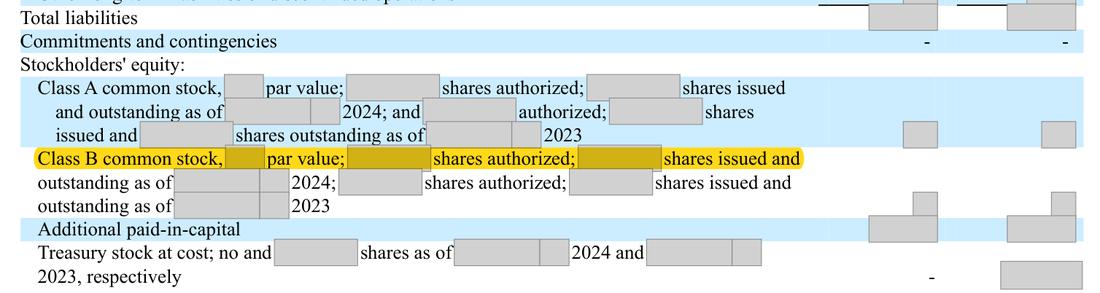
- In the next Form 10-Q and Form 10-K, state 'Class A common stock, $.01 par value; [n] shares authorized' and 'Class B common stock, $.01 par value, convertible into Class A common stock share for share; [n] shares authorized' (with the 2024 column at [n] and [n]), and correct the matching Inline XBRL facts.
Evidence relied on
| # | What it shows | Type | Where |
|---|---|---|---|
| 1 | The [date] balance sheet states [n] Class A shares authorized | Document | Form 10-K 2025, unnumbered page |
| 2 | The Class B caption states [n] shares authorized and does not say the shares are convertible | Document | Form 10-K 2025, unnumbered page |
| 3 | This 10-K incorporates the Fourth Amended and Restated Articles as Exhibit 3.1 | Document | Form 10-K 2025, unnumbered page |
| 4 | The risk factors describe the Fourth Amended and Restated Articles as the company's Articles of Incorporation | Document | Form 10-K 2025, unnumbered page |
| 5 | Note 1 (capital structure) describes the Class B conversion feature that the face of the balance sheet does not indicate | Document | Form 10-K 2025, unnumbered page |
| 6 | Article IV of the Fourth Amended and Restated Articles (Exhibit 3.1 to the Form 10-Q filed [date]) authorizes [n] Class A and [n] Class B shares | Document | |
| 7 | The [date] annual meeting approved the increase in authorized shares | Document | |
| 8 | The company's own registration statement, filed one week after the 10-K, states the authorized capital under the Fourth Amended and Restated Articles | Document | |
| 9 | Shareholders approved the increase in authorized shares at the [date] annual meeting | Document |
Absence check
- Document
- Form 10-K 2025
- Where it would appear
- Class B common stock, $.01 par value
- What is missing
- the statement on the face of the balance sheet that the Class B common stock is convertible
- Pages looked at
- p.93-54 (balance sheet), p.57 (statement of stockholders' equity), unnumbered page (Note 1 capital structure)
- Result
- 'convertible' hits unnumbered page (convertible debt securities in a financing risk factor) and unnumbered page (Class B convertible share for share, a risk factor); 'convert' hits p.41 and [n] as above, unnumbered page (interest rate swap converting variable to fixed interest) and unnumbered page (Note 1: Class B shares convert to Class A); 'conversion' hits unnumbered page only. None of the hits is on the face of the balance sheet; the note discloses the basis of conversion, which the rule allows in a note, but not the indication on the face.
Prepared by Pramanex from the company’s public SEC filings, without the company’s involvement, to show how a 10-K Pre-filing Check reads. The company is not named, and nothing on this page is a statement about any identifiable company. Observations are not an audit, review or other attestation or assurance engagement, and not legal advice. An SEC-style question is a question, not a conclusion.
Want this on your own 10-K, before you file?
Start with three free findings on your latest 10-K, or book a fixed-price 10-K Pre-filing Check.
Your next 10-K will be in draft before the audit is done.
Have it read before you file.
Start with three free findings on your latest 10-K, or book a fixed-price 10-K check. Drafts only under NDA, inside your insider trading policy.