1.03 [acquisition 4] acquisition note: pro forma results assume [date] instead of the start of the comparable prior year, and the gross acquired receivables, nonrecurring pro forma adjustments and intangible amortization periods are not given
Company B · a US-listed transportation and logistics company · Compliance or disclosure gap
In brief
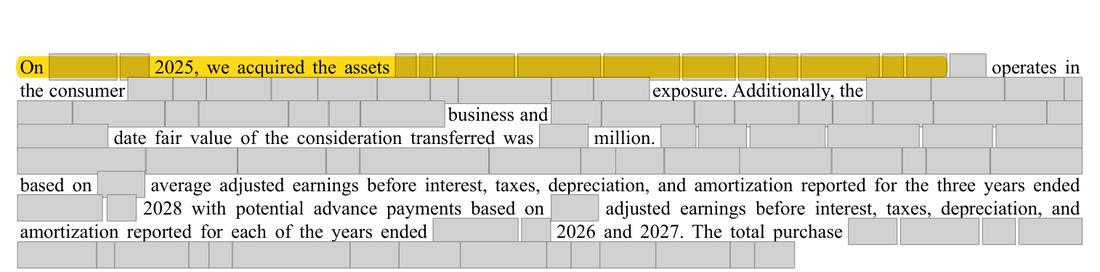
The company bought the [acquisition 4] brokerage business on [date] for [amount]. The business-combinations standard requires the supplemental pro forma results to assume the deal happened at the start of the comparable prior year, [date]; the note assumes [date], a departure from the method the prior-year 10-K used for its 2023 acquisition. The note also omits the gross contractual amount of the [amount] of acquired receivables and the amount not expected to be collected, the nature and amount of nonrecurring pro forma adjustments (the deal's [n] of transaction costs appears only in the management's discussion), and the amortization periods of the [amount] of acquired intangibles.
The evidence, as filed
What the filing shows, and what the rule requires
| What the filing shows | What the rule requires |
|---|---|
Pro forma results for 2025, 2024 and 2023 prepared as if [acquisition 4] were acquired on [date]; no gross receivables or uncollectible estimate; no nonrecurring adjustment disclosure; no acquisition-cost amount or line item in the note; no amortization period for the acquired intangibles. | Pro forma revenue and earnings for 2025 and 2024 as if [acquisition 4] were acquired on [date], with the nature and amount of material nonrecurring adjustments (including the [n] of transaction costs) and the acquisition costs and their line item; the gross contractual receivables and the best estimate of amounts not collectible; and the weighted-average amortization period of each major class of acquired intangible. |
The rule
FASB ASC 805-10-50-2(h); 805-20-50-1(b); 805-30-50-1; 350-30-50-1
Summary; FASB/IFRS text is copyrighted For each material acquisition disclose consideration, assets and liabilities recognized, goodwill factors, measurement-period adjustments and, for PBEs, supplemental pro forma revenue and earnings.
Version: Text in force at the date of this review · Source: FASB Accounting Standards Codification, ASC 805-10-50-2, 805-20-50-1 and 805-30-50-1 (as amended by ASU 2010-29)
Exchange Act Rule 12b-20
In addition to the information expressly required to be included in a statement or report, there shall be added such further material information, if any, as may be necessary to make the required statements, in the light of the circumstances under which they are made not misleading.
Version: Text in force at the date of this review · Source: 17 CFR 240.12b-20, as in force for fiscal 2025
Why it applies here. The pro forma date differs from the fixed date. Gross receivables, nonrecurring adjustments (the [amount] of transaction costs appears only in MD&A) and amortization periods are not given.
Why it matters
- 2024 and 2025 pro forma figures are not on the basis the standard fixes, and readers cannot see where one-off items were placed.
- Business-combination disclosures are a recurring SEC comment area; a future-filings undertaking is the realistic outcome, with no restatement.
How often the SEC staff raises this. In 1,100 SEC staff comment letters on fiscal 2023 and 2024 Forms 10-K, released January 2025 to October 2026, business combinations and consolidation drew 62 of the 1,774 numbered comments (3.5%): topic 9 of 25 by frequency.
Exposure
A staff comment and a future-filings undertaking are the realistic consequences (business combinations and pro forma disclosures are a recurring comment area); no restatement of the statements.
Our workings
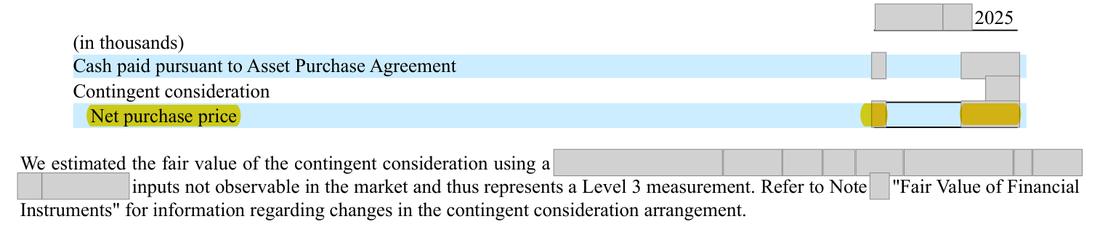
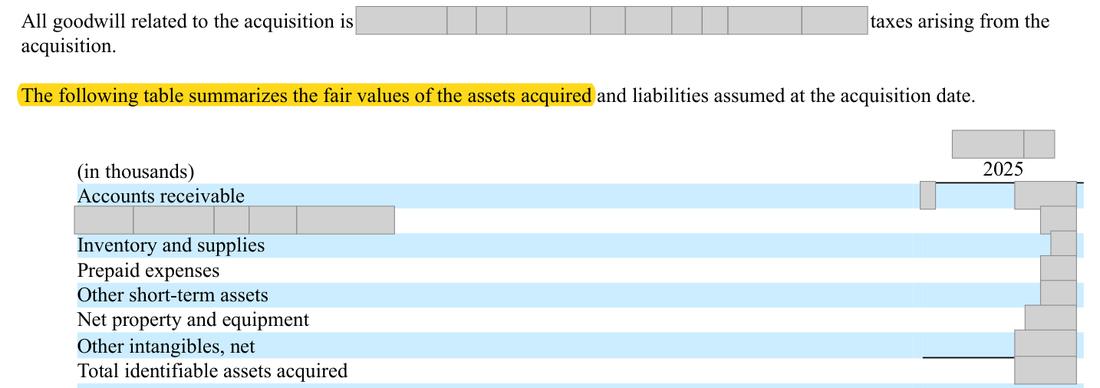
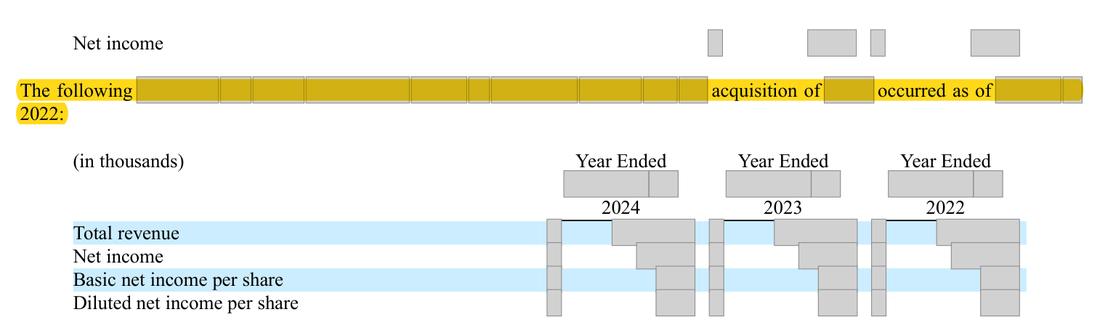
Note 6 says [acquisition 4] was acquired on [date], net purchase price [n], with accounts receivable of [n] and other intangibles of [n] at fair value, and presents unaudited pro forma results that assume the acquisition occurred as of [date], for 2025, 2024 and 2023 (pro forma revenue [n] for 2025). The non-GAAP reconciliation in the management's discussion lists transaction costs of [n] for 2025; Note 6 gives no acquisition-cost amount. A search of the whole filing finds no gross contractual receivable amount, no nonrecurring pro forma adjustment and no amortization period for the acquired intangibles; the critical accounting estimates give only a general range of 3 to 17 years for all finite-lived intangibles. The prior-year 10-K presented its 2023 acquisition ([acquisition 2]) as if acquired on [date], the start of the comparable prior year.
[n] - [n] = [n] of pre-acquisition [acquisition 4] revenue added for 2025, [n]% of reported revenue, so the acquisition is material to the pro forma presentation.
the [date] date departs from the standard's fixed date and from the company's own prior practice; with the correct date, one-off items such as the [n] of transaction costs belong in the 2024 pro forma year, and the reader cannot tell where they were placed. The other gaps are required elements of the same note.
| Step | Computation | Result (USD thousand) |
|---|---|---|
| Pre-acquisition [acquisition 4] revenue in 2025 pro forma | [n] - [n] = [n] | [n] |
| Share of reported 2025 revenue | [n] / [n] = [n]% | [n]% |
| Purchase price as share of total assets | [n] / [n] = [n]% | [n]% |
| Acquired intangibles: customer relationships, Segment 3 | [n] - [n] = [n] | [n] |
| Acquired intangibles: non-compete, Segment 3 | [n] - [n] = [n] | [n] |
| Total acquired intangibles | [n] + [n] = [n] | agrees to Note 6 |
| Requirement | Where | Status |
|---|---|---|
| Revenue and earnings of [acquisition 4] since acquisition (805-10-50-2(h)(1)) | Note 6, unnumbered page: [n] and ([n]) | Given |
| Pro forma as if acquired at the start of the comparable prior annual period (805-10-50-2(h)(3)) | Note 6, unnumbered page: assumes [date], not [date] | Different |
| Nature and amount of material nonrecurring pro forma adjustments (805-10-50-2(h)(4)) | Note 6, unnumbered page | Absent |
| Acquisition-related costs, amount expensed and line item (805-10-50-2) | Only as 'Transaction costs [n]' in the non-GAAP table, p.39 | Partial (outside the notes) |
| Acquired receivables: fair value, gross contractual amount, amount not expected to be collected (805-20-50-1(b)) | Note 6, unnumbered page: fair value [n] only | Partial |
| Goodwill: qualitative factors and tax-deductible amount (805-30-50-1) | Note 6, unnumbered page | Given |
| Provisional amounts and reasons (805-20-50-4A) | Note 6, unnumbered page: may change on finalizing contingent consideration and intangibles | Given |
| Acquired intangibles by major class with weighted-average amortization period (350-30-50-1) | Note 9, p.69-123: classes derivable, no periods for the acquired assets | Partial |
| Earn-out range or maximum (805-30-50-1(c)) | Note 6, unnumbered page | Carried by 1.02 |
Management’s best defense, and our reply
Management could say a [date] date simply adds a third year of pro forma information, which is more than the standard asks, and that recurring amortization is the same under either date. They could add that the receivables were collected in the ordinary course, the transaction costs were small and are disclosed in the management's discussion, and the intangibles were provisional at year end. However, the standard fixes the assumed date at the start of the comparable prior year precisely to stop the earlier diversity of practice, and the date decides in which year one-off items such as the [n] of transaction costs fall; the company applied the correct date for its 2023 acquisition. Disclosure in the management's discussion does not complete the note, and provisional status does not remove the amortization-period requirement.
The fix
- In the fiscal 2026 Form 10-K, re-present [acquisition 4] pro forma results for 2025 (and 2026 if required) as if acquired on [date], state the nature and amount of nonrecurring adjustments and the acquisition costs with their line item, give the gross contractual receivables and the uncollectible estimate, and give the amortization period for each class of acquired intangible.
Evidence relied on
| # | What it shows | Type | Where |
|---|---|---|---|
| 1 | Acquisition date [date] | Document | Form 10-K 2025, unnumbered page |
| 2 | Net purchase price [n] | Document | Form 10-K 2025, unnumbered page |
| 3 | Acquired receivables given at fair value only | Document | Form 10-K 2025, unnumbered page |
| 4 | Acquired intangibles [n], no amortization period given | Document | Form 10-K 2025, unnumbered page |
| 5 | Pro forma assumes [date], not the start of the comparable prior year | Document | Form 10-K 2025, unnumbered page |
| 6 | Pro forma revenue for 2025, 2024 and 2023 | Document | Form 10-K 2025, unnumbered page |
| 7 | Reported 2025 revenue for the pro forma increment | Document | Form 10-K 2025, page 55 |
| 8 | Total assets for the size of the acquisition | Document | Form 10-K 2025, unnumbered page |
| 9 | 2025 Segment 3 customer relationships gross [n] | Document | Form 10-K 2025, page 69 |
| 10 | 2025 Segment 3 non-compete gross [n] | Document | Form 10-K 2025, page 69 |
| 11 | 2024 Segment 3 customer relationships gross [n] | Document | Form 10-K 2025, unnumbered page |
| 12 | 2024 Segment 3 non-compete gross [n] | Document | Form 10-K 2025, unnumbered page |
| 13 | 2025 transaction costs of [n] appear only in the non-GAAP reconciliation | Document | Form 10-K 2025, page 39 |
Absence check
- Document
- Form 10-K 2025
- Where it would appear
- The following table summarizes the fair values of the assets acquired
- What is missing
- the gross contractual amount of the acquired receivables and the best estimate of the amounts not expected to be collected
- Pages looked at
- p.118-119, 69-123
- Result
- None of the terms hits anywhere in the filing.
Absence check
- Document
- Form 10-K 2025
- Where it would appear
- The following unaudited pro forma consolidated results
- What is missing
- the nature and amount of material nonrecurring pro forma adjustments, and the acquisition-related costs with their line item
- Pages looked at
- p.118-119, 39-68
- Result
- 'nonrecurring' and 'non-recurring' do not hit. 'transaction cost' hits p.16 and [n] (risk factors on acquisitions in general) and p.39-68 (the non-GAAP reconciliation in the management's discussion, which lists [n] of transaction costs without linking them to the pro forma or naming the line item); 'acquisition-related' hits p.16 (risk factor) and unnumbered page (critical estimate on amortization). None is the pro forma adjustment disclosure in the note.
Absence check
- Document
- Form 10-K 2025
- Where it would appear
- GOODWILL, INTANGIBLES, AND OTHER ASSETS
- What is missing
- the weighted-average amortization period of each major class of intangible asset acquired with [acquisition 4]
- Pages looked at
- p.118, 69-123, and unnumbered page (critical accounting estimates)
- Result
- None of the terms hits; the remaining-life column on p.69-123 covers each whole class, not the assets acquired in 2025, and the critical accounting estimates on unnumbered page give only a general 3 to 17 year range for all finite-lived intangibles.
Prepared by Pramanex from the company’s public SEC filings, without the company’s involvement, to show how a 10-K Pre-filing Check reads. The company is not named, and nothing on this page is a statement about any identifiable company. Observations are not an audit, review or other attestation or assurance engagement, and not legal advice. An SEC-style question is a question, not a conclusion.
Want this on your own 10-K, before you file?
Start with three free findings on your latest 10-K, or book a fixed-price 10-K Pre-filing Check.
Your next 10-K will be in draft before the audit is done.
Have it read before you file.
Start with three free findings on your latest 10-K, or book a fixed-price 10-K check. Drafts only under NDA, inside your insider trading policy.