1.05 The goodwill impairment policy still describes the implied-fair-value test that US GAAP removed, in the year a [amount] impairment was booked
Company B · a US-listed transportation and logistics company · Compliance or disclosure gap
In brief
Note 1 says that once a fair-value estimate indicates impairment, the Company 'will then measure the amount of the impairment', and that goodwill impairment exists 'when the estimated implied fair value of goodwill is less than its carrying value'. That is the second step of the test that ASU 2017-04 removed from the Codification; under the test in force the loss is the excess of the reporting unit's carrying amount over its fair value, capped at the goodwill allocated to it. The policy is the only statement of the measurement method in the 10-K, and the year's partial impairment of [amount] ([n]) in the legacy Segment 2 reporting unit was booked under it. The prior-year 10-K carried the same sentences.
The evidence, as filed
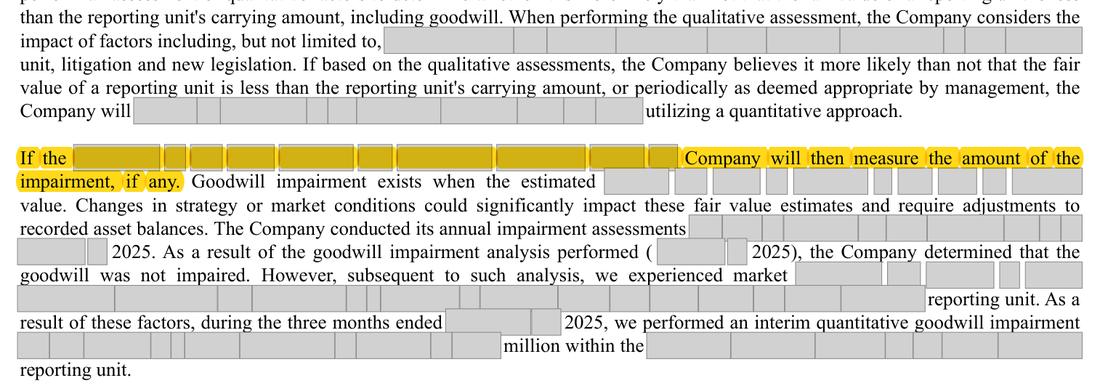
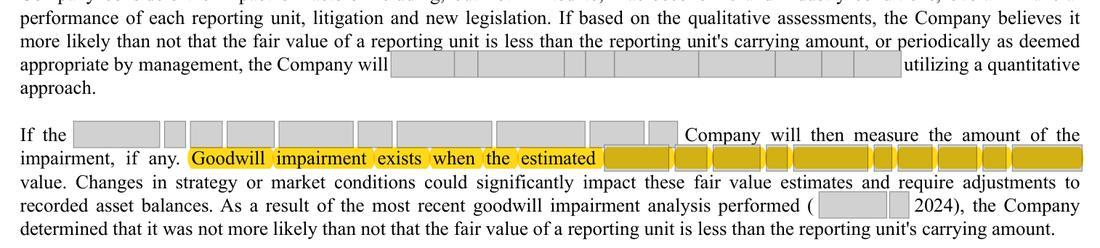
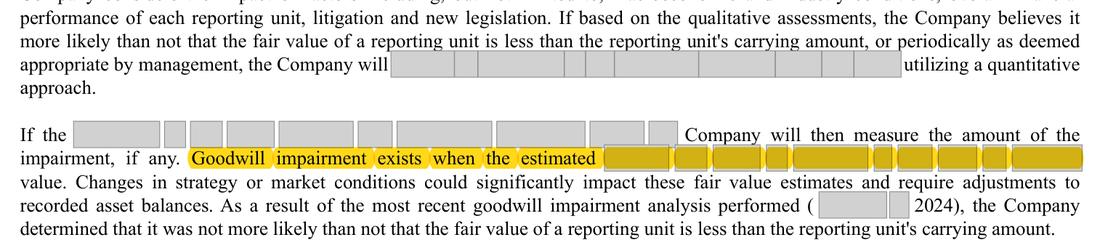
1 further page extract: screenshot withheld to protect the company’s identity. The rows below say what each shows.
What the filing shows, and what the rule requires
| What the filing shows | What the rule requires |
|---|---|
Note 1: 'If the estimation of fair value indicates that impairment potentially exists, the Company will then measure the amount of the impairment, if any. Goodwill impairment exists when the estimated implied fair value of goodwill is less than its carrying value.' Impairment booked in 2025: [n] (Segment 2 goodwill [n] down to [n]). Same wording in the prior-year 10-K. | A policy that states the one-step test in force: an impairment loss equal to the amount by which the reporting unit's carrying amount exceeds its fair value, not exceeding the goodwill allocated to that unit; and a goodwill note that says the [n] loss was measured that way. |
The rule
ASC 350-20-35-8 (goodwill impairment loss, one-step test; paraphrase, the Codification text is copyrighted)
Summary; FASB/IFRS text is copyrighted Impairment equals carrying amount exceeding reporting unit fair value, capped at goodwill; disclose goodwill changes by segment and impairment circumstances, amount and valuation method.
Version: Text in force at the date of this review · Source: FASB Accounting Standards Codification, ASC 350-20-35-8 (as amended by ASU 2017-04)
Regulation S-X Rule 4-01(a) (form, order and terminology of financial statements)
Financial statements should be filed in such form and order, and should use such generally accepted terminology, as will best indicate their significance and character in the light of the provisions applicable thereto.
Version: Text in force at the date of this review · Source: Regulation S-X, 17 CFR 210.4-01(a), eCFR text as amended
FASB ASC 235-10-50-1 to 50-4 (disclosure of significant accounting policies)
Summary; FASB/IFRS text is copyrighted Disclose significant accounting policies, including choices among acceptable alternatives and industry-specific or unusual applications, preferably in the first note.
Version: Text in force at the date of this review · Source: FASB Accounting Standards Codification, ASC 235-10-50 (paraphrase; the Codification text is copyrighted)
Why it applies here. The policy describes a measurement the Codification no longer contains. No amount is said to differ; confirming the method behind the [amount] is for management. The fiscal 2024 Form 10-K carried the same sentences.
Why it matters
- Readers cannot use the policy to understand the 2025 impairment, which equaled 191.3% of pre-tax income.
- Goodwill impairment is a frequent SEC staff comment theme; a request to revise the policy in future filings is the realistic outcome.
How often the SEC staff raises this. In 1,100 SEC staff comment letters on fiscal 2023 and 2024 Forms 10-K, released January 2025 to October 2026, goodwill and impairment drew 54 of the 1,774 numbered comments (3.0%): topic 11 of 25 by frequency.
Exposure
A staff comment asking for the policy to be revised in future filings is the realistic outcome; a re-measurement arises only if the removed step was in fact applied.
Our workings
Note 1 (unnumbered page) describes a two-stage process: a fair-value estimate that 'indicates that impairment potentially exists', after which the Company 'will then measure the amount of the impairment', with impairment existing 'when the estimated implied fair value of goodwill is less than its carrying value'. The same paragraph reports the interim quantitative test in the fourth quarter of 2025 that 'resulted in a partial impairment of goodwill of [amount]' in the legacy Segment 2 reporting unit, and the goodwill roll-forward (unnumbered page) shows Segment 2 goodwill falling from [n] by [n] to [n]. The prior-year 10-K (Form 10-K 2024 (prior year) p.70) carries the identical two sentences. No other passage states how the loss was measured: the critical accounting estimate (unnumbered page) describes the qualitative option and how fair value is estimated, not how the loss is computed from it. Law: ASC paragraph 350-20-35-8, as amended by ASU 2017-04 (in force for SEC filers other than smaller reporting companies from 2020, and for every entity by 2023), measures the loss as the excess of the reporting unit's carrying amount over its fair value, limited to the goodwill allocated to that unit; the hypothetical purchase-price allocation that produced an 'implied fair value of goodwill' was removed. ASC paragraphs 235-10-50-1 to 50-4 require the significant accounting policies to be disclosed, and Regulation S-X Rule 4-01(a) requires generally accepted terminology.
[n] - [n] = [n]; the charge is 191.3% of pre-tax income of [n].
the policy as printed describes a measurement the Codification no longer contains. If the loss was measured by the one-step test, the required policy statement does not describe the method applied; if the implied-fair-value step was in fact used, the measurement itself departs from GAAP. On either reading the policy disclosure does not state GAAP in force. No amount is said to differ: the gap is the policy statement, and confirming the method behind the [n] is for management.
| Item | Computation | Result (USD thousand) |
|---|---|---|
| Segment 2 goodwill after impairment | [n] - [n] = [n] | [n] |
| Impairment as % of pre-tax income | [n] / [n] = 191.3% | 191.3% |
Management’s best defense, and our reply
Management would say the implied-fair-value sentence is legacy wording carried forward from before ASU 2017-04, that the interim test was in fact a one-step quantitative test using the blended income and market fair value the critical accounting estimate describes, and that the auditor reviewed the measurement. They would add that a stale sentence in a policy note leaves every recognized amount unchanged.
The fix
- Replace the sentence with: 'A goodwill impairment loss is recognized for the amount by which a reporting unit's carrying amount exceeds its fair value, not to exceed the carrying amount of goodwill allocated to that reporting unit', and state in the goodwill note that the 2025 loss was measured this way.
Evidence relied on
| # | What it shows | Type | Where |
|---|---|---|---|
| 1 | The policy describes a second, separate measurement step after the fair-value estimate (the two-step test). | Document | Form 10-K 2025, unnumbered page |
| 2 | The policy states the superseded implied-fair-value measure. | Document | Form 10-K 2025, unnumbered page |
| 3 | A goodwill impairment was booked in 2025 under this policy. | Document | Form 10-K 2025, unnumbered page |
| 4 | Segment 2 goodwill before the impairment: [n]. | Document | Form 10-K 2025, unnumbered page |
| 5 | The 2025 impairment of [n], all in Segment 2. | Document | Form 10-K 2025, unnumbered page |
| 6 | Segment 2 goodwill after the impairment: [n]. | Document | Form 10-K 2025, unnumbered page |
| 7 | The prior-year 10-K carried the same superseded wording. | Document | Form 10-K 2024 (prior year), page 70 |
| 8 | The fiscal 2024 goodwill note already described impairment by the implied fair value of goodwill, the measure removed from the annual test before that year. | Document | Form 10-K 2024 (prior year), page 70 |
| 9 | The wording sat in the note describing the [date] annual test, so the same superseded description applied to the fiscal 2024 test. | Document | Form 10-K 2024 (prior year), page 70 |
Absence check
- Document
- Form 10-K 2025
- Where it would appear
- A summary of the changes in carrying amount of goodwill
- What is missing
- a statement of how the [n] goodwill impairment loss was measured (carrying amount of the reporting unit over its fair value)
- Pages looked at
- p.40-70 (critical accounting estimates), unnumbered page (Note 1), p.69-123 (goodwill note)
- Result
- 'implied fair value' hits only unnumbered page, the superseded policy sentence itself; 'excess of the carrying' hits only p.60, the equity-method investment ([equity investee]) impairment policy, not goodwill; the other terms do not hit.
Prepared by Pramanex from the company’s public SEC filings, without the company’s involvement, to show how a 10-K Pre-filing Check reads. The company is not named, and nothing on this page is a statement about any identifiable company. Observations are not an audit, review or other attestation or assurance engagement, and not legal advice. An SEC-style question is a question, not a conclusion.
Want this on your own 10-K, before you file?
Start with three free findings on your latest 10-K, or book a fixed-price 10-K Pre-filing Check.
Your next 10-K will be in draft before the audit is done.
Have it read before you file.
Start with three free findings on your latest 10-K, or book a fixed-price 10-K check. Drafts only under NDA, inside your insider trading policy.