1.04 No valuation method or assumptions are given for the [n] stock options granted in fiscal 2023, a year whose income statement is presented
Company A · a US-listed consumer leisure company · Compliance or disclosure gap
In brief
The option table shows [n] options granted in fiscal 2023 at a weighted-average fair value of [amount]. The note does not say how that fair value was estimated or give the expected volatility, term, risk-free rate or dividend yield. Fiscal 2023 is one of the three years presented, and the prior-year Form 10-K was silent too. The gap closes by itself next year, because no options have been granted since and fiscal 2023 drops out of the years presented.
The evidence, as filed
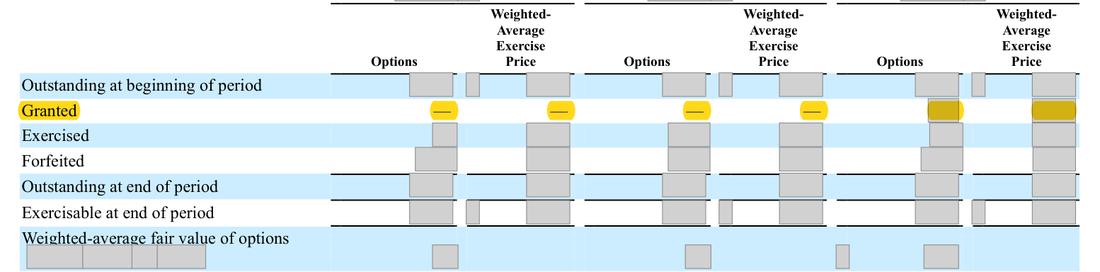
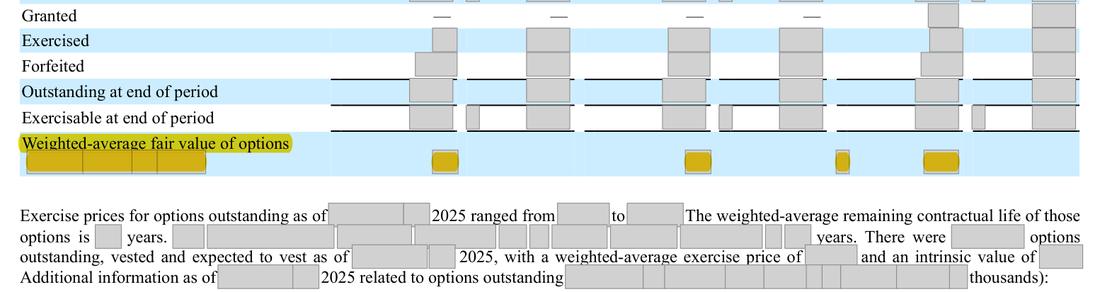
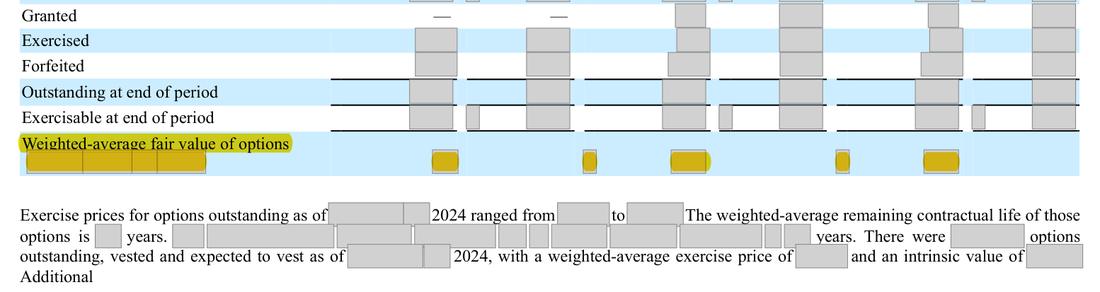
1 further page extract: screenshot withheld to protect the company’s identity. The rows below say what each shows.
What the filing shows, and what the rule requires
| What the filing shows | What the rule requires |
|---|---|
Grant count and weighted-average grant-date fair value for fiscal 2023; no valuation method and no assumptions. | For each year for which an income statement is presented and options were granted: the valuation method and the expected term, expected volatility, expected dividends and risk-free rate used. |
| What we checked. Note 7 (all award tables and narrative), Note 1 policies, the statements of equity and cash flows, and the prior-year Form 10-K. | |
The rule
FASB ASC 718-10-50-2(f) (fair-value method and significant assumptions, each income-statement year)
Summary; FASB/IFRS text is copyrighted Disclose share-based arrangement terms, fair-value methods and assumptions, award activity, compensation cost and tax effects, and unrecognised cost with weighted-average recognition period.
Version: Text in force at the date of this review · Source: FASB Accounting Standards Codification, ASC 718-10-50-2 (as amended to 2025), paraphrased
Why it applies here. Accounting Standards Codification (ASC) paragraph 718-10-50-2(f) requires, for each year for which an income statement is presented, a description of the method used to estimate fair value and the significant assumptions (expected term, expected volatility, expected dividends, risk-free rate). The requirement is tied to the income-statement years, not to the year of the grant being current; the fiscal 2023 column remains in this Form 10-K. The amount is modest, which is why the severity is low.
Why it matters
A reader cannot relate the fiscal 2023 option cost to any stated assumption. Prospectively the gap is spent: options ceased from fiscal 2024, none were granted in the first half of fiscal 2026, and the fiscal 2026 Form 10-K will no longer present fiscal 2023.
Exposure
Low: the staff reviewed this Form 10-K and closed its review on [date] without raising the point; a comment would arise only if options were granted again without the disclosure.
Our workings
Note 7 shows [n] options granted in fiscal 2023 at a weighted-average exercise price of [amount] and a weighted-average fair value of [amount], and states that the company ceased issuing options from fiscal 2024. No valuation model or assumption appears anywhere in the Form 10-K.
the fiscal 2023 grants carried a grant-date fair value of about [n] ([n] x [n]).
| Measure | Figure | Working |
|---|---|---|
| Grant-date fair value of fiscal 2023 option grants | [n] | [n] x [n] = [n] |
| Requirement | Status | Where |
|---|---|---|
| Valuation method | Absent | nowhere |
| Expected term | Absent | nowhere |
| Expected volatility | Absent | nowhere |
| Expected dividends | Absent | nowhere |
| Risk-free rate | Absent | nowhere |
| Weighted-average grant-date fair value | Given | Note 7 option table |
Management’s best defense, and our reply
Management could say that no options have been granted since fiscal 2023, that the fiscal 2023 grant is small relative to total share-based expense, and that the grant-date fair value per option is already shown. It could add that the staff reviewed this Form 10-K, raised only the fiscal 2024 debt conversion expense, and closed its review on [date], and that fiscal 2023 drops out of the three-year window next year.
The fix
- No change is needed for the fiscal 2026 Form 10-K while no options are granted. If options are granted again, add to the share-based compensation note: 'The fair value of options granted in fiscal [year] was estimated using the [model] with expected volatility of [x%], expected term of [y] years, expected dividend yield of [z%] and a risk-free rate of [w%].'
Evidence relied on
| # | What it shows | Type | Where |
|---|---|---|---|
| 1 | Option grants: [n] in fiscal 2023 only | Document | Form 10-K 2025, page 73 |
| 2 | Fair value given for the fiscal 2023 grants, with no method or assumptions | Document | Form 10-K 2025, page 73 |
| 3 | Fiscal 2023 is the only presented year with option grants | Document | Form 10-K 2025, page 72 |
Absence check
- Document
- Form 10-K 2025
- Where it would appear
- A summary of the Company’s stock option activity
- What is missing
- the valuation method and the expected term, volatility, dividend yield and risk-free rate for the fiscal 2023 option grants
- Pages looked at
- p.72-75 (Note 7), p.59-64 (Note 1) - images
- Result
- 'volatility' hits only p.18, a risk factor about the share price. 'expected term' hits only p.70, the lease note (depreciable life limited to the expected lease term). 'risk-free', 'Black-Scholes' and 'dividend yield' have no hit.
Prepared by Pramanex from the company’s public SEC filings, without the company’s involvement, to show how a 10-K Pre-filing Check reads. The company is not named, and nothing on this page is a statement about any identifiable company. Observations are not an audit, review or other attestation or assurance engagement, and not legal advice. An SEC-style question is a question, not a conclusion.
Want this on your own 10-K, before you file?
Start with three free findings on your latest 10-K, or book a fixed-price 10-K Pre-filing Check.
Your next 10-K will be in draft before the audit is done.
Have it read before you file.
Start with three free findings on your latest 10-K, or book a fixed-price 10-K check. Drafts only under NDA, inside your insider trading policy.