1.02 Earnings per share reconciliation shows one numerator: no convertible-note interest add-back behind fiscal 2023 diluted earnings per share, and no earnings allocated to each share class
Company A · a US-listed consumer leisure company · Compliance or disclosure gap
In brief
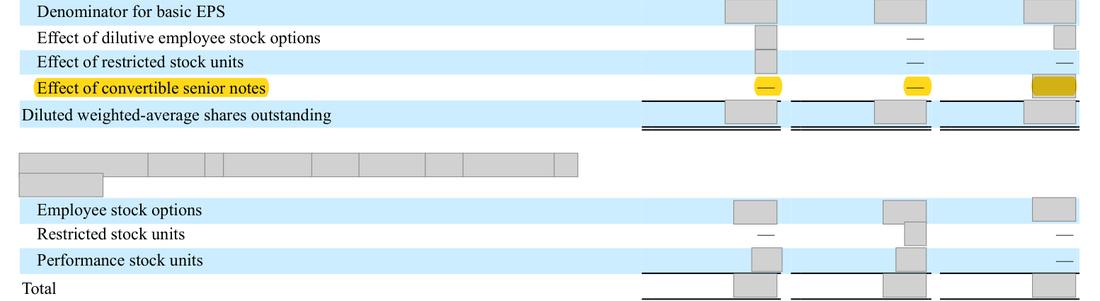
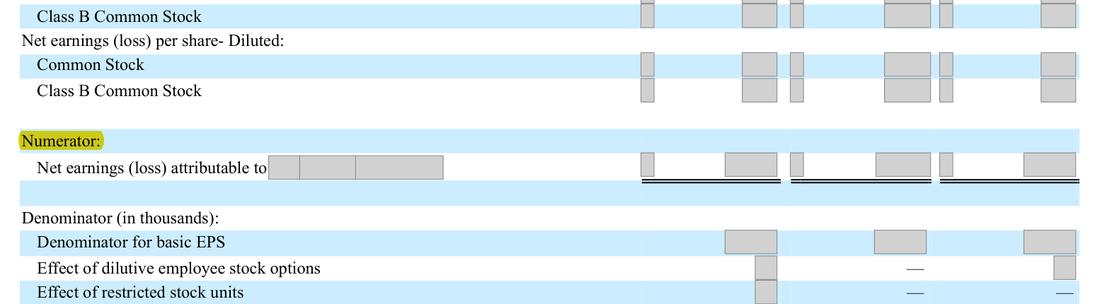
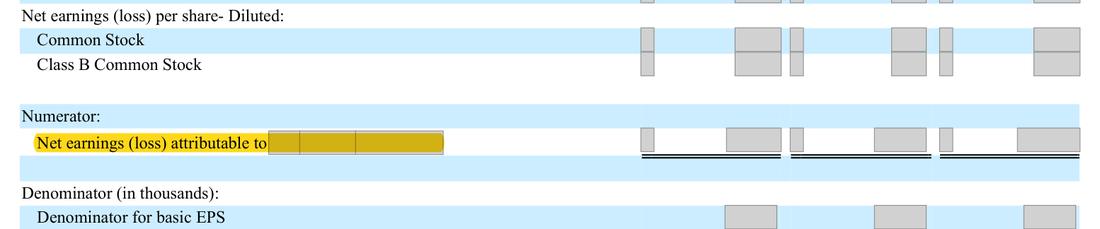
The earnings per share (EPS) table shows one numerator for basic and diluted EPS, [amount] for fiscal 2023, while the diluted share count includes [n] shares from the convertible senior notes ([n] in total). That numerator gives diluted EPS of [n]; the printed figure of [amount] implies an after-tax interest add-back of about [n] that the reconciliation never shows. US GAAP requires the reconciliation to show the income effect, not just the share effect, of each dilutive security. The same single numerator also hides the two-class allocation: for fiscal 2025 the dividends on Common Stock ([n]) and Class B Common Stock ([n]) leave [n] of undistributed earnings to share between the classes, and the note never shows the earnings allocated to either class.
The evidence, as filed

What the filing shows, and what the rule requires
| What the filing shows | What the rule requires |
|---|---|
Numerator: net earnings attributable to the Company only (fiscal 2023: [n]); denominator adds [n] convertible-note shares; diluted Common Stock EPS printed as [amount]; no interest add-back line. Fiscal 2025: one numerator of [n] for both classes; class dividends [n] and [n]; basic Common Stock EPS [n]; no allocated-earnings line for either class. | A numerator line for fiscal 2023 adding back the interest on the convertible senior notes, net of tax, so that the diluted numerator divided by [n] shares gives the [amount] printed; and, for each year, the distributed and undistributed earnings allocated to Common Stock and to Class B Common Stock. |
The rule
FASB ASC 260-10-50-1(a) (reconciliation of numerators and denominators, with the income and share effects of each security)
Summary; FASB/IFRS text is copyrighted Present basic and diluted EPS on the income statement, apply the two-class method to participating securities, and reconcile numerators and denominators including antidilutive securities.
Version: Text in force at the date of this review · Source: FASB Accounting Standards Codification, ASC 260-10-45 and 260-10-50-1 (as amended by ASU 2020-06), paraphrased
Regulation S-X Rule 4-01(a)(1)
Financial statements filed with the Commission which are not prepared in accordance with generally accepted accounting principles will be presumed to be misleading or inaccurate, despite footnote or other disclosures
Version: Text in force at the date of this review · Source: Regulation S-X, 17 CFR 210.4-01(a)(1), as in force in 2025 (eCFR)
Why it applies here. under the if-converted method the numerator is increased by the interest on the convertible instrument, net of tax, and the EPS Topic requires a reconciliation of numerators and denominators that includes the individual income and share effects of every security affecting EPS. Showing the share effect alone leaves a reader unable to get from the printed numerator to the printed diluted EPS. The same single numerator also leaves out the two-class allocation. Holders of Common Stock receive [n]% of the Class B dividend and undistributed earnings are allocated in that proportion (Note 1). For fiscal 2025 the class dividends of [n] and [n] leave undistributed earnings of [n] (workings); allocating it in that proportion reproduces the printed basic figures of [n] and [n], so the figures are right, but a reader must rebuild the allocation because no class numerator is printed. The same presentation appears in the prior-year report.
Why it matters
A reader cannot get from the printed numerator to the printed fiscal 2023 diluted EPS; the audited reconciliation omits an element the EPS Topic requires.
Exposure
At most a staff comment; the fiscal 2023 column leaves the statements in the next Form 10-K, so the realistic remedy is to correct the table before filing. No fine applies.
Our workings
the table reconciles shares ([n] basic plus [n] option shares plus [n] convertible-note shares gives [n] diluted) but shows only one numerator, net earnings attributable to the Company of [amount], for both basic and diluted EPS. The policy on the previous page says convertible debt is included using the if-converted method. The notes carried a 5.00% coupon on [amount] and were retired in fiscal 2024.
[n] / [n] = [n], while [n] x [n] = [n], so the diluted figure rests on an after-tax add-back of about [n] ([n] - [n]), consistent with the [n] annual coupon after tax. Fiscal 2025 needs no add-back: [n] / [n] = [n], as printed.
| Item | Computation | Result |
|---|---|---|
| Diluted Common Stock EPS from the printed numerator, fiscal 2023 | [n] / [n] = [n] | [n] |
| Numerator implied by the printed diluted EPS | [n] x [n] = [n] | [n] |
| After-tax add-back not shown | [n] - [n] = [n] | [n] |
| Annual coupon on the Convertible Notes, pre-tax | [n] x 5.00% = [n] | [n] |
| Fiscal 2025 check (no convertible effect) | [n] / [n] = [n] | [n] |
| Fiscal 2025 undistributed earnings to allocate between the classes | [n] - [n] - [n] = [n] | [n] |
Management’s best defense, and our reply
The finance team would say the diluted figure itself is right, that the if-converted policy on the previous page tells the reader interest is added back, and that fiscal 2023 is the third year presented for an instrument retired in fiscal 2024. It would add that the staff reviewed this 10-K in 2026 without commenting on EPS. However, the requirement is to show the income effect of each dilutive security in the reconciliation, not to describe the method, and without it the printed numerator gives [n] rather than the [n] printed; a staff review that did not comment is not a finding of compliance.
The fix
- Add a numerator line for fiscal 2023, 'Interest on convertible senior notes, net of tax', and a 'Diluted numerator' subtotal; and show, for each year, the distributed and undistributed earnings allocated to Common Stock and to Class B Common Stock.
Evidence relied on
| # | What it shows | Type | Where |
|---|---|---|---|
| 1 | The only numerator line, used for both basic and diluted EPS | Document | Form 10-K 2025, page 63 |
| 2 | The fiscal 2023 diluted share count includes the convertible-note shares | Document | Form 10-K 2025, page 63 |
| 3 | Diluted share counts | Document | Form 10-K 2025, page 63 |
| 4 | Printed diluted EPS of Common Stock | Document | Form 10-K 2025, page 63 |
| 5 | Basic share counts | Document | Form 10-K 2025, page 63 |
| 6 | Policy: convertible debt enters diluted EPS on the if-converted method | Document | Form 10-K 2025, page 62 |
| 7 | Coupon and principal of the convertible notes | Document | Form 10-K 2025, page 69 |
| 8 | Fiscal 2025 Common Stock dividends, the distributed earnings of that class | Document | Form 10-K 2025, page 57 |
| 9 | Fiscal 2025 Class B dividends, the distributed earnings of that class | Document | Form 10-K 2025, page 57 |
| 10 | Undistributed earnings are allocated between the classes by dividend entitlement | Document | Form 10-K 2025, page 63 |
| 11 | Basic Class B EPS: [n] for fiscal 2025 | Document | Form 10-K 2025, page 63 |
| 12 | The [n]% dividend entitlement that drives the allocation | Document | Form 10-K 2025, page 63 |
| 13 | Basic Common Stock EPS: [n] for fiscal 2025 | Document | Form 10-K 2025, page 63 |
| 14 | Basic EPS for Common Stock on the face, fiscal 2025: [n] | Document | Form 10-K 2025, page 55 |
| 15 | Fiscal 2025 Common dividends, the distributed earnings of that class | Document | Form 10-K 2025, page 57 |
Absence check
- Document
- Form 10-K 2025
- Where it would appear
- Numerator:
- What is missing
- The income effect of the convertible senior notes (interest add-back, net of tax) in the fiscal 2023 diluted numerator
- Pages looked at
- p.55 (statement of operations), p.62-63 (EPS policy and table) - page images
- Result
- 'add-back' has no hit; 'net of tax' hits p.56 (other comprehensive income items), p.64 and p.76 (pension amounts in accumulated other comprehensive loss), none about EPS; 'if-converted' hits p.62 and [n] (policy wording only, no amount); 'Numerator' hits only p.63, the single net earnings line.
Prepared by Pramanex from the company’s public SEC filings, without the company’s involvement, to show how a 10-K Pre-filing Check reads. The company is not named, and nothing on this page is a statement about any identifiable company. Observations are not an audit, review or other attestation or assurance engagement, and not legal advice. An SEC-style question is a question, not a conclusion.
Want this on your own 10-K, before you file?
Start with three free findings on your latest 10-K, or book a fixed-price 10-K Pre-filing Check.
Your next 10-K will be in draft before the audit is done.
Have it read before you file.
Start with three free findings on your latest 10-K, or book a fixed-price 10-K check. Drafts only under NDA, inside your insider trading policy.