1.01 Impairment note gives no quantitative Level 3 inputs for the venue asset write-downs
Company A · a US-listed consumer leisure company · Compliance or disclosure gap
In brief
Note 3 records venue impairments of [amount] in fiscal 2025 and [amount] in fiscal 2024, measuring the impaired asset groups at fair value with Level 3 (unobservable) inputs. It names the technique, discounted cash flows including estimated sale proceeds, but gives no value, range or weighted average for any input. US generally accepted accounting principles (US GAAP) require that information for nonrecurring Level 3 measurements, and the fiscal 2025 charge equals 59.4% of pre-tax income.
The evidence, as filed



What the filing shows, and what the rule requires
| What the filing shows | What the rule requires |
|---|---|
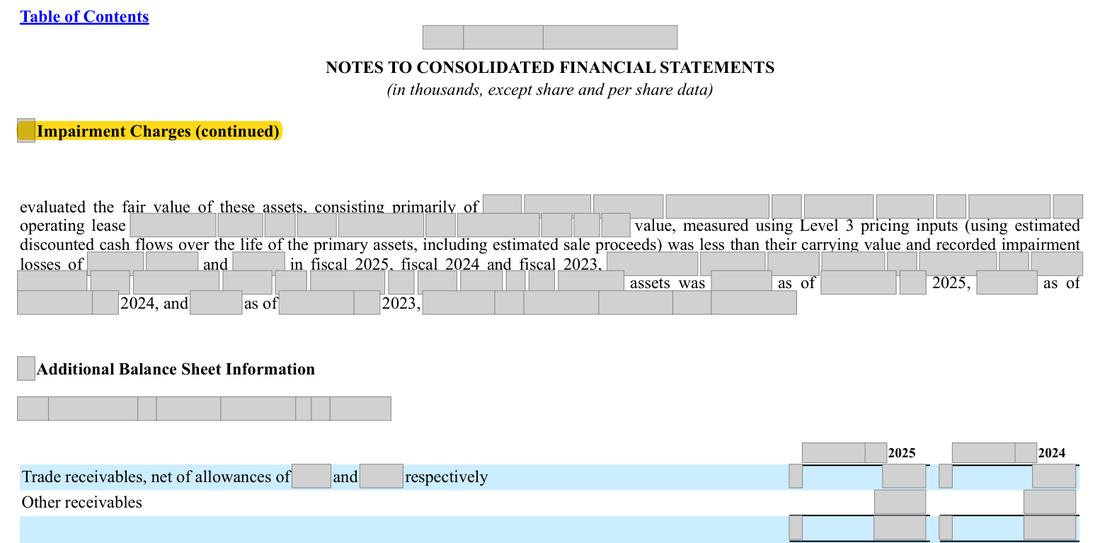
Note 3 says only that fair value was measured using Level 3 pricing inputs (estimated discounted cash flows over the life of the primary assets, including estimated sale proceeds), and gives the [amount] left in the impaired groups. No discount rate, cash-flow assumption, sale-proceeds assumption, range or weighted average appears anywhere in the report, in either year. | For the fiscal 2025 and fiscal 2024 nonrecurring Level 3 measurements: the valuation technique and quantitative information about each significant unobservable input (revenue growth rate, discount rate, estimated sale values of surplus property), with the range and weighted average of each. |
The rule
FASB ASC 820-10-50-2(bbb) (Level 3 measurements, recurring and nonrecurring)
Summary; FASB/IFRS text is copyrighted Disclose fair values by hierarchy level, Level 3 techniques and significant unobservable inputs with ranges and weighted averages, Level 3 changes and measurement uncertainty.
Version: Text in force at the date of this review · Source: FASB Accounting Standards Codification, ASC 820-10-50-2 (as amended by ASU 2018-13), paraphrased
Regulation S-X Rule 4-01(a)(1)
Financial statements filed with the Commission which are not prepared in accordance with generally accepted accounting principles will be presumed to be misleading or inaccurate, despite footnote or other disclosures
Version: Text in force at the date of this review · Source: Regulation S-X, 17 CFR 210.4-01(a)(1), as in force in 2025 (eCFR)
Why it applies here. the Financial Accounting Standards Board (FASB) Accounting Standards Codification (ASC) sets the fair value disclosures by type of measurement in its fair value measurement Topic; paragraph (bbb) applies to recurring and nonrecurring Level 3 measurements alike and asks for the technique, the inputs and quantitative information about the significant unobservable inputs, and since Accounting Standards Update (ASU) 2018-13 the range and weighted average of those inputs. The only relief is for inputs the entity did not develop itself (unadjusted third-party prices); here the Company built its own discounted cash-flow forecasts and sale-proceeds estimates, so the relief does not apply to the venue measurements; at most it could reach a surplus parcel valued on an agreed third-party sale price. These inputs are the judgments behind a charge larger than half of the year's pre-tax income, and long-lived asset impairment is a frequent theme of staff comment letters, which usually ask for the key assumptions.
Why it matters
Readers cannot judge how sensitive the charge, and the [amount] still carried in the impaired groups, are to the Company's own assumptions; the audited notes depart from a specific disclosure requirement in two consecutive years.
Exposure
A staff comment asking for the inputs and an undertaking to give them in future filings; no fine applies.
Our workings
Note 3 measures impaired venue asset groups at fair value using Level 3 inputs and records impairment of [amounts] for fiscal 2025, 2024 and 2023. The fair value policy in Note 1 states that non-recurring measurements are discussed in Note 3. Note 3 names the technique only. The auditor's critical audit matter on venue impairment names the forecast cash flows, primarily driven by revenue growth rates for venue properties and estimated sale values of surplus property, as the most significant assumption, so the significant unobservable inputs are identified in the filing but never quantified. No input value appears in Note 3, the fair value policy or the critical accounting estimates, and the prior-year Note 3 is worded the same way.
the fiscal 2025 charge is 59.4% of pre-tax income; the fiscal 2024 charge is 66.8% of that year's pre-tax loss.
| Item | Computation | Result |
|---|---|---|
| Fiscal 2025 impairment against pre-tax income | [n] / [n] = 59.4% | 59.4% |
| Fiscal 2024 impairment against pre-tax loss | [n] / [n] = 66.8% | 66.8% |
| Quantitative unobservable inputs given for these measurements | whole-report search and page images of Notes 1 and 3 | none |
Management’s best defense, and our reply
The finance team would say the charges arise across many small venue asset groups, each with its own forecast, so a single range would not be meaningful, and that the technique is already described in words. It would add that the impaired assets are a small part of property and equipment and that the staff reviewed this 10-K in 2026 and raised only the debt conversion question. However, paragraph (bbb) names nonrecurring Level 3 measurements expressly and the range-and-weighted-average form exists precisely for many measurements; the charge exceeds half of pre-tax income, the same gap runs in the prior year, and the staff's closing letter itself says the absence of comment does not relieve the company of responsibility for its disclosures.
The fix
- Add to Note 3 a short table of the significant unobservable inputs for each year's measurement (discount rate, cash-flow or attendance assumptions, estimated sale proceeds), giving the range and weighted average of each.
Evidence relied on
| # | What it shows | Type | Where |
|---|---|---|---|
| 1 | The only description of how fair value was measured: the technique is named, no input value is given | Document | Form 10-K 2025, page 67 |
| 2 | Impairment charges measured with these Level 3 inputs in each year | Document | Form 10-K 2025, page 67 |
| 3 | Carrying amount left in the impaired asset groups after the write-down | Document | Form 10-K 2025, page 67 |
| 4 | The fair value policy sends the reader to Note 3 for non-recurring measurements | Document | Form 10-K 2025, page 60 |
| 5 | Pre-tax income used to size the charge | Document | Form 10-K 2025, page 55 |
| 6 | The auditor's critical audit matter identifies the significant unobservable inputs, none of which the note quantifies | Document | Form 10-K 2025, page 52 |
Absence check
- Document
- Form 10-K 2025
- Where it would appear
- 3. Impairment Charges (continued)
- What is missing
- Quantitative information (values, range and weighted average) about the significant unobservable inputs used to measure the impaired venue asset groups at fair value
- Pages looked at
- p.48 (critical accounting estimates), p.59-61 (fair value policy), p.66-67 (Note 3) - page images
- Result
- 'unobservable' hits only p.60 (the general definition of Level 3); 'discount rate' hits p.71 (lease discount rates) and p.77 (pension assumptions); 'Level 3' hits p.60 (policy: no recurring Level 3 items, non-recurring items referred to Note 3), p.61 (goodwill test described in words) and p.67 (technique named only); 'non-recurring' hits p.38 and 40-42 (MD&A non-GAAP adjustments and covenant definitions) and p.59-60 (hierarchy policy). None gives an input value for the impairment measurements.
Prepared by Pramanex from the company’s public SEC filings, without the company’s involvement, to show how a 10-K Pre-filing Check reads. The company is not named, and nothing on this page is a statement about any identifiable company. Observations are not an audit, review or other attestation or assurance engagement, and not legal advice. An SEC-style question is a question, not a conclusion.
Want this on your own 10-K, before you file?
Start with three free findings on your latest 10-K, or book a fixed-price 10-K Pre-filing Check.
Your next 10-K will be in draft before the audit is done.
Have it read before you file.
Start with three free findings on your latest 10-K, or book a fixed-price 10-K check. Drafts only under NDA, inside your insider trading policy.