5.02 The segment discussion no longer quantifies the end-market changes and named growth drivers that the SEC staff asked to see quantified in future filings
Company H · a US-listed aerospace services company · SEC-style question
In brief
In its [date] comment letter on the IPO filing, the SEC staff asked the company to quantify, in future filings, the individual factors behind its results. The company replied that it had included the quantitative impact of these factors for each end market, and the fiscal 2024 Form 10-K did this for each segment in dollars and percentages. The fiscal 2025 Form 10-K gives end-market growth only as consolidated percentages; the segment discussion explains a [amount] [segment] increase and a [amount] [segment] increase by naming drivers without any figures.
The evidence, as filed
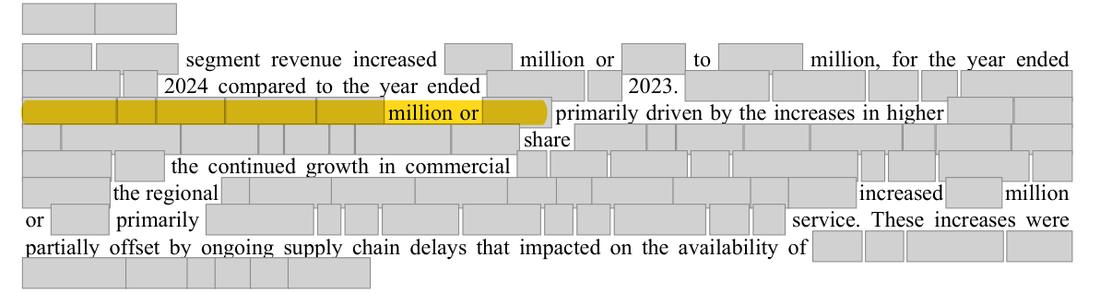
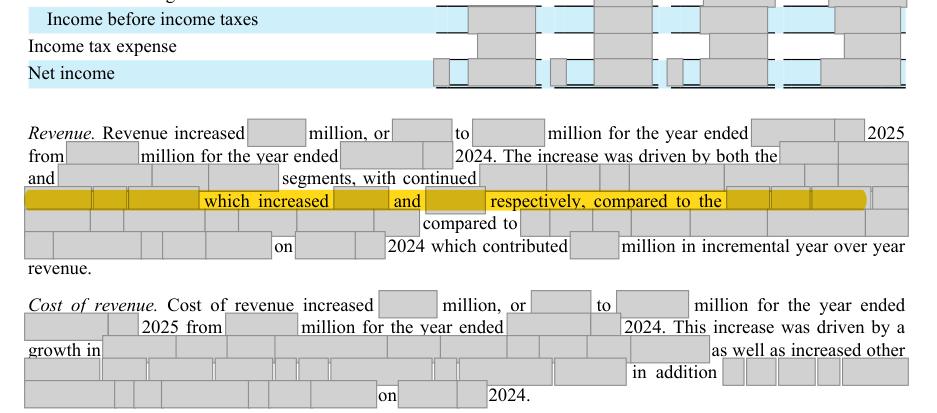
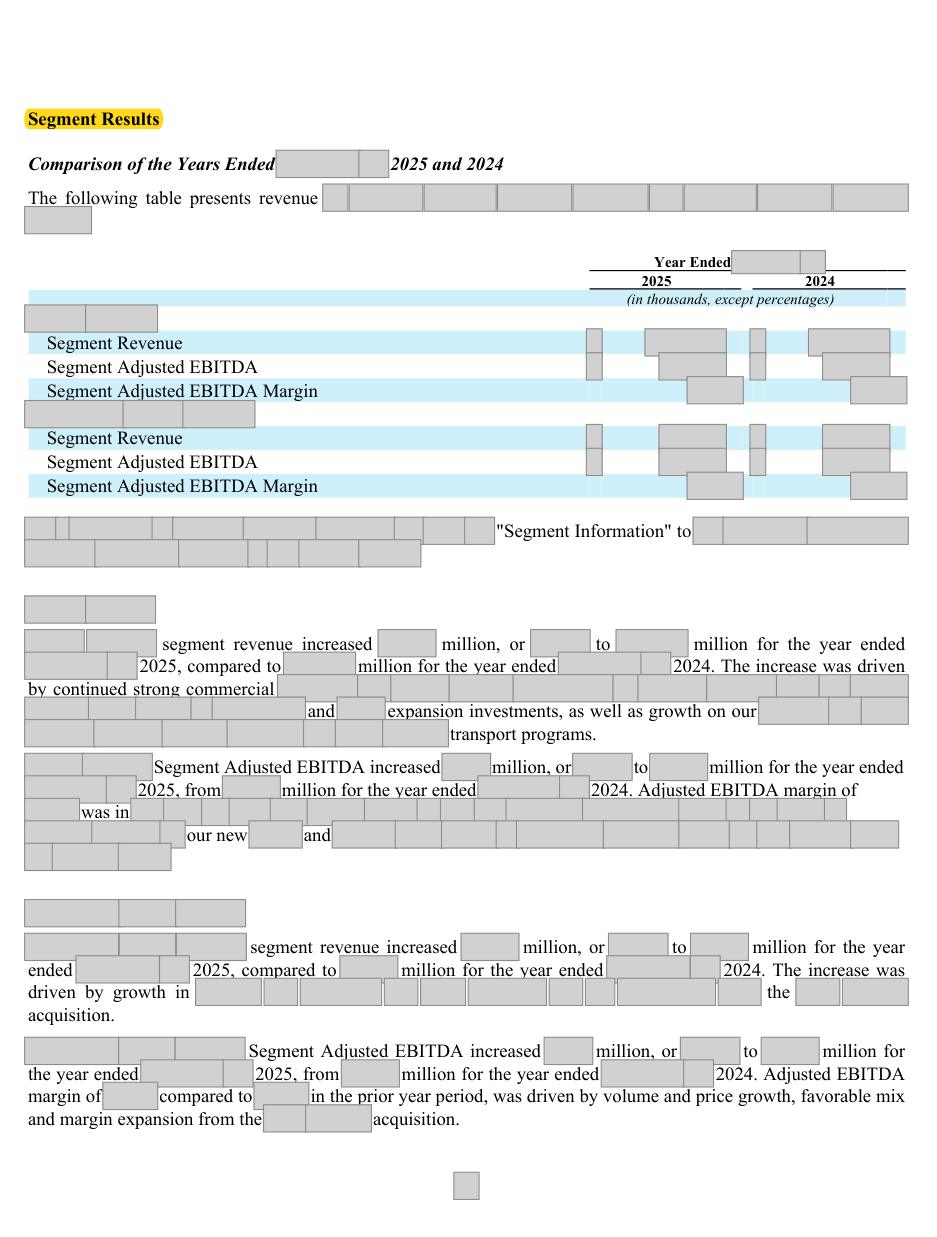
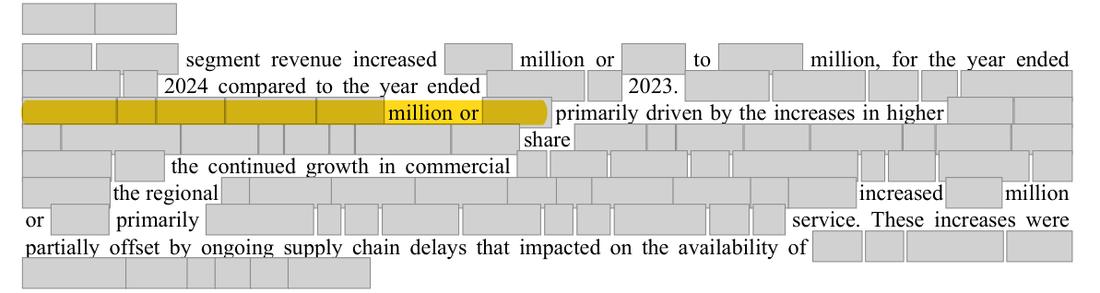
1 further page extract: screenshot withheld to protect the company’s identity. The rows below say what each shows.
What the filing shows, and what the rule requires
| What the filing shows | What the rule requires |
|---|---|
Consolidated end-market growth of [n]%, [n]% and [n]%; [segment] revenue up [amount] and [segment] up [amount], each explained only by named drivers with no amounts. The prior 10-K gave, by segment, e.g. commercial aerospace up [amount] or [n]% in [segment]. | For each segment, the dollar (or percentage) change by end market and the amount contributed by each named driver where material ([engine program], [engine program] [site] and [engine program] ramps; business aviation platforms; military transport programs; [acquired business] within [segment]), as in the fiscal 2024 Form 10-K and as the company described to the staff. |
| What we checked. The 2024 staff letters and company responses on the IPO filing, read to effectiveness; MD&A results and the end-market revenue table in Note 3 of this 10-K; the same sections of the fiscal 2024 10-K. | |
The rule
Regulation S-K Item 303(b)
Where the financial statements reflect material changes from period-to-period in one or more line items, including where material changes within a line item offset one another, describe the underlying reasons for these material changes in quantitative and qualitative terms.
Version: Text in force at the date of this review · Source: 17 CFR 229.303 (Regulation S-K Item 303), as amended by Release 33-10890
Regulation S-K Item 303(b)(2)(iii)
If the statement of comprehensive income presents material changes from period to period in net sales or revenue, if applicable, describe the extent to which such changes are attributable to changes in prices or to changes in the volume or amount of goods or services being sold or to the introduction of new products or services.
Version: Text in force at the date of this review · Source: 17 CFR 229.303 (Regulation S-K Item 303), as amended by Release 33-10890
Why it applies here. Note 3's end-market table lets a reader derive consolidated dollar changes (commercial aerospace [amount], business aviation [amount], military and helicopter [amount], other [amount]) but not the split by segment or driver. The percentages partly meet the undertaking; only management can say whether the segment-level figures were dropped by choice, and why.
Why it matters
- A reader cannot see how much segment growth came from the new [engine program], [engine program] and [engine program] programs or from each end market.
- The staff may read the thinner discussion as a step back from what it was told in 2024; a comment citing the 2024 undertaking is the realistic outcome.
How often the SEC staff raises this. In 1,100 SEC staff comment letters on fiscal 2023 and 2024 Forms 10-K, released January 2025 to October 2026, segment reporting drew 191 of the 1,774 numbered comments (10.8%): topic 4 of 25 by frequency.
The SEC staff has raised this with other companies
The SEC staff asked G-III Apparel and Amphenol to quantify, for each segment, how far changes in net sales came from volume, product mix and price.
Exposure
No penalty attaches to a question; if the staff reviews the next filing, it may ask for expanded quantification in future filings.
Our workings
comment 9 of the staff letter of [date] on the draft IPO registration statement asked the company, in future filings, to quantify the impact of the individual factors affecting its results and, where material, the supply-chain effects. The company's response of [date] said a direct price and volume analysis was not available but that it had included the quantitative impact and description of the factors for each end market. The fiscal 2024 Form 10-K followed that approach in each segment discussion (for example, [segment] commercial aerospace revenue up [amount] or [n]%).
the fiscal 2025 Form 10-K gives consolidated end-market growth as percentages ([n]%, [n]%, [n]%) and the [acquired business] contribution of [amount], but the segment discussion describes the [amounts] increases only by naming drivers.
the Note 3 end-market table lets a reader derive consolidated dollar changes (commercial aerospace [amount]; business aviation [amount]; military and helicopter [amount]; other [amount]), but not the split by segment or by driver.
the consolidated percentages partly meet the undertaking; whether the company has dropped the segment-level and driver quantification it gave in the prior 10-K, and why, can only be answered by management.
| End market (Note 3, USD thousand) | 2025 | 2024 | Change | Change % |
|---|---|---|---|---|
| Commercial Aerospace | [n] | [n] | [n] - [n] = [n] | [n] / [n] = [n]% |
| Business Aviation | [n] | [n] | [n] - [n] = [n] | [n] / [n] = [n]% |
| Military & Helicopter | [n] | [n] | [n] - [n] = [n] | [n] / [n] = [n]% |
| Other | [n] | [n] | [n] - [n] = [n] | [n] / [n] = 44.5% |
| Level | Fiscal 2024 Form 10-K | Fiscal 2025 Form 10-K |
|---|---|---|
| Consolidated, by end market | Dollars and percent | Percent only (dollars derivable from Note 3) |
| [segment], by end market | Dollars and percent (e.g. +[amount], [n]%) | None |
| [segment], by end market | Dollars and percent (e.g. +[amount], [n]%) | None |
| Named drivers ([engine program], [engine program] [site], [engine program], platforms) | Described | Described, no amounts |
Management’s best defense, and our reply
Management would say the fiscal 2025 10-K does quantify the factors: it gives the growth rate of each end market, the [amount] acquisition contribution, and a Note 3 table from which every end-market dollar change can be computed. It would add that its 2024 response described quantification by end market only, not by program, and that a price and volume split is not available for its business, which it explained to the staff. However, the segment-level end-market figures it gave in the fiscal 2024 10-K have gone, and the named program drivers carry no amounts, so the question is whether the narrower form meets the undertaking; this is a judgment for management, which is why the point is put as a question.
The fix
- In each segment discussion, give the dollar change by end market and the amount from each material driver, e.g. 'Commercial aerospace revenue in [segment] increased $X million, of which $Y million came from [engine program] and [engine program] [site] volumes'.
Question for the company
In [date] the SEC staff asked that future filings quantify the individual factors behind the results, and the company replied that it had quantified them for each end market; the fiscal 2024 Form 10-K did so segment by segment. Why does the fiscal 2025 Form 10-K give end-market changes only as consolidated percentages, and could the segment discussions quantify the end-market changes and the named [engine program], [engine program] [site] and [engine program] drivers?
Evidence relied on
| # | What it shows | Type | Where |
|---|---|---|---|
| 1 | The SEC staff asked for quantification of the individual factors in future filings (comment 9) | Document | |
| 2 | The company's response: quantified factors for each end market | Document | |
| 3 | The fiscal 2024 10-K quantified end-market changes inside the [segment] segment discussion | Document | Form 10-K 2024 (prior year), page 60 |
| 4 | Fiscal 2025: consolidated end-market growth given as percentages | Document | Form 10-K 2025, page 59 |
| 5 | Fiscal 2025: military and helicopter growth as a percentage | Document | Form 10-K 2025, page 59 |
| 6 | The one driver quantified: the [acquired business] contribution | Document | Form 10-K 2025, page 59 |
| 7 | [segment] increase explained by named drivers without amounts | Document | Form 10-K 2025, page 61 |
| 8 | Drivers named ([engine program], [engine program] [site], [engine program]) with no quantification | Document | Form 10-K 2025, page 61 |
| 9 | [segment] increase explained by named drivers without amounts | Document | Form 10-K 2025, page 61 |
| 10 | Note 3 end-market revenue (input to the workings) | Document | Form 10-K 2025, page 91 |
| 11 | Note 3 end-market revenue (input to the workings) | Document | Form 10-K 2025, page 91 |
| 12 | Note 3 end-market revenue (input to the workings) | Document | Form 10-K 2025, page 91 |
| 13 | Note 3 end-market revenue (input to the workings) | Document | Form 10-K 2025, page 91 |
| 14 | revenue note: the 'Other' end market (land and marine, oil and gas) rose from [n] to [n], up [n] or 44.5% | Document | Form 10-K 2025, page 91 |
| 15 | the MD&A revenue discussion gives growth rates for three end markets only; the 'Other' end market's 44.5% rise, about [n]% of the revenue increase, is not discussed | Document | Form 10-K 2025, page 59 |
Absence check
- Document
- Form 10-K 2025
- Where it would appear
- Segment Results
- What is missing
- a figure, for each segment, for the change by end market and for each named driver of the revenue increase
- Pages looked at
- p.59-62 (MD&A results and segment results) and p.91 (Note 3)
- Result
- 'end market increased' and 'contributed $' hit only p.59, the consolidated percentages and the [amount] [acquired business] contribution; '[engine program]' and 'ramping volumes' hit only p.61, where the drivers are named without figures.
Prepared by Pramanex from the company’s public SEC filings, without the company’s involvement, to show how a 10-K Pre-filing Check reads. The company is not named, and nothing on this page is a statement about any identifiable company. Observations are not an audit, review or other attestation or assurance engagement, and not legal advice. An SEC-style question is a question, not a conclusion.
Want this on your own 10-K, before you file?
Start with three free findings on your latest 10-K, or book a fixed-price 10-K Pre-filing Check.
Your next 10-K will be in draft before the audit is done.
Have it read before you file.
Start with three free findings on your latest 10-K, or book a fixed-price 10-K check. Drafts only under NDA, inside your insider trading policy.