4.08 The MD&A and the debt note give different weighted average interest rates for the same years ([n]% and [n]% for 2025)
Company H · a US-listed aerospace services company · SEC-style question
In brief
The interest expense discussion in the management's discussion and analysis (MD&A) gives a weighted average interest rate of borrowings of [n]% for 2025 and [n]% for 2024. The long-term debt note in the same 10-K gives [n]% for 2025 and [n]% for 2024. The prior-year 10-K had the same pattern: [n]% and [n]% in the MD&A against [n]% and [n]% in the note. Neither passage says how its rate is worked out.
The evidence, as filed
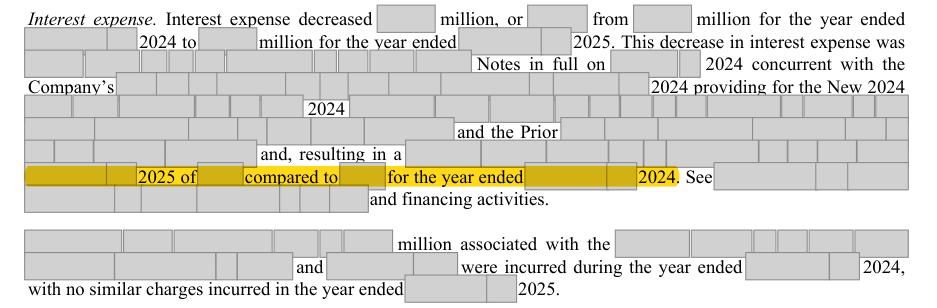
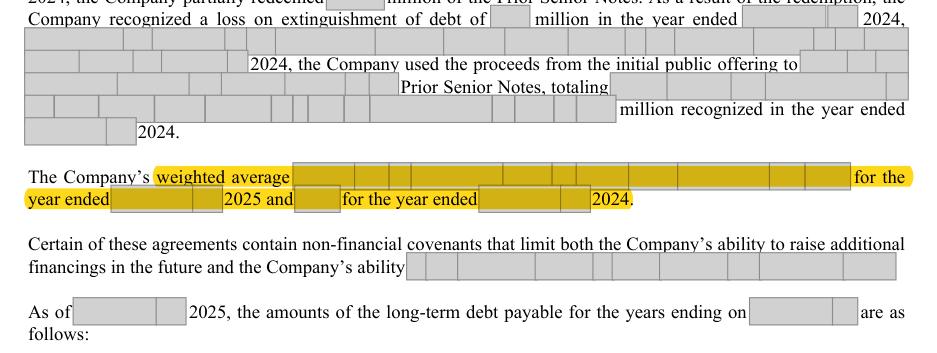
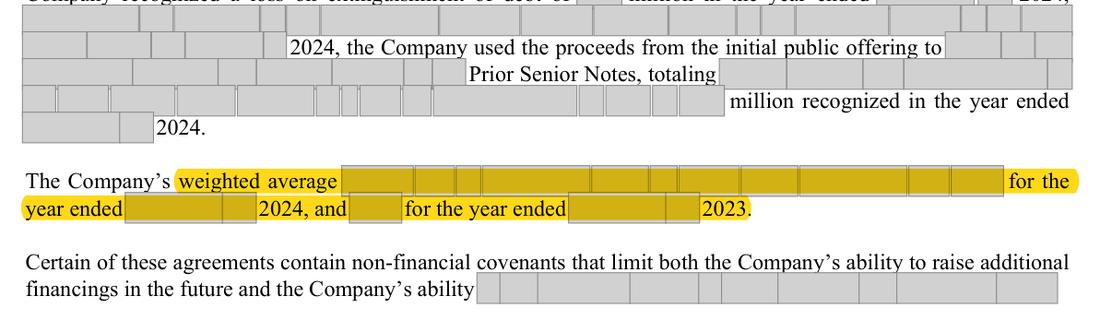
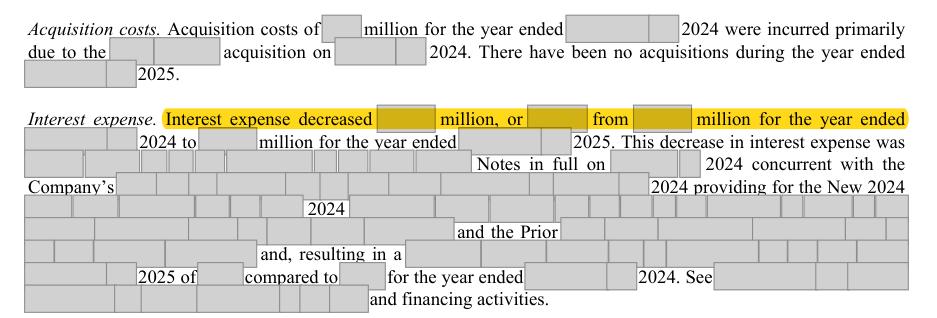
1 further page extract: screenshot withheld to protect the company’s identity. The rows below say what each shows.
What the filing shows, and what the rule requires
| What the filing shows | What the rule requires |
|---|---|
MD&A of the fiscal 2025 10-K: [n]% for 2025 compared to [n]% for 2024. Debt note (Note 12) of the same 10-K: [n]% for 2025 and [n]% for 2024. Prior-year 10-K: MD&A [n]% and [n]% for 2024 and 2023; debt note [n] and [n]. Neither passage states the basis of its rate. | One weighted average rate used in both places, or two rates each labelled with its basis: which borrowings it covers, and whether it includes swap settlements, commitment fees and amortized discount and fees. The MD&A explanation of the fall in interest expense would then agree with the note. |
The rule
Regulation S-K Item 303(b)
Where the financial statements reflect material changes from period-to-period in one or more line items, including where material changes within a line item offset one another, describe the underlying reasons for these material changes in quantitative and qualitative terms.
Version: Text in force at the date of this review · Source: 17 CFR 229.303 (Regulation S-K Item 303), as amended by Release 33-10890
Exchange Act Rule 12b-20
there shall be added such further material information, if any, as may be necessary to make the required statements, in the light of the circumstances under which they are made not misleading
Version: Text in force at the date of this review · Source: 17 CFR 240.12b-20 (Exchange Act Rule 12b-20)
Why it applies here. the 2024 and 2023 gaps could be rounding, but the 2025 gap cannot. The note's wording ('under its senior credit agreements') suggests a narrower set of borrowings than the MD&A's 'borrowings'. Finance leases carry a lower rate ([n]% in the lease note), so leaving them out would not make the note's rate lower. The difference must therefore come from how the rate is calculated, for example the effect of interest rate swaps, fees or amortized discount. The filing does not say which. Item 303(b) asks for the reasons for material changes in line items to be described in quantitative terms, and the rate is the quantitative driver the MD&A gives for interest expense.
Why it matters
A reader cannot tell whether the cost of borrowing fell to [n]% or to [n]% in 2025, and the two rates in the same 10-K do not support each other. Because the same pattern ran through the prior-year 10-K, it looks like a standing difference in method rather than a one-off typing slip.
How often the SEC staff raises this. In 1,100 SEC staff comment letters on fiscal 2023 and 2024 Forms 10-K, released January 2025 to October 2026, MD&A liquidity and capital resources drew 47 of the 1,774 numbered comments (2.6%): topic 12 of 25 by frequency.
Exposure
None while the point is a question. The SEC staff commonly asks registrants to define a metric used in MD&A and to apply it consistently, and that request would be met in future filings.
Our workings
the MD&A explains the [amount] fall in interest expense partly by a fall in the weighted average interest rate of borrowings, from [n]% for 2024 to [n]% for 2025. The debt note states the weighted average interest rate of borrowings under the senior credit agreements as [n]% for 2025 and [n]% for 2024. In the prior-year 10-K the MD&A gave [n]% for 2024 and [n]% for 2023 and the note gave [n]% and [n]%.
the gaps are [n] percentage points for 2025, [n] for 2024 (in both [n]-Ks) and [n] for 2023 (workings).
| Year (10-K) | MD&A rate | Debt note rate | MD&A less note (percentage points) |
|---|---|---|---|
| 2025 (fiscal 2025 10-K) | [n]% | [n]% | [n] - [n] = [n] |
| 2024 (fiscal 2025 10-K) | [n]% | [n]% | [n] - [n] = -[n] |
| 2024 (prior-year 10-K) | [n]% | [n]% | [n] - [n] = -[n] |
| 2023 (prior-year 10-K) | [n]% | [n]% | [n] - [n] = [n] |
Management’s best defense, and our reply
The two figures measure different things. The note covers only borrowings under the senior credit agreements, while the MD&A rate covers all borrowings and may include swap settlements and fees, so both can be correct. The 2024 and 2023 differences are [n] percentage points, which a reader would take as rounding. However, neither passage states its basis, and the 2025 gap of [n] percentage points is too large to be rounding. Leaving out the [n]% finance leases would not make the note's rate the lower one, and the MD&A gives no basis for its own figure. The defense is credible, which is why the point is put as a question.
The fix
- Use one defined rate in both places, for example: 'The weighted average interest rate on borrowings under the New Senior Secured Credit Facilities, including the effect of interest rate swaps, was x% for 2025 and y% for 2024.' If two measures are kept, label each with its basis.
Question for the company
How is each of the two weighted average interest rates worked out (which borrowings they cover, and whether swap settlements, commitment fees and amortized discount and fees are included)? Which rate should the MD&A use to explain the fall in interest expense?
Evidence relied on
| # | What it shows | Type | Where |
|---|---|---|---|
| 1 | MD&A interest expense paragraph: weighted average interest rate of borrowings [n]% for 2025 and [n]% for 2024 | Document | Form 10-K 2025, page 60 |
| 2 | Debt note in the same 10-K: [n]% for 2025 and [n]% for 2024 | Document | Form 10-K 2025, page 102 |
| 3 | Prior-year MD&A: [n]% for 2024 and [n]% for 2023 | Document | Form 10-K 2024 (prior year), page 59 |
| 4 | Prior-year debt note: [n]% for 2024 and [n]% for 2023, the same pattern as the current 10-K | Document | Form 10-K 2024 (prior year), page 100 |
| 5 | The fall in interest expense that the rate is used to explain | Document | Form 10-K 2025, page 60 |
| 6 | Lease note: finance leases carry a [n]% rate, so leaving them out of the note's rate would not make it lower than the MD&A rate | Document | Form 10-K 2025, page 104 |
Prepared by Pramanex from the company’s public SEC filings, without the company’s involvement, to show how a 10-K Pre-filing Check reads. The company is not named, and nothing on this page is a statement about any identifiable company. Observations are not an audit, review or other attestation or assurance engagement, and not legal advice. An SEC-style question is a question, not a conclusion.
Want this on your own 10-K, before you file?
Start with three free findings on your latest 10-K, or book a fixed-price 10-K Pre-filing Check.
Your next 10-K will be in draft before the audit is done.
Have it read before you file.
Start with three free findings on your latest 10-K, or book a fixed-price 10-K check. Drafts only under NDA, inside your insider trading policy.